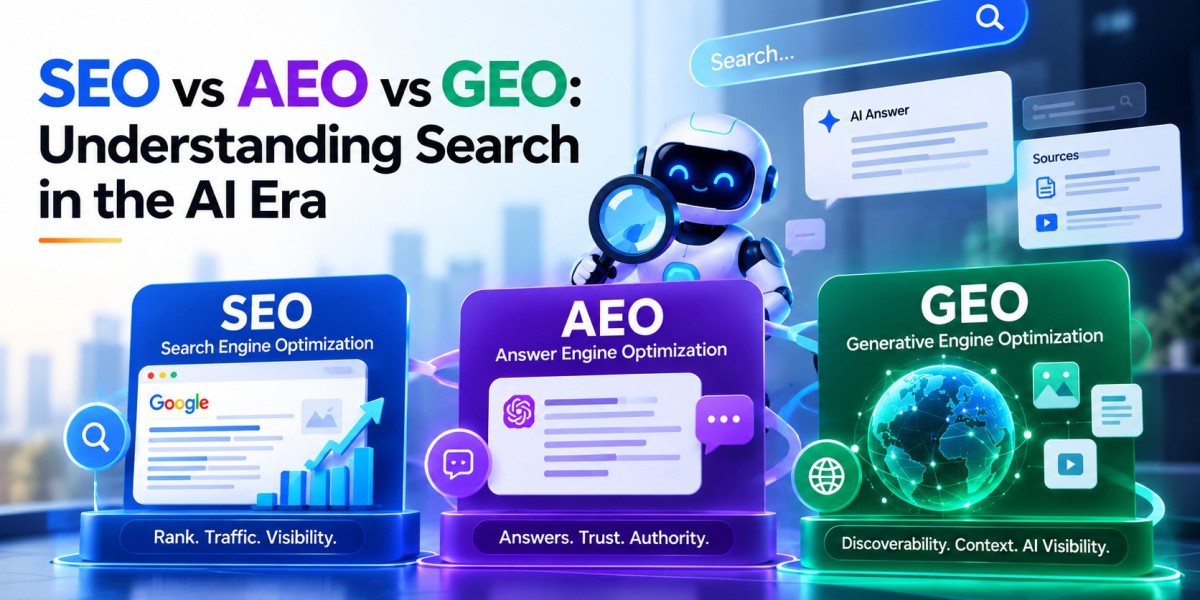

For twenty years, "getting found" meant one thing. Rank on page one of Google and the pipeline followed. That single belief quietly shaped everything downstream: how budgets got signed off, which agencies got hired, and what a "good month" looked like in the report. It is no longer a safe assumption, and the teams still betting on it are losing ground they cannot see on a rankings dashboard.
Here is what actually changed. Buyers no longer start in one place. Some still type a query into Google and scan the blue links the old way. Plenty read the AI Overview sitting at the top and never scroll past it. And a fast-growing group skips the search box altogether, asks ChatGPT, Perplexity, or Gemini a full question in plain language, and acts on a single synthesized answer that might cite three sources and silently ignore the other forty. The search box did not die. It split into several surfaces that behave differently, reward different things, and demand different work from you.
That split is exactly why so many founders and marketing leaders are re-opening questions they thought were settled: what they buy from SEO, what paid media is really returning, whether their content is doing anything, and whether their agency is built for the search era we are actually in. A ranking that once fed the funnel can now sit politely below an AI answer that resolved the buyer's question before they ever clicked. This piece breaks the three surfaces apart, defines the terms without the fog, and shows what the shift means for B2B, SaaS, and D2C teams. It also hands you a straight way to judge whether your setup, in-house or outsourced, is ready. An AI First Digital Marketing Agency exists to run all three surfaces in one motion, but you should understand the mechanics first, before you hand anyone a retainer. If you want the deeper version of that argument, we laid it out in our AI-first digital marketing agency pillar.
What is an AI-first digital marketing approach?
An AI-first digital marketing approach rebuilds the core workflows around AI instead of bolting a few tools onto a legacy process. Research, content production, campaign operations, reporting: all of it gets re-engineered so the slow, repetitive parts collapse in time and your senior people spend their hours on strategy, judgment, and quality control. The goal is leverage and speed. It is not "replace the humans."
In practice it shows up in very specific places. Research that used to eat a week of manual competitor and SERP digging now runs in a few hours, which means you test more ideas per quarter instead of betting the quarter on one. Content gets drafted faster but still passes through a human editorial gate for accuracy, originality, and brand voice, which is the difference between a useful article and confident nonsense. Campaign work leans on automated bidding and testing while a strategist decides what to test and why. Reporting stitches channels together so leadership sees pipeline, not a pile of clicks.
Done well, a human still owns the outcome. Done badly, you simply get more content, faster, that nobody asked for and nobody reads. Speed with no judgment behind it is not an advantage. It is just a quicker way to be wrong. This is also why the "who checks the AI output" question matters so much, and why we built a formal editorial QA system rather than trusting the first draft model hands back.
SEO, AEO, and GEO: three surfaces, one content system
These three acronyms describe where your brand can show up, and each one rewards slightly different work.
Traditional SEO is about visibility in classic search results, the ranked list of pages an engine returns. It rewards relevance, technical health, credible links, and content that matches what the searcher actually meant.
Answer Engine Optimization is the practice of making your content the source an answer engine reaches for when it responds directly to a question. Think featured snippets, "people also ask," voice results, and the answer boxes that settle a query without a click. So what does an Answer Engine Optimization Agency actually do? It structures content so machines can lift a clean, correct answer with confidence: clear question-shaped headings, a concise direct answer near the top, structured data, and facts stated without ambiguity.
Generative Engine Optimization is the newer discipline, aimed squarely at large language model answers. When someone asks ChatGPT, Perplexity, or Google's AI Overviews something, the model writes a response and sometimes cites its sources. A Generative Engine Optimization Agency works to make a brand understandable and citable inside those generated answers, through consistent entity information, claims that other sources corroborate, mentions across trusted third-party sites, and writing a model can quote without mangling it.
The trap is treating these as three separate projects with three separate budgets. They are three outputs of one well-built content system. A page that is genuinely clear, factually tight, cleanly structured, and referenced by other credible sites tends to perform across all three at once. Nobody honest can promise you a specific slot inside an AI answer, because those systems are opaque and shifting under our feet. What you can do, reliably, is become the easiest correct thing to cite. That is the whole game.
How an AI marketing agency differs from a traditional agency
An AI Marketing Agency is not defined by owning AI tools. At this point, almost everyone owns the tools. The real difference is where AI sits in the workflow and who stays accountable when it goes wrong.
On strategy, both should lead with a human point of view. The AI-first version just gets there with more evidence and less guessing. On research, a traditional shop samples a handful of competitors, while an AI-first team can read the full result set and cluster intent at scale. On content, the old model trades cost for speed, whereas the AI-first model gets both but adds a fact-checking and editorial layer so the output does not read like everyone else's. On paid media, automation now handles most of the bidding and testing, so the human value shifts to creative direction, budget allocation, and knowing which signals to actually trust. We went deep on where that human line sits in our piece on how AI changed paid media buying. On reporting, the tired model shows activity ("rankings improved"), while the modern one shows commercial signal ("pipeline moved, and here is the attribution").
Kept honest, the comparison is balanced. AI does not remove the need for senior judgment. It raises the cost of not having any, because a fast process aimed at the wrong bet just manufactures the wrong thing more efficiently.
B2B marketing when the buyer asks an AI first
B2B buying was already long, multi-stakeholder, and research-heavy. The search shift adds a real twist: much of the early research now happens inside an AI answer, before a vendor is ever contacted. By the time a prospect fills in your form, an opinion has often already been formed somewhere you never saw. A B2B Digital Marketing Agency built for this stops optimizing only for rankings and starts optimizing for how a category, a problem, and a solution get described across search, answer engines, and generative engines.
The B2B work that matters now includes account research, demand generation, and founder-led content that gives both models and buyers a clear, quotable point of view. It includes entity clarity, so an AI answer describes your product correctly instead of inventing a version of it. And it includes a lifecycle nurture that can survive a six-month cycle without going cold. A modern B2B SEO Agency approach is built from topic clusters, intent mapping, entity optimization, technical health, genuinely good content, internal linking, digital PR, and conversion-focused pages. Rankings are one input. The honest test is whether the right accounts show up, understand the offer, and convert. Judging B2B search on position alone misses most of the value now, because a single AI answer can shape a buyer's view long before a click is ever counted.
SaaS SEO in the AI search era
SaaS search is uniquely brutal. The results are crowded, the buyer journey is product-led and rarely linear, and demand fragments across feature searches, comparison searches, integration searches, and enterprise-intent queries. Stack AI answers on top of that, and a lot of the top-of-funnel blog traffic that used to trickle into trials now gets absorbed by a generated summary the reader never leaves.
That is why a capable SaaS SEO Agency in 2026 shifts weight away from blog volume and toward high-intent assets: strong category pages, comparison and alternatives pages, integration and use-case pages, and documentation an answer engine can cite cleanly. Blog content still builds topical authority and still matters. But the durable wins come from pages that map to how software actually gets evaluated. The strategic question is no longer "how many articles this month." It is "which pages own the searches a buyer runs in the ten minutes before they start a trial."
D2C and performance marketing under blended reality
D2C growth used to be narrated by platform-reported ROAS. That number, on its own, is now shaky at best, thanks to privacy changes, attribution gaps, and acquisition costs that keep climbing. A serious D2C Marketing Agency reasons in blended terms instead: blended CAC across all spend, retention curves, contribution margin, and the timing of brand investment, not the last-click return a single channel happily claims for itself.
The disciplines still combine the same way, paid media, SEO, content, CRO, social, customer data, retargeting, and creative testing. What AI changes is the tempo. It speeds up creative iteration, audience analysis, and campaign optimization, so a team can run more variants and read results sooner. A Performance Marketing Agency For D2C earns its keep by tying ad activity back to real margin and repeat purchase behavior, not by presenting a platform dashboard as if it were the truth. And no credible partner should ever promise you a specific ROAS or growth figure. The honest promise is a tighter loop between spend, creative, and measured profit. If your reporting still can't tell you the difference, our guide to marketing attribution is the place to start.
What a performance marketing agency should actually own
A Performance Marketing Agency supports measurable objectives through a repeatable loop: audience segmentation, creative experimentation, disciplined campaign testing, conversion tracking, landing page optimization, budget allocation across channels, attribution, and reporting you can read at a glance. AI now automates large chunks of the mechanical work. That does not make human choices less important. It makes them more important, because what to test, which audiences to trust, and how to allocate budget against attribution you actually believe are the decisions the whole result rests on. The signal to look for is a partner reporting on cost per qualified lead and pipeline, not impressions and reach. One tell of a real operator: leads don't sit in a form for two days. We wrote about closing that gap in our AI lead scoring and routing breakdown.
Fractional CMO services for growing businesses
Not every company needs a full-time marketing executive, and plenty that hire one too early buy themselves an expensive misalignment. Fractional CMO Services put senior marketing leadership in the room on a part-time or embedded basis: strategy, planning, positioning, channel selection, budget planning, demand generation, team structure, measurement, and the unglamorous job of managing agencies and vendors so they pull in one direction.
The difference between a fractional CMO and a traditional agency is scope. An agency executes a defined discipline. A fractional CMO owns the direction those disciplines are meant to serve, decides what to build in-house versus outsource, and carries the numbers at leadership level. Growing companies often use both, a fractional CMO to set the system and specialist execution to run it. It is also why an embedded model, where senior people stay close from diagnosis to deployment, tends to beat a hands-off retainer. We compared the three routes in detail in agency vs in-house vs fractional CMO.
How to evaluate a digital marketing agency for this landscape
There is no objective "best" agency, so treat any such claim with a raised eyebrow. The Best Digital Marketing Agency for you is the one whose strengths line up with your model, your stage, and your single biggest constraint. Skip the ranking lists and use a practical framework instead.
Assess strategic depth first: can they form a clear point of view about your actual growth bottleneck, or do they just recite a service menu? Check business-model fit: do they understand B2B cycles, SaaS product-led motions, or D2C margin math specifically, or in general terms only? Look for real SEO capability alongside current AEO and GEO knowledge, not buzzwords stapled to a deck. Probe how they think about paid media and attribution. Review content quality and their editorial controls for AI output. Examine analytics and reporting: do they connect activity to revenue, and will you own the dashboard when the relationship ends? Test their cadence: how fast does the first test go live, and how honestly do they report a failure? Finally, ask for evidence tied to named work, not adjectives. A marketing audit template is a fast way to pressure-test all of this before you sign anything.
Two easy tells worth memorizing. Anyone guaranteeing a #1 ranking or a fixed ROI is selling certainty that does not exist in search, and we explain exactly why guaranteed rankings are a red flag. And anyone whose sales team is senior while the delivery team is junior is selling you the pitch, not the partnership.
Where this leaves you
The single-surface era is done. Winning attention now means being findable in search results, extractable by answer engines, and citable by generative engines, all of it built from one honest, well-structured content system and measured against revenue rather than vanity. The reason funnels leak so badly today is that most teams still run these as disconnected channels instead of one system, a problem we unpack in marketing channels vs marketing systems. Whether you build the capability in-house, hire specialists, or bring in fractional leadership, the standard is the same: senior judgment, AI-accelerated execution, and reporting you can actually trust.
Zero Theory is one example of an AI-first agency structured around this reality, running SEO and GEO, answer engine optimization, performance marketing, AI marketing automation, brand identity, and web development as one connected system rather than a stack of separate line items. The approach is simple to state: AI for research, production, operations, and reporting, with senior humans owning strategy and outcomes. The useful takeaway is not which logo you pick. It is that the surfaces have multiplied, and your marketing has to be built for all of them.
Want to know which of the three surfaces you are already winning and which you are losing? A quick audit answers that in a week, not a quarter. Talk to Zero Theory.