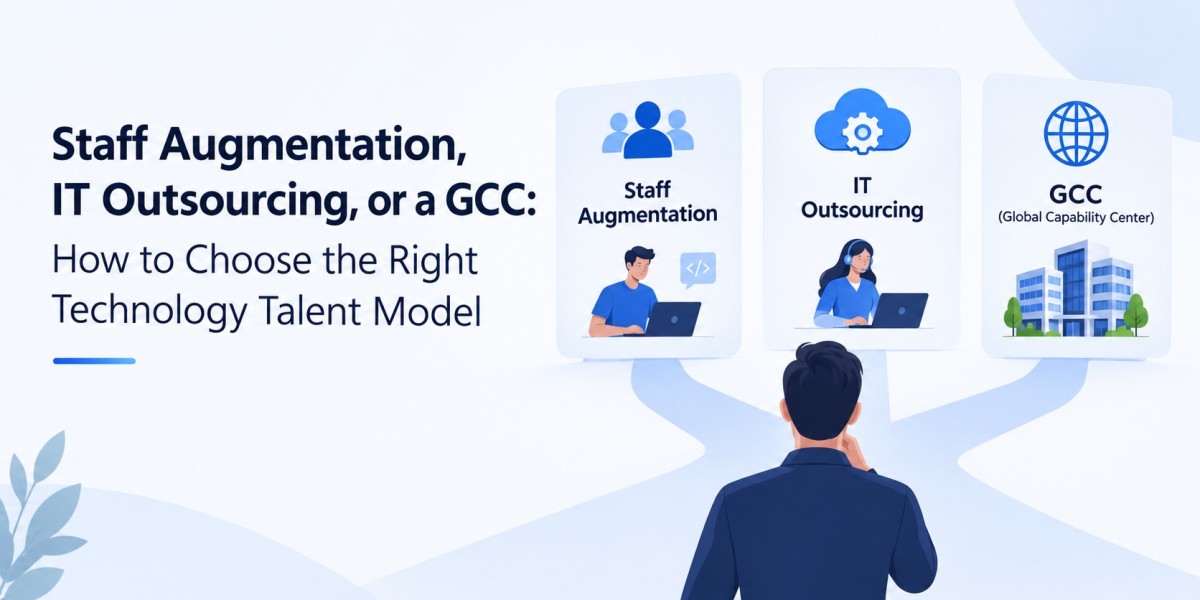

Here is something most leaders will not admit out loud: they never actually chose their talent model. They fell into it. A deadline started slipping, a critical skill was nowhere on the team, or the board asked why engineering was burning so much cash, and the fix became whatever could be arranged fastest that quarter. It holds together for a while. Then it doesn't. Six months on, the same company is unwinding a contract, re-hiring a role it just filled, or sitting in a call with headquarters explaining why the "temporary" arrangement is now running a core product.
The decision between staff augmentation, dedicated teams, IT outsourcing, and building your own Global Capability Center is not a procurement exercise, even though it usually gets treated like one. It is really a question about three things: how much control you want, how fast you need to move, and how long you expect to need the capability at all. Get those straight and the model picks itself. This guide gives you a way to match the model to your stage, and a way to size up a partner once you know which direction you are heading.
The four models, in one paragraph each
The words get thrown around loosely, and the differences are exactly where money leaks, so it is worth defining each one cleanly before comparing them.
What is IT staff augmentation?
IT staff augmentation means you bring external engineers onto your own team, under your management, to close a specific skill or capacity gap. They work inside your processes, your tools, your sprint rhythm. The provider still owns the employment, the payroll, and the replacement if someone does not work out. You keep the work; you rent the capacity.
That last line is the entire pitch. You are not handing off a project. You are stretching your existing team with people who report to your leads and follow your roadmap. This is why fast-moving product teams lean on Staff Augmentation Companies the moment they need a React specialist, a data engineer, or a couple of backend developers for a release, without opening permanent roles or waiting a quarter for local hiring to grind through.
Compared to traditional hiring, the difference is speed and commitment. You scale up or down without severance packages or three-month recruitment cycles. Compared to outsourcing, the difference is ownership. You direct the work instead of buying a finished result. The catch, and it is a real one, is that augmentation does not lighten your management load. You still plan, review, and lead. If your team is already thin on senior oversight, adding more hands can make the strain worse, not better. If you want the fuller version of that trade-off, we broke it down in our guide on when to use staff augmentation.
What are dedicated teams?
A dedicated team is a stable group of engineers assembled to work only on your product, usually with its own lead and integrated with your stack for the long haul. It lives between augmentation and outsourcing: more permanent and more owned than augmentation, more integrated and more directed than a project handoff. Companies reach for dedicated teams when the work is ongoing rather than a one-off, and when product knowledge is worth accumulating in one place instead of losing it every time a contract ends.
What is IT outsourcing?
IT outsourcing is when you hand a defined scope to an external provider who then owns delivering it, often for a fixed price or against milestones. You are buying an outcome, not a headcount. An IT Outsourcing Company usually owns the team composition, the day-to-day management, and the delivery risk, and reports progress to you rather than taking direction on how the work gets done.
Outsourcing is at its best when the scope is genuinely understood, the timeline is set, and you would rather not build internal muscle for the job: a website rebuild, a legacy migration, a mobile app with clean requirements. It gets uncomfortable fast when requirements keep shifting, when the product is your core IP, or when the work needs tight daily collaboration. The rule of thumb is simple: the further your work drifts from a fixed spec, the more friction a pure outsourcing arrangement generates.
What is a GCC?
A Global Capability Center, or GCC, is your own offshore entity and team, most often in India, running as a true extension of the company rather than a vendor on the other end of an invoice. You own the entity, the people, the IP, and the roadmap. It is the most committed of the four, and over a long enough horizon, usually the most strategic.
Why companies use each model
Strip away the jargon and the reasons sort themselves by urgency and permanence.
Speed and skill gaps push teams toward augmentation. When a specialised skill is missing this sprint, renting it beats hiring it every time. Ongoing product work pushes teams toward dedicated teams, where a stable pod and retained context matter more than raw flexibility. Bounded, self-contained projects push teams toward an outsourcing partner who will own delivery from start to finish. And long-term cost structure, IP ownership, and scale push mature companies toward a GCC.
None of these is the "smart" choice and the rest dumb choices. They answer different questions. The mistake is answering one question with the model built for another.
Staff augmentation vs IT outsourcing
This is the comparison buyers get wrong most often, because on the surface both just look like external people writing your code. The real difference is who is accountable for the result.
With augmentation, you own and direct the work. With outsourcing, the provider owns delivery of a defined scope. Augmentation adds to your management load; outsourcing takes it off your plate. Augmentation scales one person at a time and absorbs changing requirements without much drama; outsourcing is efficient when scope is fixed and expensive the moment scope starts moving. On cost, augmentation is usually time-based per engineer, while outsourcing tends to be milestone or fixed-price. And the best-fit line is clean: augmentation for capacity and skills inside your own roadmap, outsourcing for bounded projects you would rather not run yourself.
Here is a test that settles most arguments. If you can write a clear, stable specification and hand it over without flinching, outsourcing might fit. If the work is going to change every week and it sits at the heart of your product, augmentation or a dedicated team will serve you far better.
How to evaluate staff augmentation and technology talent partners
Once you know the model, the provider still makes or breaks the outcome. This is the uncomfortable part: strong providers and weak ones look nearly identical on a homepage, then behave completely differently once the work starts. When you are weighing the Best Staff Augmentation Companies, look past the headline rate and pressure-test these dimensions instead.
Ask exactly how candidates are screened, both technically and for communication; "pre-vetted developers" only means something once you know where the bar actually sits. Check how fast they can put relevant profiles in front of you, because a serious partner shares a shortlist in days, not weeks. Nail down the replacement and ramp-down terms before you sign, so you know what happens when a hire underperforms and how quickly you can scale back. For US and UK teams working with India, guaranteed daily overlap matters more than the raw number of hours worked, so make it explicit rather than assumed. Push on retention, because high attrition on the provider's side quietly becomes your problem in the form of lost context. And do not wave through security and compliance: certifications, data-handling practices, IP protection, and markers like GDPR alignment and PCI DSS maturity tell you how grown-up the operation really is.
There is one more question that separates a staffing vendor from a partner worth keeping: can the same firm move you from augmentation to a dedicated team to a GCC without starting from zero. That single trait is why the strongest Top IT Staff Augmentation Companies are increasingly the ones that also build teams and stand up entities.
AI and ML talent: why AI ML specialists change the equation
The whole calculation shifts the moment AI and ML enter the picture. Generalist engineers are everywhere. Specialised AI talent is not, and that scarcity quietly reshapes which model actually makes sense.
AI ML Specialists is a label that hides a lot of very different roles: machine learning engineers, applied AI engineers, data scientists, generative AI engineers, MLOps specialists, computer vision engineers, NLP specialists, AI solution architects. They are not interchangeable, and almost no company needs all of them at once or forever. That intermittent, high-skill demand is precisely what augmentation and specialist and leadership hiring exist to serve. You bring in a computer vision engineer for one model, or an MLOps specialist to stand up a pipeline, without committing to a permanent seat you cannot keep busy afterward.
For companies making AI central to the product itself, the math tilts again, this time toward dedicated teams or a GCC, where the knowledge stays in-house and compounds instead of walking out the door. The honest takeaway is that AI and ML demand is the single variable most likely to move you up the commitment curve faster than you planned. We go deeper on this in our piece on hiring AI/ML engineers in India.
GCC Setup in India: what it is and why companies do it
GCC Setup in India means standing up your own captive center: a legal entity, an office or remote-first setup, and a team that belongs to you rather than to a vendor. Companies do it to own their IP and roadmap outright, to build a durable talent base in one of the deepest engineering markets on earth, and to convert a jumpy variable vendor cost into a controllable internal capability.
A GCC is no longer just a cost-arbitrage move. Modern centers own products, run platform teams, and host senior leadership, not only backend delivery. The trade-off is commitment: entity setup, compliance, governance, and leadership hiring are real work, and a GCC below a certain size can carry overhead that is hard to defend. This is where sequencing earns its keep. Most companies do not begin with a GCC. They grow into one, and the smart ones plan the runway before they need it. If you want the numbers behind the timeline, our breakdown of how long it takes to build an offshore team in India lays it out.
What to evaluate in GCC setup partners
Choosing among the Top GCC Setup Companies comes down to one question: can this partner do more than register an entity. Weigh their talent-acquisition depth, their recruitment infrastructure, their legal and compliance support, their location strategy across tier-1 and tier-2 hubs, and how deliberately they design governance. Then look at the exit: can they transfer the whole operation to you cleanly over time. A Build.Own.Transfer arrangement, where a partner builds and runs the center before handing you the keys, is one of the most practical bridges from a vendor relationship to a fully owned capability.
Sequencing the models: how companies actually scale
Here is the framing that two-way comparisons keep missing. These four models are not permanent, mutually exclusive choices. They are stages on a path.
Early stage, you reach for augmentation and specialist hiring, because you need skills now and cannot forecast next quarter, so you rent capacity and buy specific expertise. Growth stage, you move to dedicated teams, because the work is clearly ongoing and you want a stable pod that banks product knowledge. For defined side projects that you would rather not run in-house, you hand a bounded scope to an outsourcing partner. And at scale, when the capability has become core, large, and long-term, you build a GCC, because ownership and IP control finally justify running your own center.
The expensive mistakes all happen at the transitions: outsourcing something that turns out to be core IP, or setting up a GCC before you have the volume to fill it. A partner who can carry you across those transitions, instead of forcing a fresh vendor search at every one, removes almost all of the switching cost. We mapped the full progression in our pillar on building a scalable technology workforce in India.
What makes a strong tech talent company
A Tech Talent Company worth partnering with shows the same handful of traits across every one of these models: rigorous technical screening, real access to scarce talent including AI and ML skills, transparent communication, engagement models that flex, genuine domain understanding of your industry, and low attrition. Above all, it meets you at your stage and grows with you, rather than selling you the one model it happens to be good at.
How to choose the right IT staff augmentation services: a checklist
When you are ready to shortlist providers of Top IT Staff Augmentation Services, run every candidate through the same questions. How are engineers screened, and can you test that bar yourself with a live interview? How fast can they share a relevant shortlist? What is their provider-side attrition, and how do they actually retain people? What are the replacement and scale-down terms? How much daily time-zone overlap is guaranteed? How do they handle security, data, and IP? Which engagement models do they offer, and can they move you between them? And can they support specialist and leadership hiring, not just developers?
One consistent scorecard beats chasing the lowest rate every time. It also happens to be how sharp buyers separate the Best IT Consulting Companies and staffing partners from the ones that just forward resumes and hope. For a head-to-head on how the rates themselves stack up, see our comparison of cost per engineer, US vs India.
When should a company choose staff augmentation?
Choose staff augmentation when you have a clear, near-term skill or capacity gap inside work you want to keep directing: a project that landed suddenly, a specialised skill shortage, a product push, a cloud migration, an AI implementation, a new market entry. It is the right tool when speed and flexibility matter and the work lives squarely inside your own roadmap. If your India collaboration hinges on real working-hours overlap, our note on US-India time-zone overlap for engineering teams is worth a read before you commit.
Where SquadXP fits
SquadXP is a technology talent and team-building partner focused on India, offering three connected paths: dedicated teams built around your business, specialist and leadership hiring for business-critical roles, and full GCC setup in India, with a Build.Own.Transfer route for companies that want to own the center eventually. It supports industries spanning SaaS, financial services, healthcare, manufacturing, and technology services, and pairs hiring with workforce intelligence like talent availability and compensation benchmarking. The reason it fits this framework is the sequencing: the same partner can start you with a dedicated team and carry you all the way to an owned GCC without a restart, which is exactly the transition where most companies bleed time and money.
Conclusion
Pick the model that fits the problem in front of you, but pick it knowing where you are likely to go next. Augmentation and specialist hiring for speed and scarce skills. Dedicated teams for ongoing product work. Outsourcing for bounded projects. A GCC when the capability becomes core. The companies that scale cleanly are the ones that treat these four as a single path, and that choose a partner able to walk the whole path alongside them.
Ready to pick the right model, not just the fastest one?
You do not have to lock into a single talent model and hope it still fits in a year. SquadXP builds dedicated teams, runs specialist and leadership hiring for your business-critical roles, and handles full GCC setup in India, with a Build.Own.Transfer route when you want to own the center outright. Same partner, whole path, no restart at the transitions where most companies lose time and money.
Tell us where you are today and where you are trying to get to. We will map the model that fits your stage and show you what the next one looks like before you need it. Book a call with SquadXP and we will put relevant profiles or a setup plan in front of you within days, not weeks.