
The US Waste Management Market is evolving as municipalities, businesses, industries, and households seek more efficient ways to collect, transport, treat, recycle, and dispose of growing waste volumes. Technology adoption, environmental regulation, circular economy initiatives, and greater attention to resource recovery are gradually moving the industry beyond traditional collection and landfill models.
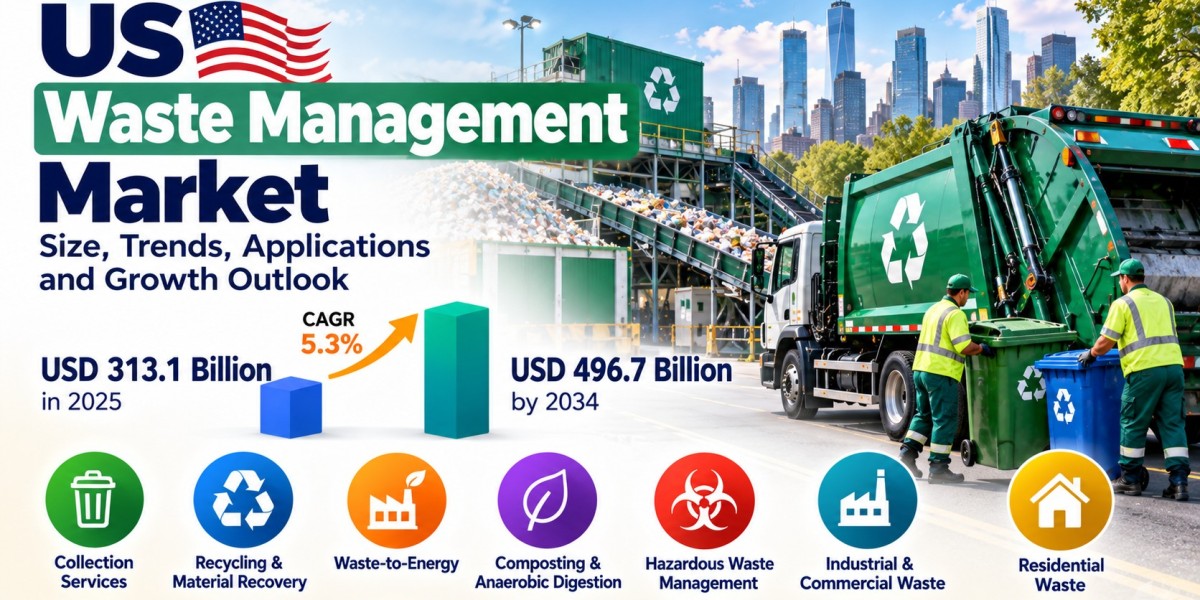
The market is estimated at USD 313.1 billion in 2025 and is projected to reach USD 496.7 billion by 2034, expanding at a CAGR of 5.3%. Collection services, non-hazardous waste, incineration and combustion, and residential users are expected to remain important market segments.
Digital waste tracking, smart collection systems, advanced recycling, composting, anaerobic digestion, and waste-to-energy technologies are also changing how waste is managed. This article explores the major drivers, applications, technologies, market segments, challenges, and future opportunities shaping the US waste management industry.
What Is the US Waste Management Market?
The market includes services and infrastructure used to handle waste from the point of generation through collection, transportation, treatment, recycling, recovery, and final disposal.
Waste streams include municipal solid waste, industrial waste, construction and demolition debris, medical waste, electronic waste, plastic waste, organic materials, and other hazardous and non-hazardous materials. Service providers work with households, businesses, industries, healthcare facilities, government agencies, and institutions.
The industry increasingly focuses not only on disposing of waste, but also on recovering useful materials, generating energy, reducing landfill dependence, and improving environmental performance.
Why Is the US Waste Management Market Growing?
Increasing Waste Generation
Population concentration, consumer activity, e-commerce, construction, and industrial operations continue to generate significant volumes of waste.
The US generated approximately 292.4 million tons of municipal solid waste in 2018, according to statistics cited in the DMR report from the US Environmental Protection Agency. This illustrates the scale of infrastructure required for collection, processing, recycling, and disposal.
Stronger Sustainability Requirements
Federal, state, and municipal policies are encouraging recycling, landfill diversion, composting, extended producer responsibility, and more sustainable materials management.
Businesses are also paying greater attention to waste reduction as environmental performance becomes more integrated into corporate strategies.
Expansion of Recycling and Resource Recovery
Waste materials increasingly represent potential secondary resources. Paper, metals, plastics, organic waste, and other materials can be recovered, processed, and returned to productive use.
This approach supports circular economy models in which waste management shifts from simple disposal toward reuse and resource recovery.
Key Trends Shaping the US Waste Management Market
Smart waste management is becoming increasingly important. IoT-enabled bins, GPS-based route optimization, RFID tracking, data analytics, and AI-supported sorting technologies can help operators improve collection efficiency, reduce fuel consumption, monitor waste levels, and optimize processing.
Another major trend is the rise of circular economy practices. Municipalities and businesses are investing in material recovery facilities, source separation, recycled content, closed-loop systems, and packaging designed for recyclability.
Organic waste treatment is also gaining momentum. Composting and anaerobic digestion provide alternatives to landfilling food and yard waste while creating products such as compost and biogas.
Get a Free Sample of the US Waste Management Market Report
Businesses, municipalities, technology providers, investors, and sustainability teams can review the sample report for deeper insights into market size, service types, waste categories, disposal methods, end users, competitive activity, and emerging opportunities.
https://dimensionmarketresearch.com/request-sample/us-waste-management-market/
Major Applications of Waste Management Services
Municipal Waste Collection
Residential and municipal collection remains one of the industry's most essential functions. Waste must be collected efficiently before it can be transported, sorted, recycled, treated, or disposed of.
Commercial and Industrial Waste Management
Retailers, manufacturers, offices, warehouses, construction companies, and other businesses generate diverse waste streams that require specialized collection and processing.
Recycling and Material Recovery
Recycling facilities process materials such as paper, cardboard, metals, plastics, and glass for reuse in manufacturing and packaging supply chains.
Medical and Hazardous Waste Treatment
Hospitals, laboratories, manufacturers, and industrial facilities generate materials that require controlled handling and specialized treatment because of health, chemical, or environmental risks.
Waste-to-Energy
Waste-to-energy facilities process suitable waste streams to reduce disposal volume while generating electricity or heat. The DMR report notes that the US had 63 waste-to-energy plants processing 26.6 million tons of municipal solid waste in 2022.
Key Factors Driving Market Growth
Regulatory requirements are encouraging investment in modern collection, recycling, treatment, and disposal infrastructure. Extended producer responsibility programs and landfill diversion policies are also influencing how products and packaging are managed after use.
Digitalization is improving operational efficiency. Route planning technologies can reduce unnecessary collection mileage, while sensor-based systems can identify when containers require servicing.
Food waste diversion presents another opportunity. Composting, anaerobic digestion, food recovery, and specialized collection programs are expanding as states and municipalities seek to reduce organic material entering landfills.
Waste-to-energy and advanced recovery technologies also provide opportunities where recycling or reuse is not practical.
Market Segmentation
The market is segmented by service type, waste type, disposal method, and end user.
By Service Type
Major services include:
Collection
Disposal
Transportation
Treatment Services
Collection services are projected to lead the market in 2025. Collection represents the first stage of nearly every waste management process and supports residential, commercial, industrial, recycling, yard waste, and bulky waste operations.
By Waste Type
The market includes:
Non-Hazardous Waste
Hazardous Waste
Other Waste Types
Non-hazardous waste includes municipal solid waste, construction and demolition debris, and industrial waste.
Non-hazardous waste is expected to hold the largest revenue share in 2025, supported by its high generation volume across households, businesses, institutions, construction sites, and industrial operations.
Hazardous waste includes medical waste, electronic waste, plastic waste categories identified in the report, and other materials requiring specialized handling.
By Disposal Method
Major disposal and processing methods include:
Incineration and Combustion
Landfill Disposal
Composting and Anaerobic Digestion
Recycling
Open Dumping
Incineration and combustion are projected to lead the disposal method segment in 2025. Waste-to-energy applications support this category by combining waste volume reduction with energy recovery.
By End User
Major end users include:
Residential
Industrial
Commercial
Residential users are projected to lead the market, supported by consistent household waste generation and recurring demand for curbside collection, recycling, organic waste handling, and disposal services.
US Market Outlook
Waste management conditions vary considerably across the country because regulations, recycling programs, disposal infrastructure, landfill capacity, and environmental priorities differ between states and municipalities.
Some states have adopted stronger recycling, organics diversion, and extended producer responsibility programs, while others continue to rely more heavily on landfill disposal. This creates a diverse operating environment for national and regional waste management companies.
Urban areas present strong opportunities for smart collection, recycling, waste-to-energy, and organic waste treatment because high population density creates concentrated waste volumes.
Rural markets can face different challenges, including longer transportation distances, limited processing infrastructure, and higher costs per household.
Key Challenges
High capital requirements remain a major barrier. Recycling centers, composting facilities, waste-to-energy plants, advanced sorting systems, and specialized treatment infrastructure can require substantial investment.
Operating expenses are also significant because waste companies must manage labor, fuel, vehicles, equipment maintenance, environmental compliance, and facility costs.
Regulatory fragmentation presents another challenge. Waste management requirements differ between states and municipalities, making compliance more complex for companies operating across multiple markets.
Recycling economics can also fluctuate because the value of recovered materials such as paper and plastics changes with commodity market conditions.
Future Outlook
The US Waste Management Market is expected to increasingly focus on circular economy strategies, digital collection technologies, advanced recycling, organic waste diversion, waste-to-energy, and specialized hazardous waste treatment.
The projected rise from USD 313.1 billion in 2025 to USD 496.7 billion by 2034 reflects continued demand for collection, treatment, recycling, recovery, and disposal infrastructure.
Technology providers and service companies that improve material recovery, operational efficiency, regulatory compliance, and landfill diversion can address growing demand from municipalities, businesses, and households.
Explore the Complete US Waste Management Market Analysis
The complete report provides detailed analysis of market size, service types, waste categories, disposal methods, end users, market drivers, restraints, technology trends, competitive developments, and emerging opportunities.
https://dimensionmarketresearch.com/checkout/us-waste-management-market/
Frequently Asked Questions
1. What is the US Waste Management Market?
It includes collection, transportation, disposal, recycling, treatment, composting, and recovery services used to manage residential, commercial, industrial, hazardous, and non-hazardous waste.
2. What is driving the US Waste Management Market growth?
Growth is supported by waste generation, urbanization, environmental regulations, recycling programs, circular economy initiatives, digital waste technologies, and investment in advanced treatment infrastructure.
3. What are the major applications of waste management services?
Major applications include municipal collection, commercial waste management, industrial waste handling, recycling, composting, medical waste treatment, hazardous waste processing, and waste-to-energy.
4. Which segments are important in the US Waste Management Market?
Collection services are expected to lead by service type, non-hazardous waste by waste type, incineration and combustion by disposal method, and residential users by end-user category in 2025.
5. What is the future outlook for the US Waste Management Market?
The market is projected to reach USD 496.7 billion by 2034, supported by smart waste systems, recycling, organics diversion, waste-to-energy investment, regulatory requirements, and circular economy development.
Conclusion
The US Waste Management Market is moving from a disposal-focused industry toward a broader system built around collection efficiency, recycling, resource recovery, digital technology, and environmental responsibility. Residential waste remains fundamental, while commercial, industrial, hazardous, electronic, and organic waste streams are creating additional service requirements.
Future development will increasingly depend on smart collection, AI-supported sorting, composting, advanced recycling, waste-to-energy, and stronger circular economy practices. These technologies can help operators manage growing waste volumes while improving efficiency and reducing pressure on disposal infrastructure.