
Why Cold Rolled Coil Production Cost Matters to This Audience
Cold rolled coil is one of those industrial products that quietly shows up everywhere once you start looking for it. It's in structural beams for construction, appliance panels in dryers and dishwashers, and precision automotive components like bearings and gears, and that broad demand base is exactly why it tends to look like a stable, low-risk investment on paper. Pricing has held its ground too, with cold rolled coil in the US recently trading in a considerably higher and steadier range than hot rolled coil, even as the broader steel market saw softer conditions. That kind of relative price stability is attractive, but it also means margin pressure often shows up on the cost side rather than the revenue side, which is exactly where a lot of surface-level financial models fall short.
For investors and corporate advisers evaluating a CRC plant, the real complexity here is that this isn't a primary steel product. It's a secondary processing operation built on top of hot rolled coil, which means the plant's cost base inherits every bit of volatility that already exists upstream in iron ore and coal markets before the cold rolling process even adds its own cost layer. Frankly, a lot of pitch decks in this space lean heavily on end-market demand growth in construction and automotive without adequately addressing how exposed the underlying economics are to hot rolled coil pricing swings. Shouldn't that upstream exposure be the first thing any serious buyer checks?
What a Production Cost Report Actually Covers
A properly built cold rolled coil cost report walks through the entire conversion process, starting with detailed process flow showing exactly how hot rolled coil feedstock gets transformed into finished cold rolled product. Raw material and product specifications follow, quantifying how much hot rolled coil input is needed per tonne of finished cold rolled output, since yield loss during processing directly affects unit economics.
From there, the report covers land and site cost details, equipment and construction cost breakdowns, and the utility requirements needed to run cold rolling mills, which are considerably more energy-intensive than people outside the steel industry typically assume. Fixed cost analysis, conversion cost analysis, and variable cost analysis round out the operational picture, while capital investment analysis, financing costs, and depreciation charges complete the financial model. Manpower and infrastructure requirements get their own treatment too, since running a cold rolling operation demands a technically trained workforce and substantial floor space for mill lines and finishing equipment.
Raw Materials Required for Cold Rolled Coil Production
Hot rolled coil is the dominant, and really the only major, raw material required for cold rolled coil production. That single dependency shapes the entire cost structure of this business, because hot rolled coil pricing is itself driven by upstream inputs, primarily iron ore and coal. Shifts in global infrastructure development and steel production directly influence iron ore prices and availability, while transportation and logistics costs affect coal procurement, and both of these pass straight through into hot rolled coil cost before a cold rolling plant even touches the material.
This layered dependency means a CRC producer's margin is really a function of the spread between hot rolled coil input cost and cold rolled coil selling price, not an independent cost calculation. Regulatory and trade considerations, including tariffs, import duties, and environmental standards, add another layer of procurement cost on top of raw material pricing itself, and strict adherence to quality certifications like ASTM and ISO further shapes sourcing decisions, since not every hot rolled coil supplier meets the specification requirements downstream customers demand. Anyone evaluating a CRC plant should be checking whether the operation has secured stable, quality-certified hot rolled coil supply, because a plant sourcing on the spot market carries meaningfully more margin risk than one with contracted upstream relationships.
The Industrial Production Process
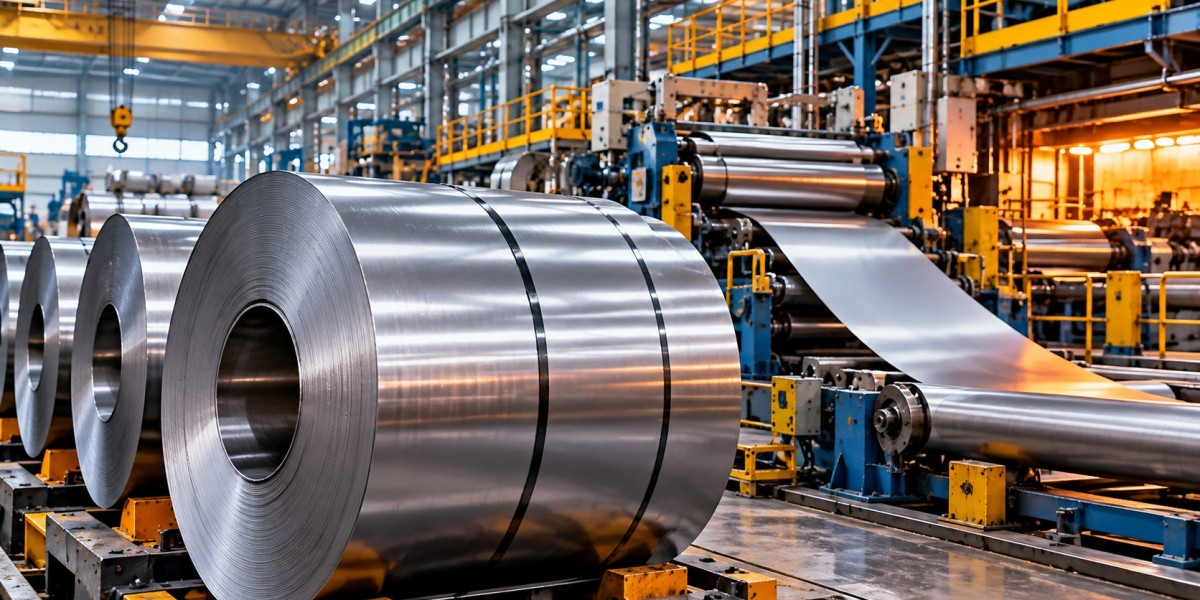
Cold rolled coil is produced through the cold rolling process, which takes hot rolled coil as its feedstock and processes it further at room temperature, as opposed to the elevated temperatures used in the initial hot rolling stage. This additional processing is what gives cold rolled coil its defining characteristics: a smoother surface finish, tighter dimensional tolerances, and improved mechanical properties compared to hot rolled steel, all of which matter considerably for applications like automotive body panels and precision appliance components where exact thickness and surface quality are non-negotiable.
The cold rolling process typically begins with pickling, where the hot rolled coil surface gets cleaned to remove scale and oxidation that formed during the hot rolling stage. The cleaned coil then passes through a series of rolling stands that progressively reduce thickness while the metal remains at ambient temperature, a process that work-hardens the steel and requires periodic annealing to restore ductility for further processing or end use. Final steps typically include temper rolling to achieve the desired surface finish and mechanical properties, followed by coiling and packaging for shipment. Each of these stages adds conversion cost on top of the base hot rolled coil price, and the specific finish and gauge tolerance a customer demands can meaningfully change how many processing passes, and how much energy, a given order requires.
Capital Investment and Plant Setup Cost Factors
Setting up a cold rolled coil facility involves substantial capital investment centered around the rolling mill equipment itself. Land and site costs need to account for the considerable floor space required for mill lines, pickling equipment, annealing furnaces, and finishing and coiling systems, along with the heavy-duty foundation work needed to support rolling stand equipment that operates under enormous mechanical stress continuously.
Equipment costs represent the largest capital category by a wide margin, covering pickling lines, multi-stand rolling mills, annealing furnaces, and temper rolling and finishing equipment, each of which requires precise engineering to achieve consistent gauge and surface quality across high production volumes. Engineering and consulting charges tend to be significant given the precision tolerances this equipment must maintain, and contingency budgeting should account for the mechanical complexity involved in commissioning multi-stand rolling systems correctly. Working capital requirements need to cover hot rolled coil inventory, since maintaining a steady feedstock supply matters for keeping production lines running efficiently, along with the cash cycle time between purchasing input material and collecting on finished product sales.
Operating Cost Factors: Variable, Fixed, and Financial
Variable costs are overwhelmingly dominated by hot rolled coil feedstock, typically representing the largest single expense category in the entire cost structure. Utilities add a meaningful secondary cost, since cold rolling mills and annealing furnaces both consume substantial electricity and, where used, natural gas for heat treatment stages. Other variable costs, covering pickling chemicals and rolling lubricants, round out this category.
Fixed costs include labor and wages for skilled mill operators and quality control personnel, along with overhead expenses tied to running a capital-intensive processing facility. Maintenance charges run high here given the mechanical stress rolling equipment endures continuously at tight tolerances, and unplanned downtime on a rolling line can be costly given how capital-intensive replacement or repair of precision mill equipment tends to be. Financing costs, including interest on working capital and equipment loans, plus depreciation on the substantial capital base, complete the operating picture alongside general sales and admin costs. Because feedstock cost dominates the variable side so heavily, even modest improvements in yield or scrap reduction during processing can meaningfully improve overall plant margins.
What Pushes Cold Rolled Coil Production Costs Up or Down
Hot rolled coil pricing sits at the top of the list by a clear margin, and it's shaped by iron ore and coal market dynamics well upstream of anything a cold rolling plant controls directly. The market for cold rolled coil is expected to stay range-bound as supply discipline and cost pressures balance against a gradual demand recovery, which suggests near-term margin outcomes will depend heavily on how well individual producers manage feedstock cost relative to that fairly stable pricing environment.
Technology and mill efficiency matter considerably too, since modern rolling equipment achieves better yield, tighter tolerance control, and lower energy consumption per tonne than older mill lines. Scale plays its usual role, with larger operations generally securing better hot rolled coil purchasing terms and spreading fixed equipment and labor costs across greater production volume. Regional factors close out the picture, and the variation here is substantial: cold rolled coil pricing recently ranged from roughly 556 US dollars per tonne in China to over 1,300 US dollars per tonne in the US and Canada, reflecting differences in regional feedstock cost, trade policy, tariffs, and local demand conditions that any cross-border investment comparison needs to account for carefully rather than assuming a single global benchmark applies everywhere.
Frequently Asked Questions
Q: What's the single biggest cost driver for a cold rolled coil producer?
Hot rolled coil feedstock cost, without much competition. Since it's the dominant raw material input, its price, which itself tracks iron ore and coal markets, largely determines whether a given plant's margin holds up in any given quarter.
Q: Why does cold rolled coil pricing stay more stable than hot rolled coil pricing?
It tends to reflect steadier downstream demand from sectors like automotive and appliance manufacturing that require the tighter tolerances and better surface finish only cold rolling provides, which can insulate CRC pricing somewhat from the sharper swings sometimes seen in primary hot rolled coil markets.
Q: How much does regional location affect cold rolled coil production economics?
Substantially. Regional pricing has recently varied by more than double between markets like China and North America, driven by differences in feedstock access, trade policy, tariffs, and local demand, so cross-border cost comparisons need real adjustment rather than a flat global assumption.
Q: Does quality certification really matter for procurement decisions in this sector?
Yes, more than people expect. Downstream customers in automotive and construction often require strict adherence to standards like ASTM and ISO, and a hot rolled coil supplier that can't consistently meet those specifications limits a CRC producer's ability to serve premium end markets.
Q: What operational factor most commonly separates a profitable CRC plant from a marginal one?
Feedstock management and yield efficiency. Since hot rolled coil represents such a dominant share of variable cost, even small improvements in processing yield or scrap reduction can shift overall plant margin more than most other operational levers available to management.
Why This Report Belongs in Every Serious Deal Review
Cold rolled coil's broad end-market demand makes it easy to build an optimistic growth narrative around a plant, but the real economics live in the spread between hot rolled coil input cost and finished product pricing, a spread that's more exposed to upstream commodity volatility than most investors initially appreciate. A Cold Rolled Coil Production Cost Report gives investors, brokers, and advisers a grounded, checkable view of exactly how feedstock dependency, conversion efficiency, and regional cost differences shape actual plant margins, rather than relying on end-market demand growth alone to justify a valuation.