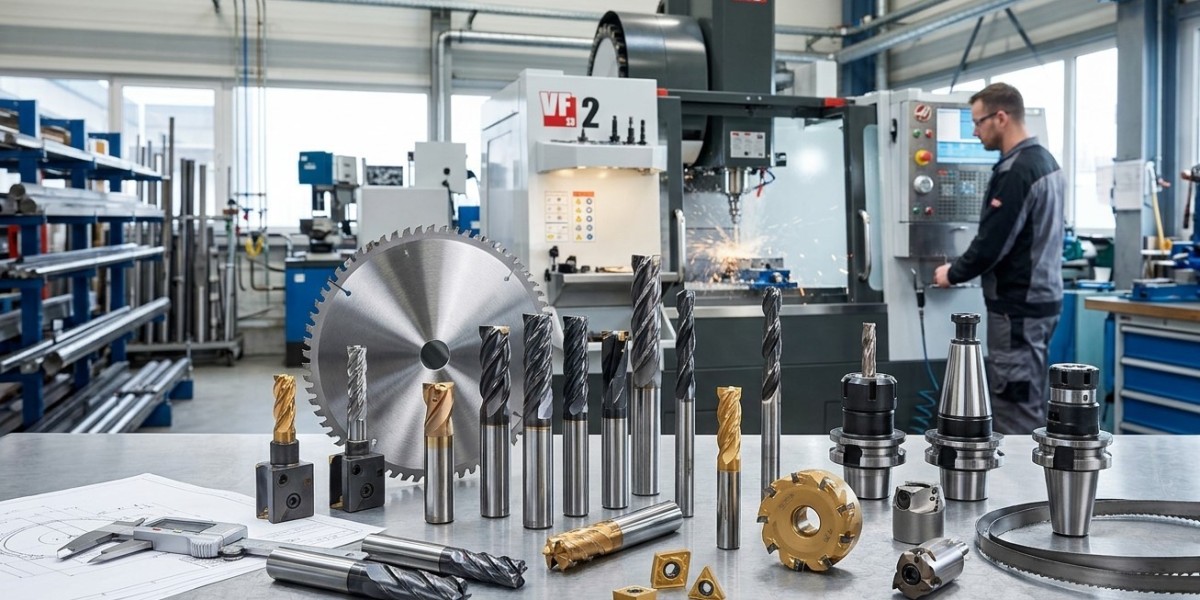

Choosing the right industrial cutting tools is an important decision for manufacturing companies, CNC machining facilities, engineering workshops, and industrial maintenance teams. The performance of a cutting tool can directly affect machining accuracy, productivity, surface finish, tool life, and overall production costs. Buying a tool simply because it is affordable or widely used may not produce the desired results.
Before purchasing industrial cutting tools, businesses should evaluate the workpiece material, machining operation, tool geometry, cutting parameters, machine capability, coating, tool life, and application requirements. For companies searching for an Industrial Tools Supplier in Dubai, understanding these factors can make the purchasing process more effective and help avoid unnecessary tooling costs.
Khokhawala Trading LLC, an Industrial Tools Supplier in Dubai, provides industrial and engineering tools for a variety of machining, manufacturing, and workshop applications. This guide explains the key factors businesses should consider before buying industrial cutting tools.
Why Choosing the Right Cutting Tool Matters
Industrial cutting tools are responsible for removing material from a workpiece during machining operations such as milling, drilling, turning, grooving, threading, and profiling. The cutting edge must withstand mechanical forces, heat, friction, and wear while maintaining the required cutting performance.
Using the right tool can help manufacturers:
- Improve machining accuracy
- Increase production efficiency
- Achieve better surface finishes
- Extend tool life
- Reduce tool replacement frequency
- Minimize machine downtime
- Reduce scrap and rework
- Control machining costs
- Maintain consistent component quality
On the other hand, an unsuitable tool can lead to excessive vibration, poor surface finish, premature wear, tool breakage, and dimensional inaccuracies.
1. Consider the Workpiece Material
The first factor to evaluate before buying a cutting tool is the material being machined. Different materials have different hardness, toughness, thermal conductivity, and chip-forming characteristics.
Common industrial materials include:
- Carbon steel
- Stainless steel
- Alloy steel
- Cast iron
- Aluminum
- Brass
- Copper
- Titanium
- Hardened steel
- Nickel-based alloys
A tool that performs well on aluminum may not be suitable for hardened steel or stainless steel. For example, aluminum machining may require sharp cutting edges and efficient chip evacuation, while harder materials may require tooling with greater wear resistance.
Therefore, always identify the workpiece material before selecting the tool grade, geometry, and coating.
2. Identify the Machining Operation
Different machining operations require different cutting tools. Before purchasing, determine exactly how the tool will be used.
Common machining operations include:
- Milling
- Drilling
- Turning
- Threading
- Grooving
- Reaming
- Boring
- Slotting
- Profiling
- Chamfering
- Facing
Milling Tools
Milling applications may require end mills, face mills, shoulder mills, slot cutters, or specialized profile cutters.
Drilling Tools
Drilling applications may require high-speed steel drills, carbide drills, indexable drills, or specialized hole-making tools.
Turning Tools
Turning operations commonly use replaceable carbide inserts mounted in suitable holders.
Choosing a tool specifically designed for the intended operation can improve both productivity and machining quality.
3. Choose the Right Tool Material
Cutting tools are manufactured from different materials, each offering different performance characteristics.
High-Speed Steel
High-speed steel tools provide good toughness and can be suitable for various general-purpose applications. They are commonly used for drills, taps, reamers, and other tooling.
Carbide
Carbide cutting tools provide high hardness and wear resistance and can support higher cutting speeds in suitable machining applications. Carbide end mills, drills, inserts, and other tools are widely used in CNC and industrial machining.
Ceramic and Other Advanced Materials
Certain demanding applications may require advanced cutting tool materials designed for high-temperature or specialized machining conditions.
The correct tool material should be selected according to the workpiece, machine, cutting conditions, and required productivity.
4. Check Tool Geometry
Tool geometry has a significant effect on cutting forces, chip evacuation, surface finish, and tool life.
Important geometry features can include:
- Number of flutes
- Helix angle
- Rake angle
- Clearance angle
- Nose radius
- Cutting-edge preparation
- Flute design
- Insert geometry
For example, the number of flutes on an end mill can influence chip evacuation and feed capability. A geometry suitable for roughing may not be ideal for precision finishing.
When buying cutting tools, avoid selecting a tool based only on diameter or size. The complete geometry should match the machining application.
5. Consider Tool Diameter and Size
Tool diameter should be compatible with the workpiece geometry and machine setup.
A larger tool may provide greater rigidity and material removal capability, while a smaller tool may be necessary for narrow slots, small features, or detailed components.
Also consider:
- Tool length
- Cutting length
- Overall length
- Shank diameter
- Tool holder compatibility
- Required depth of cut
Excessive tool length or overhang can increase vibration and reduce machining stability. Select the shortest practical tool configuration that provides the required access.
6. Evaluate Cutting Speed and Feed Rate
Cutting speed and feed rate have a major influence on cutting tool performance.
Running a tool at an excessively high speed can generate excessive heat and accelerate tool wear. Operating at an unnecessarily low speed may reduce productivity.
Feed rate also needs to be appropriate for the tool, workpiece material, machine, and cutting operation.
Before purchasing, check whether the tool manufacturer provides recommended cutting parameters. A tool should be evaluated not just by its purchase price but also by the machining performance it can deliver under appropriate conditions.
7. Consider Tool Coatings
Many modern industrial cutting tools are available with specialized coatings. These coatings can improve wear resistance, reduce friction, and protect the cutting edge under demanding machining conditions.
Different coatings are designed for different applications and materials. A coating suitable for general steel machining may not be the best choice for aluminum, stainless steel, or high-temperature alloys.
Therefore, coating selection should be based on:
- Workpiece material
- Cutting speed
- Machining temperature
- Tool material
- Required tool life
- Production volume
A coated tool is not automatically the best choice for every application. The coating must be appropriate for the complete machining environment.
8. Consider Machine Capability
The machine used for machining has a direct impact on tool selection.
Before buying an industrial cutting tool, check:
- Spindle speed
- Spindle power
- Machine rigidity
- Tool-holding system
- Maximum tool diameter
- Coolant capability
- CNC control
- Available working space
A high-performance tool cannot provide its full potential if the machine lacks sufficient spindle power or rigidity.
Machine vibration is another important consideration. If the machine or workholding system is unstable, even a high-quality cutting tool may experience premature wear or poor surface finish.
9. Evaluate Required Surface Finish
Different applications require different surface finish levels. Roughing operations are generally focused on removing large amounts of material efficiently, while finishing operations focus on dimensional accuracy and surface quality.
Before buying a tool, determine whether it will be used for:
- Heavy roughing
- Semi-finishing
- Precision finishing
- Profile machining
- High-speed machining
Finishing tools may require different geometries and cutting-edge characteristics compared with roughing tools.
Matching the tool to the desired surface finish can help reduce the need for additional machining operations.
10. Consider Tool Life
Tool life is one of the most important factors when evaluating industrial cutting tools. A low-cost tool that wears quickly may ultimately cost more than a higher-quality tool that provides longer service.
When comparing products, consider:
- Number of components produced per tool
- Cutting time
- Tool replacement frequency
- Surface finish consistency
- Downtime caused by tool changes
- Cost per machined component
For high-volume production, even a modest improvement in tool life can significantly reduce total tooling costs.
11. Consider Replaceable Inserts
For many turning and milling applications, replaceable carbide inserts can provide an economical and flexible tooling solution.
Instead of replacing the entire tool, the cutting insert can be indexed or replaced when the cutting edge becomes worn.
Benefits can include:
- Reduced tool replacement time
- Multiple usable cutting edges
- Consistent tool geometry
- Easier tool management
- Suitable options for different materials
However, the insert grade, geometry, chip breaker, and holder must all be appropriate for the machining application.
12. Think About Chip Evacuation
Effective chip evacuation is particularly important when machining deep holes, slots, pockets, and difficult materials.
Poor chip evacuation can result in:
- Recutting of chips
- Increased heat
- Poor surface finish
- Tool damage
- Workpiece damage
- Reduced tool life
Tool geometry, flute design, coolant delivery, and machining parameters all influence chip evacuation.
When purchasing a cutting tool, consider how effectively it will remove chips from the cutting zone.
13. Check Tool Holder Compatibility
The cutting tool and tool holder work together as a system. A high-quality cutter may still perform poorly if the tool holder causes excessive runout or vibration.
Before buying, verify compatibility between:
- Tool shank
- Holder type
- Machine spindle
- Collet or chuck
- Tool diameter
- Required tool length
Proper tool holding can improve stability, accuracy, and tool life.
14. Consider Production Volume
The best cutting tool for a small workshop may not be the best option for high-volume manufacturing.
For occasional machining, a general-purpose tool may provide sufficient performance. For continuous production, businesses may benefit from specialized tooling designed for longer tool life and higher material removal rates.
Production volume should therefore influence the decision regarding tool grade, coating, geometry, and overall purchase cost.
15. Compare Total Cost, Not Just Purchase Price
One of the most common purchasing mistakes is selecting the cheapest tool without considering its overall machining cost.
The total cost can include:
- Tool purchase price
- Tool replacement frequency
- Machine downtime
- Setup time
- Scrap
- Rework
- Productivity
- Cost per component
A more expensive cutting tool can sometimes provide better value if it delivers longer tool life and higher productivity.
Common Mistakes to Avoid When Buying Cutting Tools
Before purchasing industrial cutting tools, avoid these common mistakes:
- Selecting tools based only on price
- Ignoring workpiece material
- Choosing incorrect tool geometry
- Using unsuitable cutting parameters
- Ignoring machine limitations
- Selecting the wrong coating
- Buying incompatible tool holders
- Overlooking chip evacuation
- Failing to consider production volume
- Not comparing cost per component
A systematic purchasing process can help businesses avoid these problems.
Choosing a Reliable Industrial Tools Supplier
The supplier is an important part of the cutting tool purchasing process. A reliable supplier should provide accurate product specifications and suitable options for different machining applications.
Businesses searching for an Industrial Tools Supplier UAE should consider:
- Product range
- Tool quality
- Availability
- Technical specifications
- Application knowledge
- Customer support
- Compatibility with existing equipment
For companies looking for an Industrial Equipment Supplier in Dubai, selecting a supplier with experience in industrial tooling can make it easier to identify appropriate products for specific machining requirements.
Khokhawala Trading LLC supplies industrial and engineering tools for various manufacturing, machining, and workshop applications. Businesses can evaluate their workpiece materials, machining processes, machine capabilities, and production objectives before selecting the appropriate cutting tools.
Conclusion
Buying industrial cutting tools requires more consideration than simply selecting a tool based on size or price. Workpiece material, machining operation, tool material, geometry, diameter, coating, cutting parameters, machine capability, tool life, chip evacuation, and production volume all influence the final choice.
The right cutting tool can improve machining accuracy, surface finish, productivity, and tool life while helping reduce downtime and overall production costs. Businesses should therefore evaluate the complete machining process before making a purchase.
For companies searching for an Industrial Tools Supplier in Dubai, Industrial Tools Supplier UAE, or Engineering Tools Supplier in Dubai, Khokhawala Trading LLC provides industrial and engineering tooling solutions for different machining and workshop requirements.
A well-planned cutting tool selection process can help manufacturers achieve more consistent machining results, improve operational efficiency, and get better long-term value from their tooling investment.