
Growth breaks systems. I have watched it happen for two decades.
A Singapore trading firm runs fine with eight staff. Spreadsheets work. Email works. A simple accounting tool works. Then the firm doubles. Orders pile up. Stock counts stop matching invoices. The finance lead spends every Friday fixing numbers instead of reading them.
That is the moment owners start hunting for ERP solutions Singapore vendors can deliver fast. And that is where many of them make an expensive mistake. They buy software before they fix the problem.
This guide is written for that moment. It explains what cloud ERP does, why it speeds up growth, what it costs, and how to pick a partner who will not waste your year.
Why Growth Breaks Your Current Setup
Small teams run on memory. One person knows the supplier. Another knows the discount. A third knows which client always pays late.
That works until it doesn't.
Once you pass roughly 20 to 30 staff, memory fails. Data sits in five places. Sales quotes one price. Finance bills another. Warehouse counts a third number. Nobody is lying. The systems simply never talked to each other.
The cost is real. Teams rekey the same data. Month-end closes take two weeks. Customers wait for answers you should have in seconds. Meanwhile rent, wages and CPF contributions keep climbing.
Singapore makes this harder. Margins are thin. Labour is tight. Compliance is strict. You cannot solve the gap by hiring three more admin staff. You have to fix the plumbing.
That is the honest case for ERP. It is also why demand for ERP solutions Singapore firms can deploy quickly keeps rising every year.
What Cloud ERP Actually Means
ERP stands for Enterprise Resource Planning. Strip away the jargon and it is one shared database for your whole company.
Sales, inventory, purchasing, finance, HR and projects all write to the same place. Enter a sales order once. Stock updates. The invoice drafts itself. The general ledger posts. Nobody retypes anything.
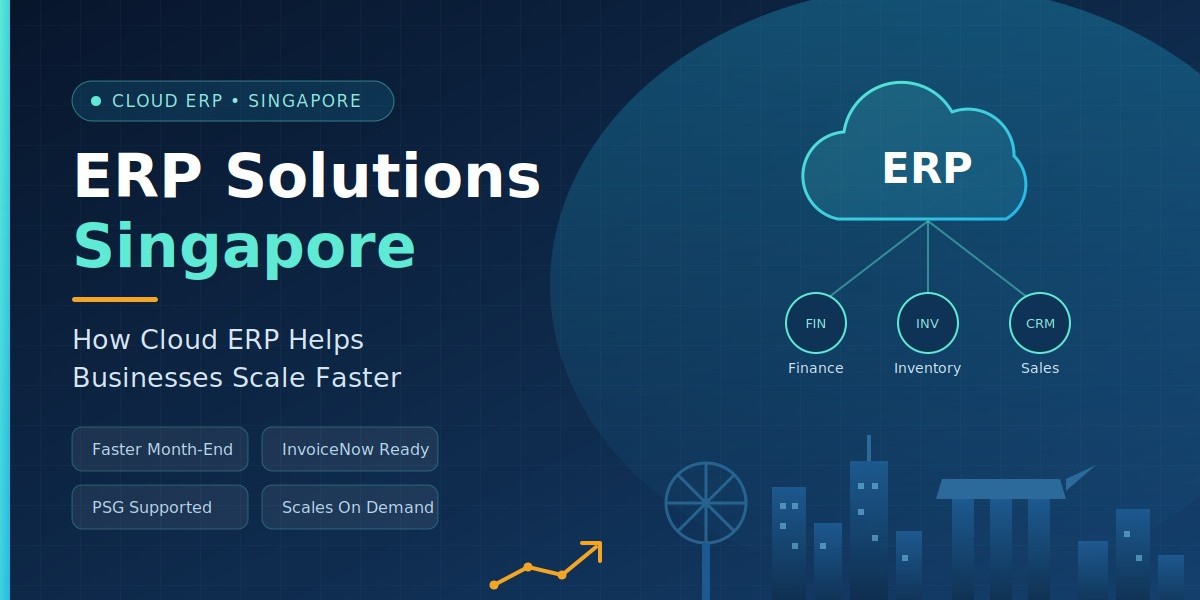
Cloud ERP does the same job, but the software runs on the vendor's servers. You reach it through a browser. There is no server room. No weekend patching. No panic when a hard drive dies.
Traditional ERP asked for a large upfront payment and a long build. Cloud ERP asks for a monthly or yearly subscription. That single change is why ERP is no longer just for large firms. Today the strongest ERP solutions Singapore SMEs adopt are almost all cloud based.
How Cloud ERP Helps You Scale Faster
Scaling is not just selling more. It is handling more without breaking. Here is how cloud ERP makes that possible.
1. One Version of the Truth
Every team reads the same numbers. Arguments about whose spreadsheet is correct simply stop.
I once watched a logistics client cut its month-end close from 14 days to 4. Nothing changed except where the data lived. Faster closes mean faster decisions. Faster decisions mean faster growth.
2. You Add Users, Not Servers
Hire ten people next quarter? Add ten licences. Open a second warehouse? Switch on another location.
There is no hardware order. No six-week wait. Capacity stops being a ceiling and becomes a setting. For fast-moving firms, this alone justifies the move.
3. Compliance Stops Being a Fire Drill
This is where Singapore is different, and where good ERP solutions Singapore providers earn their fee.
GST sits at 9%. IRAS now wants invoice data sent through the InvoiceNow network, which runs on the global Peppol standard. The rollout is phased:
- 1 Nov 2025 — newly incorporated firms registering for GST voluntarily
- 1 Apr 2026 — all new voluntary GST registrants
- 1 Apr 2028 — new compulsory registrants and firms with annual supplies up to S$200,000
- 1 Apr 2029 — existing firms up to S$1 million
- 1 Apr 2030 — existing firms up to S$4 million
- 1 Apr 2031 — everyone else
Read that list again. If you are GST registered, your date is coming. A cloud ERP that is already InvoiceNow ready handles this quietly in the background. A spreadsheet cannot.
The same logic covers CPF filing, MOM reporting and audit trails. Compliance becomes a setting, not a scramble.
4. Regional Expansion Gets Simpler
Singapore is a base, not a market. Most of my clients grow into Malaysia, Indonesia, Vietnam or Australia within three years.
Cloud ERP handles multiple currencies, tax rules, languages and entities from day one. You consolidate group accounts without a manual merge. Opening a new country becomes a configuration task instead of a fresh IT project.
5. Automation Buys Back Hours
Purchase orders raise themselves when stock hits a floor. Approvals route by value. Invoices match against receipts. Payment reminders send on schedule.
None of this is glamorous. All of it is time. A team of 40 can easily claw back several hundred hours a month. That capacity funds your next stage of growth without new headcount.
6. You Decide With Live Data
Dashboards update as work happens. You see gross margin by product today, not next month.
A retail client of mine found that one bestselling SKU was losing money once freight and returns were counted. The report took ten minutes. Before ERP, nobody had ever assembled that view. They repriced within a week.
7. Cost Shifts From CapEx to OpEx
You trade one large payment for a predictable monthly cost. Upgrades, security patches and backups sit with the vendor.
For a growing SME, cash flow matters more than ownership. Cloud ERP respects that.
Cloud ERP vs On-Premise ERP
| Factor | Cloud ERP | On-Premise ERP |
|---|---|---|
| Upfront cost | Low subscription | High licence and hardware |
| Go-live speed | 6 to 16 weeks | 6 to 18 months |
| Upgrades | Automatic | Manual, often paid |
| Remote access | Built in | Needs VPN setup |
| IT staff needed | Minimal | Dedicated team |
| Best suited to | SMEs and fast growers | Highly custom, regulated setups |
Most ERP solutions Singapore vendors sell today are cloud first, and the table above explains why.
On-premise still wins in rare cases. If your processes are deeply unusual, or your data cannot leave your building, keep it on the table. For most Singapore SMEs, cloud wins on speed and cost.
Grants Can Cut Your Bill
Singapore funds this kind of upgrade. Many owners never claim it.
Productivity Solutions Grant (PSG). Covers up to 50% of qualifying costs for pre-approved IT solutions, capped at S$30,000 per company each financial year. Your business must be registered and operating here, with at least 30% local shareholding for selected solutions.
Enterprise Development Grant (EDG). Aimed at larger transformation projects that go beyond an off-the-shelf package.
GST InvoiceNow transition support. The Government introduced funding to offset onboarding costs, from around S$1,000 for SMEs to about S$5,000 for larger firms. Free e-invoicing packages are also available to help smaller businesses connect.
One rule matters above all. Apply through the Business Grants Portal before you pay any deposit or sign a contract. Retrospective claims are rejected. I have seen firms lose five figures by signing first and asking later.
Grant rules change. Confirm current terms with Enterprise Singapore before you commit.
How to Choose the Right ERP Partner
The software matters. The partner matters more. A strong product with a weak implementation still fails. Shortlist two or three ERP solutions Singapore providers support locally, then compare them properly.
Ask these questions before you sign:
- Who does the work? Meet the actual consultants, not the sales lead.
- Have you done my industry? Ask for two references you can call.
- Is the system InvoiceNow ready today? Ask to see it running, not on a roadmap.
- What is the full three-year cost? Include licences, setup, data migration, training and support.
- How is my data protected? Ask about encryption, backups, uptime and where servers sit.
- What happens if I leave? Confirm you can export your own data in a usable format.
- Who trains my team? Adoption fails without training. Get it in writing.
If a vendor dodges the exit question, walk away. Your data belongs to you.
A Realistic Timeline
Good ERP implementation follows a rhythm.
Weeks 1 to 3. Discovery. Map how work truly flows, not how the manual says it should.
Weeks 4 to 8. Configuration. Set up your chart of accounts, roles, workflows and approvals.
Weeks 6 to 10. Data migration. Clean your master data first. Dirty data ruins good software.
Weeks 9 to 12. Testing and training. Run real transactions. Break things safely.
Weeks 12 to 16. Go live, then stabilise. Expect a bumpy fortnight. Plan for it.
Anyone promising a two-week go-live for a complex business is selling you a story.
Mistakes I See Again and Again
Buying features you will never use. Pay for what you need this year and next.
Skipping data cleanup. Garbage in, garbage out. This is still true.
Leaving staff out. The people doing the work know where the pain is. Ask them early.
Copying broken processes. ERP is a chance to fix workflows, not to digitise bad habits.
No internal owner. One person must own the project. Without that, it drifts.
Frequently Asked Questions
How much does cloud ERP cost in Singapore? Small deployments often start in the low thousands per year. Mid-sized rollouts commonly land between S$20,000 and S$80,000 in year one, including setup. Always ask for a three-year total.
How long does implementation take? Most SMEs go live in 8 to 16 weeks. Multi-entity or multi-country rollouts take longer.
Can cloud ERP handle GST and InvoiceNow? Yes. Most modern ERP solutions Singapore businesses buy are already InvoiceNow ready and accredited. Confirm this in writing before signing.
Do I need to replace my accounting software? Often, yes. ERP absorbs accounting and adds inventory, sales and operations around it. Some firms keep their existing ledger and connect it instead.
Is cloud ERP safe? Reputable vendors offer encryption, redundancy and audited security. That is usually stronger than a server in a back office.
The Bottom Line
ERP is not software. It is a decision about how your company will run at three times its current size.
Get it right and growth feels calm. Orders flow. Numbers agree. Compliance handles itself. Your team spends its energy on customers instead of copy-paste.
Get it wrong and you carry the cost for years.
Start small. Fix your data. Choose a partner who asks about your process before quoting a price. Claim the grants you qualify for. Then scale.
The best ERP solutions Singapore has to offer will not fix a broken process. They will, however, make a good process repeatable at scale. That is the difference between growing and simply getting busier.
If you want a clear-eyed view of your options, GO-Globe works with Singapore businesses on digital transformation, ERP strategy and the systems that hold growth together. GO-Globe brings the practical experience needed to match the right ERP solutions Singapore companies actually use to the way your business really works. Talk to the GO-Globe team before you commit, and start your next stage of growth on solid ground.