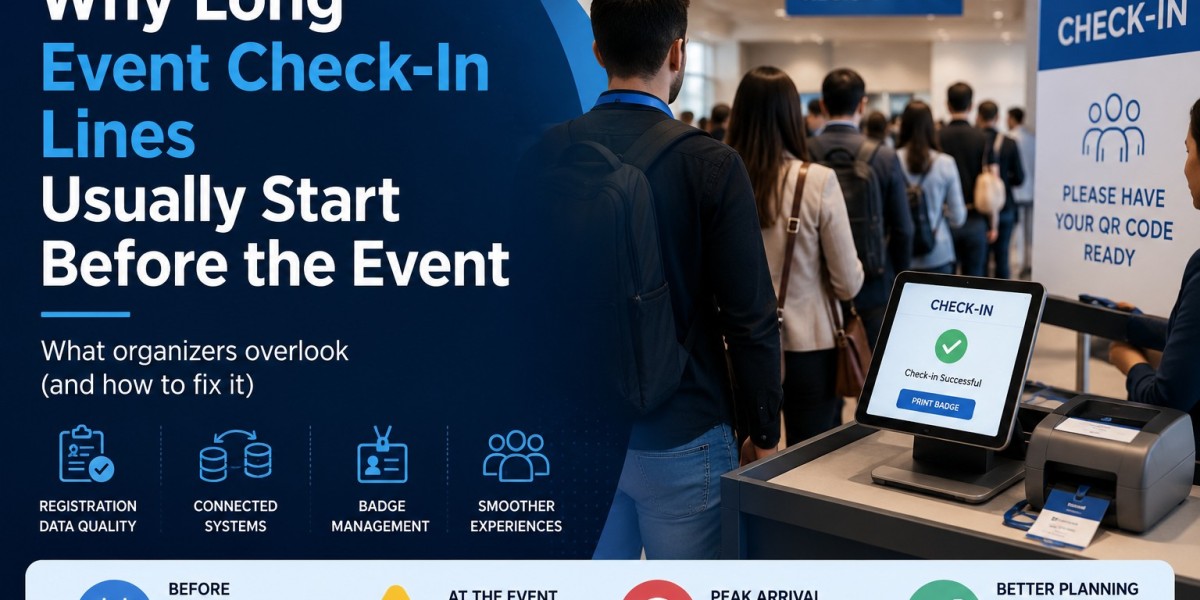

Long queues at an event entrance are easy to notice.
Attendees are waiting. Event staff are searching for names. Badges are being corrected. Organizers are trying to understand why a process that looked simple during planning has suddenly become difficult.
The natural reaction is to blame the check-in desk.
In many cases, the real problem started days or even weeks before attendees arrived.
Check-in depends on registration data
An event check-in process is only as reliable as the attendee information available to the event team.
Names, ticket types, attendee categories, company details, and access permissions may all influence the arrival process.
When this information is incomplete or spread across different systems, event staff may need to solve data problems while attendees are waiting.
A registration update may exist in the event registration software but not in the check-in system.
A ticket upgrade may have been processed but not reflected in the latest spreadsheet.
An attendee's company name may have changed, while their badge was already printed using old information.
Individually, these problems appear small. During a busy arrival period, they can quickly create delays.
Spreadsheet transfers create additional risks
Many event teams still move attendee data between systems using spreadsheets.
Registration information is exported, cleaned, reviewed, and uploaded into another platform.
The process may work when attendee information remains unchanged.
Event data rarely stays unchanged.
New attendees register. Existing attendees update their details. Ticket categories change. Sponsors add team members. Speakers confirm their participation.
Every change creates another opportunity for different systems to contain different attendee information.
When the check-in team works from an outdated attendee list, staff members often need to resolve these differences manually.
Pre-printed badges can add another bottleneck
Printing badges before an event may appear efficient.
Thousands of badges can be prepared, sorted, and transported to the venue.
The challenge begins when attendee information changes.
A badge with an incorrect name needs to be replaced. A last-minute attendee needs a new badge. A participant who changes organizations may request updated company information.
Event teams then need a separate process for badge corrections and new registrations.
On-site event badge printing can reduce some of this dependency on pre-printed badges.
When badge printing is connected with attendee records and event check-in software, organizers can print badges using current attendee information during the arrival process.
Peak arrival periods expose workflow problems
Most attendees do not arrive evenly throughout the day.
A large percentage may arrive shortly before the opening keynote or first conference session.
This creates a short period of high check-in demand.
A process that takes 30 seconds longer for one attendee may not appear significant during testing. When hundreds or thousands of people arrive within a limited time, small delays can affect the entire entrance workflow.
Event organizers should therefore test check-in based on expected peak arrival volume rather than average attendance throughout the day.
Connected event technology can reduce manual steps
Registration, check-in, and badge printing are closely related event activities.
Managing each function in a separate system can require event teams to repeatedly move and verify attendee information.
Connected event management platforms can provide a different approach.
For example, Eventify brings event registration, attendee check-in, and on-site badge printing into a connected event management environment. Event teams can manage attendee information across different stages of the event without treating every activity as a separate data workflow.
The value of this approach is not simply having more event features.
It is reducing the number of manual steps required between those features.
Technology is only one part of faster check-in
Event check-in software cannot solve every arrival problem.
Venue layout matters.
Signage matters.
Staff training matters.
The number and location of check-in stations matter.
Organizers should review the complete attendee arrival journey.
Where do attendees go when they enter the venue? Can they easily identify the correct check-in area? Are separate workflows needed for speakers, exhibitors, VIPs, or on-site registrations?
Technology works best when it supports a clearly planned arrival process.
Check-in problems often begin before event day
A long queue is the visible result of a workflow problem.
The cause may be outdated registration data, disconnected event management tools, badge corrections, or an arrival process that was not designed for peak attendance.
Event organizers can improve check-in by examining the complete flow of attendee information from registration to venue arrival.
The goal should not simply be to process attendees faster at the entrance.
It should be to remove the data and workflow problems that create delays before attendees reach the check-in desk.