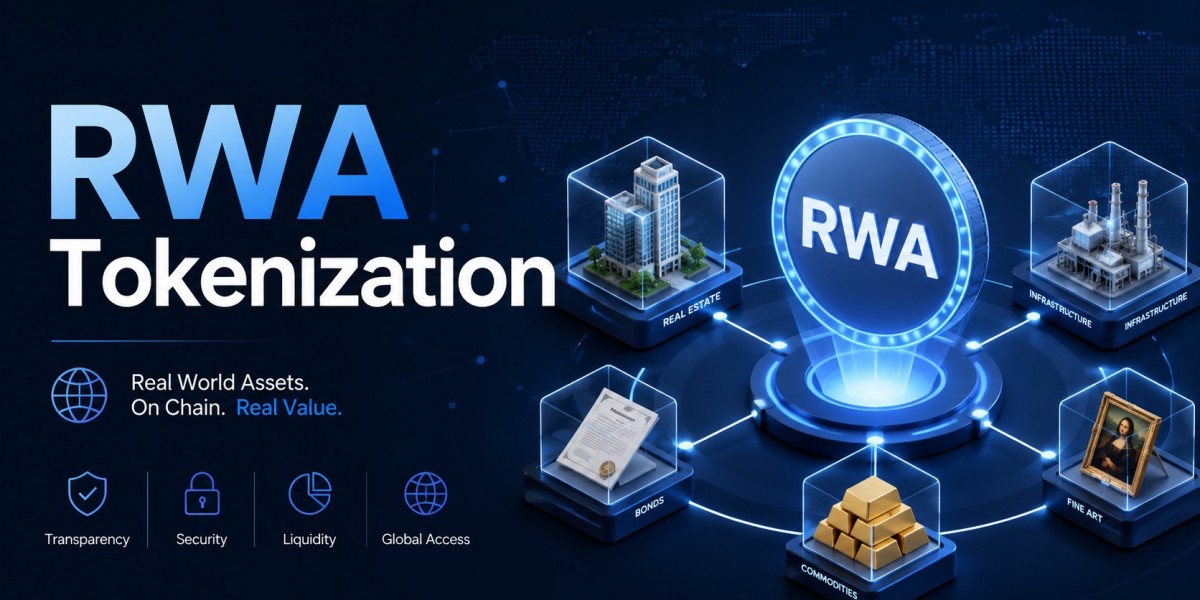

The financial landscape is evolving rapidly as blockchain technology reshapes how ownership, investment, and asset management function across industries. Among the most impactful innovations is Real World Asset (RWA) tokenization, a process that converts physical or traditional financial assets into blockchain-based digital tokens. This transformation is changing the way businesses and investors access liquidity, especially for assets that were historically difficult to trade or monetize.
Illiquid assets such as real estate, private equity, fine art, infrastructure projects, commodities, and collectibles have long presented challenges for owners seeking faster capital access. Traditional liquidation methods are often slow, expensive, and dependent on intermediaries. Real World Asset tokenization addresses these limitations by enabling fractional ownership, secondary trading, automated settlements, and global investment participation.
Understanding Illiquid Assets and Their Financial Limitations
Illiquid assets are assets that cannot easily be converted into cash without significant time delays or price reductions. Traditional examples include commercial real estate, infrastructure investments, fine art, private equity stakes, and industrial assets. These asset classes often require extensive documentation, legal processing, intermediaries, and large capital commitments before ownership transfers can occur.
One of the biggest challenges associated with illiquid assets is delayed cash flow realization. Asset owners may hold valuable properties or investment positions for years while being unable to access their embedded value quickly. Even when there is strong market demand, the absence of accessible secondary markets creates major liquidity barriers.
What Is Real World Asset Tokenization?
Real World Asset tokenization refers to the process of converting ownership rights of physical or financial assets into blockchain-based digital tokens. Each token represents a proportional share, legal claim, or financial interest in the underlying asset.
These tokens are issued on blockchain networks using smart contracts, which automate ownership transfers, compliance rules, revenue distribution, and transaction settlement. Tokenized assets may include:
- Real estate properties
- Private credit instruments
- Commodities
- Revenue-generating infrastructure
- Fine art and collectibles
Unlike traditional ownership systems that rely on centralized registries and manual processing, blockchain-based tokenization creates a programmable and transparent ownership infrastructure. This innovation transforms previously static assets into digitally transferable financial instruments that can participate in continuous market activity.
How Tokenization Unlocks Cash Flow from Illiquid Assets
Fractional Ownership Expands Investor Participation
One of the most powerful advantages of real word asset tokenization is fractional ownership. Instead of selling an entire asset, owners can divide the asset into thousands or millions of digital tokens representing smaller ownership portions. This dramatically lowers investment barriers. For instance, instead of requiring a single buyer to purchase an entire commercial property, tokenization enables multiple investors to purchase smaller fractions of the asset. This broader participation increases market demand and accelerates liquidity generation.
Fractionalization improves cash flow in several ways:
- Asset owners can monetize partial ownership while retaining operational control
- Investors gain access to previously inaccessible markets
- Smaller capital contributions increase transaction volume
- Continuous trading activity creates more dynamic liquidity
This model enables asset holders to unlock capital without fully disposing of strategic assets.
Secondary Market Trading Increases Liquidity
Traditional illiquid assets often lack active secondary markets. Selling ownership interests may require private negotiations, legal approvals, or institutional intermediaries. These processes slow down capital movement significantly. Tokenized assets can be traded on blockchain-enabled secondary marketplaces, allowing investors to buy and sell ownership fractions more efficiently. By introducing transferable digital ownership, tokenization creates continuous liquidity opportunities. Investors no longer need to wait years for full asset exits. Instead, they can partially liquidate positions through secondary token trading. This improved liquidity increases overall market participation and strengthens asset cash flow cycles. The ability to conduct near real-time transfers also reduces settlement delays commonly associated with traditional financial systems.
Faster Settlement Accelerates Capital Movement
Traditional asset transactions often involve banks, escrow services, legal institutions, clearing agents, and custodians. Settlement cycles can take days, weeks, or even months depending on the asset type. Blockchain networks significantly reduce these delays through smart contract automation and decentralized verification systems.
Tokenized transactions can settle much faster because:
- Ownership records are stored digitally on-chain
- Smart contracts automate transaction execution
- Manual reconciliation is reduced
- Intermediary dependency decreases
- Global transactions can occur continuously
Faster settlement directly improves cash flow by enabling quicker capital recycling. Investors and asset owners can redeploy funds more rapidly into new opportunities. For businesses managing large asset portfolios, improved settlement efficiency can dramatically strengthen working capital management.
Revenue Distribution Becomes More Efficient
Tokenized assets often generate recurring income streams such as rental income, dividends, royalties, or interest payments. Traditional distribution systems typically involve intermediaries, administrative costs, and processing delays. Smart contracts automate revenue allocation to token holders based on predefined ownership structures. This creates more efficient and transparent income distribution mechanisms.
For example:
- Rental income from tokenized real estate can be distributed automatically to token holders
- Infrastructure project revenues can be shared proportionally among investors
- Tokenized debt instruments can distribute interest payments programmatically
This automation improves cash flow predictability while reducing operational overhead. Additionally, investors receive faster access to generated income, which increases overall market efficiency.
Global Accessibility Expands Capital Inflows
One major limitation of traditional illiquid assets is geographic restriction. Investment participation is often confined by local regulations, banking systems, or institutional barriers. Blockchain-based tokenization enables broader global participation by allowing investors from multiple jurisdictions to access tokenized assets digitally.
Expanded investor access improves cash flow because:
- More participants increase liquidity potential
- Global capital pools become accessible
- Asset demand broadens beyond local markets
- Continuous trading activity improves market depth
This globalization of asset ownership creates more resilient and diversified liquidity ecosystems. Instead of relying solely on regional institutional buyers, asset owners can tap into international retail and institutional investors simultaneously.
Reduced Intermediary Costs Preserve More Capital
Traditional asset management systems involve multiple intermediaries including brokers, legal firms, custodians, transfer agents, and clearing houses. Each intermediary introduces fees, delays, and operational inefficiencies. Tokenization reduces reliance on centralized intermediaries by automating many transactional processes through blockchain infrastructure.
Lower intermediary dependency improves cash flow through:
- Reduced transaction fees
- Lower administrative costs
- Faster ownership transfers
- Decreased compliance processing expenses
- Improved operational efficiency
As operational costs decline, a larger portion of generated revenue remains within the investment ecosystem. This creates higher net returns for investors and asset owners alike.
Real Estate Tokenization as a Cash Flow Example
Real estate represents one of the strongest use cases for RWA tokenization because property assets are traditionally highly illiquid.
In conventional real estate markets:
- Property sales can take months
- Large capital requirements limit investor access
- Ownership transfer processes are complex
- Cross-border participation is difficult
Tokenization changes this structure entirely.
A commercial property can be divided into digital ownership tokens that investors purchase individually. These tokens may entitle holders to rental income, capital appreciation, or governance rights.
Benefits include:
- Faster capital raising for property owners
- Improved liquidity through secondary trading
- Smaller investor entry requirements
- Automated rental income distribution
- Enhanced portfolio diversification
Instead of waiting years for full property sales, owners can unlock liquidity incrementally while continuing to benefit from long-term asset appreciation.
Tokenized Private Credit and Debt Markets
Private credit markets are another area where illiquid capital can be transformed into active cash flow. Traditional private credit investments are often difficult to transfer or refinance. Tokenization introduces programmable debt structures that enable broader investor participation and more flexible capital movement.
Tokenized debt instruments can provide:
- Fractional participation in loan portfolios
- Faster refinancing opportunities
- Automated interest distributions
- Improved secondary market activity
- Increased transparency for investors
This modernization improves liquidity across debt ecosystems while enabling borrowers and lenders to access more efficient financing structures.
Infrastructure and Revenue-Producing Assets
Infrastructure projects such as renewable energy systems, logistics facilities, transportation networks, and industrial assets typically require large capital investments and long-term holding periods.
Tokenization enables these assets to generate more flexible cash flow structures by:
- Fractionalizing ownership
- Allowing secondary trading
- Automating revenue distribution
- Expanding access to global investors
For example, a renewable energy facility can tokenize future revenue streams generated through energy production contracts. Investors purchasing tokens gain exposure to recurring income while project developers access immediate capital. This approach transforms traditionally static infrastructure investments into more liquid financial ecosystems.
Transparency Strengthens Investor Confidence
Blockchain technology improves transparency through immutable transaction records and auditable ownership histories. Improved transparency enhances cash flow indirectly by increasing investor trust and reducing information asymmetry.
Benefits include:
- Real-time ownership verification
- Transparent transaction histories
- Reduced fraud risk
- Automated compliance tracking
- Improved auditability
Higher transparency often increases investor participation, which strengthens overall market liquidity.
Integration with DeFi Expands Liquidity Channels
Decentralized Finance (DeFi) platforms are increasingly integrating tokenized real-world assets into lending, borrowing, staking, and collateralization systems. This creates entirely new liquidity opportunities.
Tokenized assets can potentially be:
- Used as collateral for loans
- Integrated into yield-generating protocols
- Included in decentralized liquidity pools
- Utilized in programmable financial products
These integrations increase the utility of tokenized assets and enable capital to circulate more efficiently across digital financial ecosystems. As a result, previously illiquid assets become part of broader programmable financial infrastructure.
Institutional Interest Is Accelerating Growth
Large financial institutions are increasingly exploring tokenized asset ecosystems. Banks, investment firms, and asset managers recognize the potential benefits of blockchain-based settlement, fractional ownership, and automated financial infrastructure.
Institutional participation may strengthen:
- Secondary market depth
- Regulatory clarity
- Infrastructure development
- Custody solutions
- Market credibility
As institutional adoption grows, tokenized asset markets are expected to become more liquid and operationally mature.
The Future of Cash Flow in Tokenized Economies
Real World Asset tokenization is reshaping how capital moves through financial systems. Instead of remaining trapped inside slow, fragmented, and illiquid markets, assets can increasingly participate in programmable, globally connected liquidity networks. This transformation is not simply about digitizing ownership records. It represents a structural evolution in how assets generate, distribute, and recycle capital.
Future tokenized ecosystems may include:
- 24/7 global asset trading
- Automated yield distribution systems
- Cross-chain liquidity infrastructure
- AI-driven asset management
- Tokenized collateral ecosystems
- Fully programmable financial products
As blockchain infrastructure matures, previously illiquid assets may become increasingly integrated into high-efficiency capital markets.
Conclusion
Real World Asset tokenization significantly improves cash flow from previously illiquid assets by introducing fractional ownership, secondary market trading, automated settlement, programmable revenue distribution, and global investor accessibility. Through blockchain technology and smart contracts, tokenization converts traditionally static assets into dynamic financial instruments capable of generating more efficient liquidity cycles.
Assets such as real estate, private credit, infrastructure projects, commodities, and collectibles no longer need to remain locked within slow-moving ownership structures. Instead, tokenization enables faster capital movement, broader participation, lower operational friction, and continuous market accessibility.