
Germany Food Processing Automation Market to Reach USD 3.6 Billion by 2035
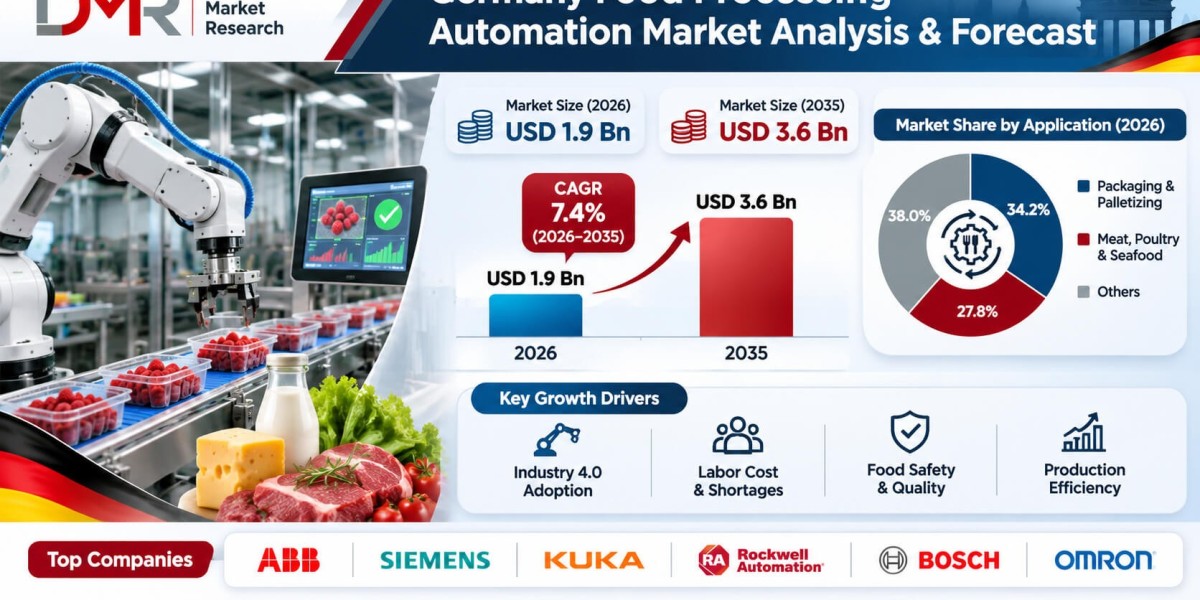
The Germany Food Processing Automation Market is witnessing strong expansion as food manufacturers increasingly adopt robotics, artificial intelligence, machine vision, and connected industrial control systems. According to Dimension Market Research, the market is projected to reach USD 1.9 billion in 2026 and grow to USD 3.6 billion by 2035, registering a compound annual growth rate (CAGR) of 7.4% during 2026-2035. Growing workforce constraints, stringent food safety requirements, and Industry 4.0 investments are encouraging manufacturers to modernize production facilities.
What Is the Current Overview of the Germany Food Processing Automation Market?
Germany's food processing automation industry is evolving through the integration of intelligent machinery, industrial software, robotics, sensors, and automated production systems. Food manufacturers are increasingly investing in technologies that improve production efficiency, product consistency, hygiene, traceability, and operational reliability.
Automation is becoming particularly important across meat, poultry, seafood, dairy, bakery, beverage, and packaged food manufacturing. Programmable Logic Controllers (PLCs), Supervisory Control and Data Acquisition (SCADA), Manufacturing Execution Systems (MES), and machine vision technologies are helping processors achieve greater production visibility and quality control.
Germany's established engineering ecosystem and advanced manufacturing infrastructure provide a strong foundation for automation adoption. Meanwhile, increasing demand for convenience foods, flexible production lines, and sustainable manufacturing is creating opportunities for automation equipment suppliers and technology developers.
Get free sample of this report (with custom data option): https://dimensionmarketresearch.com/request-sample/germany-food-processing-automation-market/
What Is the Expected Value of the Germany Food Processing Automation Market by 2035?
● The market is projected to reach USD 1.9 billion in 2026.
● Market value is forecast to reach USD 3.6 billion by 2035.
● The market is expected to expand at a 7.4% CAGR.
● Hardware is anticipated to hold a 58.4% share in 2026.
● PLCs and industrial control systems will lead with 29.6%.
● Packaging and palletizing will account for 34.2%.
● Meat, poultry, and seafood will hold a 27.8% share.
● Large enterprises will represent 65.4% of market revenue.
What Are the Latest Germany Food Processing Automation Market Research Findings?
The research identifies hardware as the leading component, supported by investments in robots, sensors, controllers, cameras, and industrial equipment. Services are expected to grow fastest at approximately 9.1% CAGR. Machine vision systems are projected to expand at 9.4%, while quality control and inspection will record approximately 9.2% growth. Fruits and vegetables are expected to register an 8.8% CAGR, and SMEs will grow at approximately 8.6%. These findings highlight increasing demand for intelligent inspection, flexible automation, equipment integration, and scalable production technologies across German food manufacturing facilities.
Why Is the Germany Food Processing Automation Market Growing?
Market growth is primarily supported by rising labor costs, skilled workforce shortages, and the need for higher manufacturing productivity. German food processors are increasingly replacing repetitive manual activities with automated packaging, robotic material handling, precision portioning, and machine vision inspection. Strict hygiene standards and traceability requirements are also encouraging investment in digital monitoring and automated quality assurance. Additionally, Industry 4.0 adoption, artificial intelligence, predictive maintenance, and resource-efficient production technologies are strengthening long-term automation demand.
What Are the Key Growth Drivers of the Germany Food Processing Automation Market?
● Increasing adoption of Industry 4.0 manufacturing technologies.
● Rising labor costs and shortages of skilled manufacturing workers.
● Growing demand for automated food safety and quality inspection.
● Expansion of robotic packaging and palletizing applications.
● Increasing investments in AI-powered manufacturing systems.
● Growing emphasis on production efficiency and waste reduction.
● Demand for improved traceability and regulatory compliance.
Which Segment Shows the Highest Growth Potential Within the Germany Food Processing Automation Market?
Machine Vision Systems
Machine vision systems are projected to be the fastest-growing automation type, registering approximately 9.4% CAGR. Food manufacturers are adopting intelligent camera systems and AI-powered inspection technologies to identify defects, detect foreign materials, verify packaging integrity, and improve product grading. These technologies support contactless inspection while maintaining production speed and consistency.
● AI-powered product inspection and defect recognition.
● Automated contamination detection and quality assurance.
● Improved food traceability and packaging verification.
Quality Control and Inspection
Quality control and inspection are expected to grow at approximately 9.2% CAGR. Automated inspection technologies help manufacturers monitor product quality throughout production while reducing dependence on manual checks. Integration of machine vision, sensors, X-ray inspection, and automated rejection systems is creating new opportunities for technology suppliers.
● Real-time food quality monitoring.
● Automated packaging and labeling verification.
● Improved hygiene and contamination prevention.
Read more about this market: https://dimensionmarketresearch.com/report/germany-food-processing-automation-market/
Germany Food Processing Automation Market Dynamics
What Are the Major Trends Shaping the Market?
Collaborative robotics, AI-powered machine vision, and connected manufacturing platforms are among the major trends transforming German food production. Manufacturers are increasingly deploying hygienic robots, automated inspection equipment, and intelligent production management systems to improve flexibility and operational performance. The convergence of operational technology and information technology is also enabling real-time monitoring of equipment performance, energy consumption, production output, and product quality. Digital twins, edge computing, predictive maintenance, and interoperable automation platforms are further supporting the transition toward smart food manufacturing facilities.
What Are the Future Growth Opportunities in the Germany Food Processing Automation Market?
Small and medium-sized food manufacturers represent an important growth opportunity as modular robots, collaborative automation, and cloud-based production software become more accessible. Flexible automation solutions can help smaller facilities automate packaging, sorting, portioning, and inspection without requiring extensive infrastructure investments. Sustainability is another important opportunity. AI-driven production optimization, smart sensors, accurate ingredient dosing, and predictive maintenance can reduce food waste, water consumption, energy usage, and equipment downtime. Suppliers offering scalable, energy-efficient, and integrated solutions are positioned to benefit from modernization investments.
What Challenges Are Affecting the Market?
High initial investment remains a major barrier, particularly for smaller food processors with limited capital resources. Automation projects involve equipment purchases, software integration, employee training, cybersecurity, and ongoing maintenance expenses. Compatibility with legacy machinery also creates implementation difficulties because older production systems may use different communication protocols and control architectures. Furthermore, food manufacturing facilities cannot easily interrupt production during modernization. Shortages of professionals with expertise in industrial automation, food processing, and digital technologies may also increase implementation costs and extend project timelines.
Who Are the Leading Companies in the Germany Food Processing Automation Market?
The competitive landscape includes industrial automation providers, robotics manufacturers, food processing equipment suppliers, and industrial software developers. Prominent companies operating in this market include:
● Siemens AG
● GEA Group AG
● KUKA AG
● Robert Bosch GmbH
● Beckhoff Automation GmbH & Co. KG
● Festo SE & Co. KG
● Krones AG
● MULTIVAC Group
● Syntegon Technology GmbH
● ABB Ltd.
● Schneider Electric SE
● Rockwell Automation Inc.
● Honeywell International Inc.
● Mitsubishi Electric Corporation
● Omron Corporation
● FANUC Corporation
● Tetra Pak International S.A.
● Bühler AG
● JBT Marel Corporation
● TOMRA Systems ASA
Competition increasingly focuses on hygienic equipment design, advanced robotics, AI capabilities, system interoperability, energy efficiency, and lifecycle support. Strategic partnerships between machinery manufacturers, software developers, and automation integrators are also influencing competitive positioning.
Future Outlook of the Germany Food Processing Automation Market
The Germany Food Processing Automation Market is positioned for continued growth through 2035 as manufacturers prioritize intelligent, flexible, and sustainable production. Robotics, machine vision, AI-enabled inspection, and connected control systems will remain important investment areas. Increasing accessibility of modular automation will also support adoption among smaller manufacturers. With market value projected to reach USD 3.6 billion by 2035, technology providers offering integrated and cost-effective solutions are likely to find expanding opportunities across Germany's food manufacturing industry.
Get 10% instant discount on report purchase:
Explore more related market research finding:
● Mexico Beverage Processing Equipment Market
● Saudi Arabia Food Processing Equipment Market
● Argentina Dairy Processing Market
● Egg Processing And Equipment Market
● Uae Food And Beverage Contract Manufacturing Market
● Singapore Food Beverage Contract Manufacturing Market
● Singapore Food Innovation Processing Technology Market