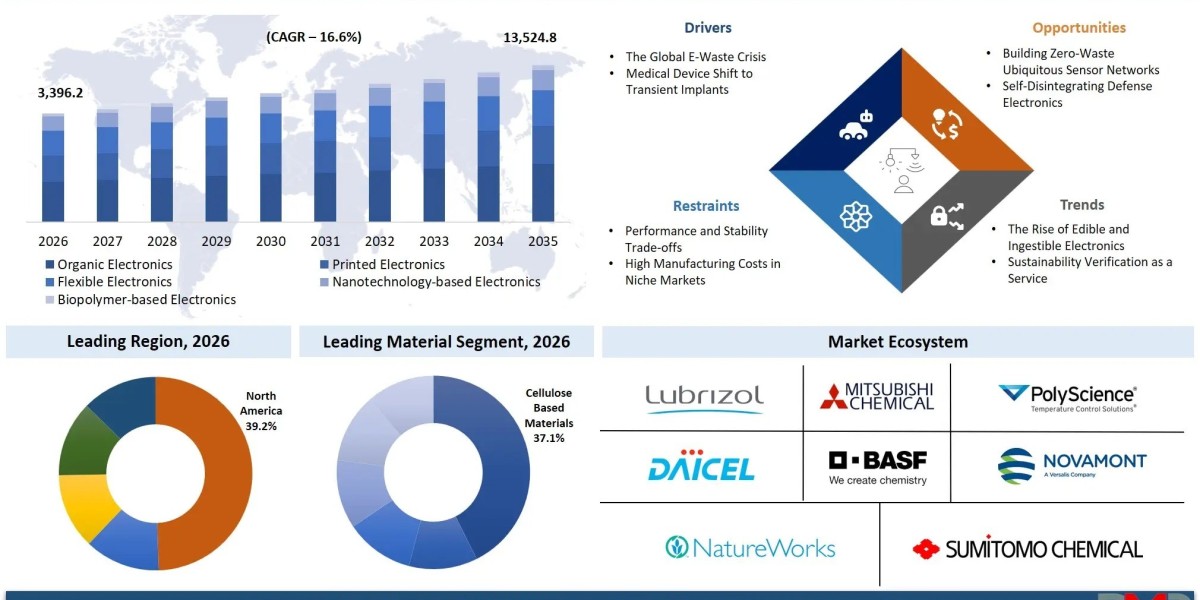

Biodegradable Electronics Market Forecast to 2035
The Biodegradable Electronics Market is gaining momentum as manufacturers, healthcare providers and research institutions seek alternatives to conventional electronic components that contribute to persistent waste. According to Dimension Market Research, the global Biodegradable Electronics Market size is expected to reach USD 3,396.2 million in 2026 and grow to USD 13,524.8 million by 2035, registering a compound annual growth rate (CAGR) of 16.6% over the forecast period.
Biodegradable electronics are designed to break down, dissolve or be absorbed under specified environmental or biological conditions. The market covers biodegradable sensors, batteries, displays, transistors and circuit boards developed using materials such as cellulose, silk proteins, polylactic acid (PLA) and polyhydroxyalkanoates (PHA). Growing interest in temporary medical implants, precision agriculture, environmental monitoring and smart packaging is creating new commercial opportunities. Advances in organic electronics, printed electronics and flexible biodegradable substrates are also helping researchers develop devices that balance functionality, safety and controlled degradation. As sustainability becomes a greater consideration in product design, biodegradable electronics are emerging as a specialized technology market with applications across healthcare, agriculture, consumer electronics and defense.
Get free sample of this report (with custom data option): https://dimensionmarketresearch.com/request-sample/biodegradable-electronics-market/
Biodegradable Electronics Market Snapshot
- 2026 global market value: USD 3,396.2 million.
- 2035 market forecast: USD 13,524.8 million.
- Forecast CAGR: 16.6% from 2026 to 2035.
- Historical market data: 2021 to 2025.
- Forecast period: 2027 to 2035.
- Leading region by share: North America, with 39.2% in 2026.
- Fastest-growing regional market: Asia-Pacific.
- Key product segment: Biodegradable sensors.
- Leading technology segment: Organic electronics.
- Prominent material category: Cellulose-based materials.
Market Research Findings
The biodegradable electronics market research report examines the industry's growth potential through product, technology, material, application, end-user and regional segmentation. Biodegradable sensors are positioned for strong demand because they support short-term data collection in healthcare and environmental monitoring. Organic electronics benefit from their flexible properties and potential for material designs that support controlled degradation. Cellulose-based materials are attracting interest because of their availability, mechanical strength and biodegradability. Healthcare devices represent an important application area, particularly for temporary physiological monitoring and bioresorbable implants. Electronics manufacturers remain central to commercialization, while healthcare providers, research institutions and agricultural organizations contribute to adoption. The report also evaluates regional performance, competitive positioning, industry restraints and emerging opportunities through 2035.
Why Is the Biodegradable Electronics Market Growing?
Growth is supported by increasing concern about electronic waste, rising demand for temporary medical devices and improvements in sustainable electronic materials. Conventional electronics can contain persistent polymers and metals that complicate end-of-life disposal. Biodegradable alternatives offer a potential solution when their materials are appropriately selected, tested and processed.
Healthcare is another important growth area. Temporary implants and bioresorbable sensors can monitor physiological conditions during recovery and may reduce the need for a second procedure to remove certain devices. In agriculture and environmental monitoring, biodegradable sensors could help collect data without requiring every deployed unit to be retrieved. Smart packaging and transient defense electronics provide additional use cases. However, successful adoption depends on electrical performance, reliable degradation behavior, manufacturing costs and appropriate safety validation.
Biodegradable Electronics Market Key Growth Drivers
- Growing concern over persistent electronic waste and disposal costs.
- Rising demand for temporary implantable medical devices.
- Advances in biodegradable polymers and organic semiconductors.
- Increasing use of sensors in precision agriculture and environmental monitoring.
- Growing interest in sustainable packaging and traceability technologies.
- Research into transient circuits and secure, temporary electronic systems.
- AI-assisted material discovery and degradation modeling.
Biodegradable Electronics Market Research Scope and Leading Segments
The research scope evaluates biodegradable electronics across product categories, enabling technologies, materials, applications, end users and geographic markets. Two particularly important areas are biodegradable sensors and organic electronics because they connect practical device requirements with advances in material science.
Biodegradable Sensors
Biodegradable sensors are an important product segment because they enable temporary monitoring where permanent electronic hardware may be unnecessary or difficult to retrieve. Healthcare applications include physiological monitoring during recovery, while environmental and agricultural applications include soil moisture, temperature, pressure and gas sensing. Their commercial potential depends on sensitivity, operating lifetime, power requirements and the ability to degrade safely after use. Manufacturers must also ensure that sensor performance remains reliable throughout the intended monitoring period. As organizations explore distributed sensor networks, biodegradable sensing devices could offer a practical option for selected short-term monitoring tasks.
- Key applications include medical monitoring, agriculture and environmental sensing.
- Important requirements include sensitivity, controlled degradation and material safety.
Organic Electronics
Organic electronics are a significant technology category because carbon-based materials and organic semiconductors can support lightweight, flexible and conformable devices. Researchers are investigating their use in transient circuits, wearable sensors, medical monitoring systems and flexible electronic substrates. Material selection is critical because biodegradability alone does not guarantee safe degradation or adequate electrical performance. Device designers must consider conductivity, stability, manufacturing compatibility and the characteristics of degradation by-products. Progress in organic materials and printed electronics could improve production flexibility and support new biodegradable product designs.
- Potential uses include flexible circuits, wearable devices and temporary medical electronics.
- Development priorities include electrical stability, scalable processing and safe degradation.
Read more about this market:https://dimensionmarketresearch.com/report/biodegradable-electronics-market/
Biodegradable Electronics Market Dynamics
Market Trends
One notable trend is the development of flexible, bioresorbable and ingestible electronic devices for specialized healthcare applications. Researchers are exploring biodegradable sensors, temporary implants and electronics that operate for a defined period before breaking down. Another trend is the use of artificial intelligence in material discovery and degradation modeling. AI-assisted simulations may help researchers screen polymer combinations, estimate degradation behavior and reduce some experimental workloads. Sustainability verification is also gaining attention as manufacturers seek evidence that their products meet defined biodegradability or compostability requirements. These developments are encouraging greater collaboration among material suppliers, device manufacturers, universities and medical research organizations.
Market Opportunities
Biodegradable electronics offer opportunities in precision agriculture, environmental monitoring, smart packaging and temporary medical technologies. Agricultural organizations could use disposable sensors to monitor soil conditions across large areas, provided that devices meet environmental safety requirements. Smart packaging companies may integrate transient sensors to track temperature exposure or product conditions throughout distribution. Healthcare manufacturers can investigate bioresorbable components for applications where temporary monitoring is appropriate. Additional opportunities exist in defense systems requiring transient hardware for specific missions. Commercial success will depend on demonstrating reliable performance, controlling production costs and validating the environmental or biological safety of the resulting materials.
Biodegradable Electronics Market: Key Competitor Companies
The competitive landscape includes material suppliers, chemical manufacturers, semiconductor companies and developers of advanced electronic technologies. Key companies identified in the report include:
- BASF SE
- NatureWorks LLC
- Mitsubishi Chemical Corporation
- Novamont S.p.A.
- Total Corbion PLA
- Daicel ChemTech
- Polysciences, Inc.
- Lubrizol Corporation
- CD Bioparticles
- Evonik Industries AG
- Merck KGaA
- Novaled GmbH
- Asahi Kasei Corporation
- AU Optronics Corporation
- Fujifilm Dimatix, Inc.
- DuPont de Nemours, Inc.
- LG Chem Ltd.
- Sumitomo Chemical Co., Ltd.
- Avery Dennison Corporation
- PragmatIC Semiconductor Ltd.
Get 10% instant discount on report purchase
Explore more reports:
- The Kingdom of Saudi Arabia (KSA) Construction Equipment Market Trends & Growth
- Electric and Hybrid Construction Equipment Market Trends & Growth
- Battery Electrolyte Chemistry Market Trends & Growth
FAQ's
1. What is the biodegradable electronics market size in 2026?
The global biodegradable electronics market is expected to reach USD 3,396.2 million in 2026, according to Dimension Market Research.
2. What is the forecast for the biodegradable electronics market by 2035?
The market is projected to reach USD 13,524.8 million by 2035, growing at a CAGR of 16.6% during 2026 to 2035.
3. What are biodegradable electronics?
Biodegradable electronics are devices designed to break down, dissolve or be absorbed under specified environmental or biological conditions.
4. What are the key growth drivers of the biodegradable electronics market?
Major drivers include electronic waste concerns, temporary medical devices, material innovation and growing demand for distributed sensor networks.
5. Which product segment is important in the biodegradable electronics market?
Biodegradable sensors are an important segment because they support temporary data collection in healthcare, agriculture and environmental monitoring.
About Us
Dimension Market Research (DMR) is a global market intelligence and consulting firm delivering data-driven insights that help organizations make informed strategic decisions. With expertise across 12+ industries and global markets, DMR provides syndicated reports, custom research, competitive analysis, white space analysis, and business strategy consulting.
Our research solutions combine analytical rigor, industry expertise, and forward-looking intelligence to identify opportunities, reduce risks, and support sustainable growth. Trusted by clients across diverse sectors, DMR is committed to delivering accurate, actionable insights that enable businesses to navigate evolving market landscapes with confidence.
Contact Us
Phone USA: +17323699777
Phone India: +919310023843
E-mail: enquiry@dimensionmarketresearch.com