
The Global Subscription Economy Market is transforming modern business operations as companies increasingly shift from traditional product ownership toward recurring payment and service-based models. Across industries such as cloud computing, entertainment, healthcare, education, retail, and financial services, subscription offerings are creating opportunities for organizations to establish continuous customer relationships while providing convenient access to products and services. This transition is being accelerated by digitalization, changing consumer preferences, and the growing importance of predictable revenue generation.
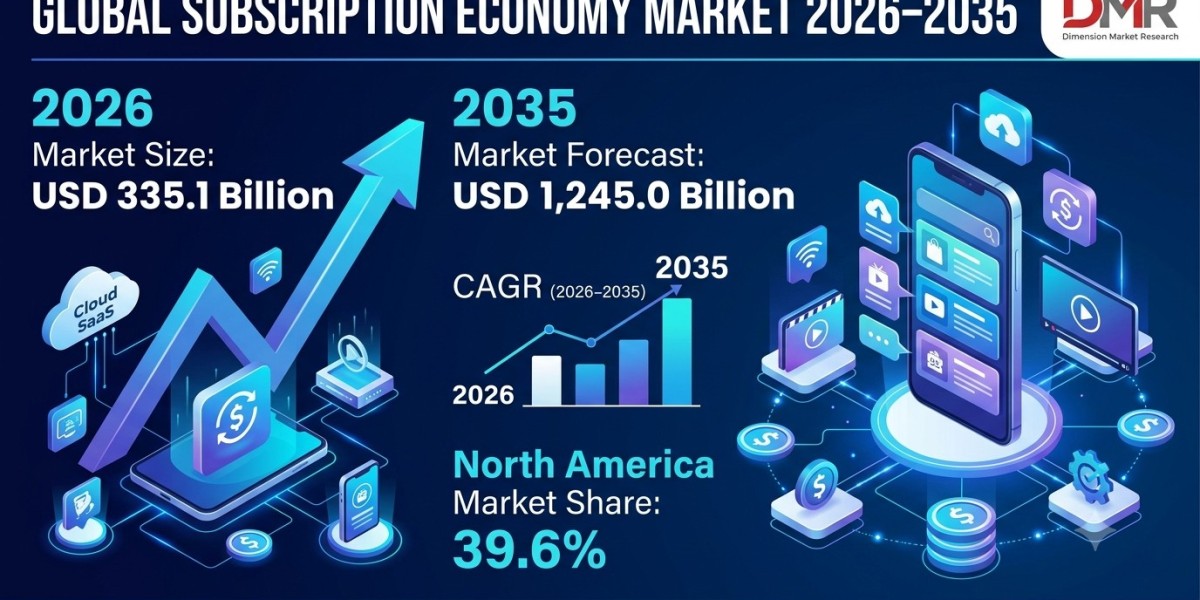
According to Dimension Market Research, the global market is projected to reach USD 335.1 billion in 2026 and expand to USD 1,245.0 billion by 2035, registering a compound annual growth rate (CAGR) of 15.7% during the forecast period. This expansion reflects the increasing adoption of digital subscription platforms, Software-as-a-Service (SaaS), membership programs, and flexible payment arrangements across developed and emerging economies.
Businesses are increasingly incorporating subscription models into their commercial strategies to enhance revenue visibility, maintain regular customer engagement, and introduce customized offerings. Meanwhile, consumers benefit from lower initial expenditure, automated service delivery, personalized recommendations, and the flexibility to modify subscriptions according to their requirements. Advancements in artificial intelligence, digital payment infrastructure, and cloud technology are further strengthening this evolving market ecosystem.
? Looking for Specific Data? Get a Free Customized Sample:
https://dimensionmarketresearch.com/request-sample/subscription-economy-market/
Subscription Economy Market Overview
The subscription economy refers to a commercial framework in which customers pay recurring fees to access products, digital platforms, professional services, or membership benefits over a defined period. Payments may occur monthly, quarterly, annually, or according to service consumption. Unlike conventional one-time transactions, subscription models prioritize ongoing service delivery, customer satisfaction, and long-term relationships.
The market encompasses digital streaming, cloud software, gaming subscriptions, online education, healthcare memberships, subscription commerce, and connected mobility solutions. Increasing demand for convenience and uninterrupted access is encouraging businesses to introduce subscription-based services across both consumer and enterprise markets.
Subscription models also support operational improvements through automated billing, integrated customer management, and real-time service analytics. Organizations can analyze customer behavior, identify changing preferences, and adjust their offerings to strengthen competitiveness.
Key Findings of the Global Subscription Economy Market
2026 market valuation: USD 335.1 billion.
2035 projected valuation: USD 1,245.0 billion.
Forecast CAGR: 15.7% from 2026 to 2035.
North America: Leading regional market with 39.6% share in 2026.
Leading subscription type: Access-based subscriptions.
Major growth catalyst: Rising SaaS and digital service adoption.
Key industry trend: AI-enabled personalization and hybrid pricing.
Subscription Economy Market Dynamics
The Subscription Economy Market is influenced by accelerating digital transformation, increasing consumer expectations, and the growing adoption of service-oriented business models. Organizations are moving beyond transactional relationships by introducing recurring access, continuous product improvements, and customizable service packages.
Digital platforms provide businesses with opportunities to monitor customer engagement and respond quickly to changes in demand. However, market participants must also manage customer acquisition expenses, subscription cancellations, data protection requirements, and intensifying competition.
Growth Drivers: Expanding Demand for Flexible Digital Services
Growing Consumer Preference for Convenience
The increasing popularity of subscription services is closely associated with changing purchasing behavior. Customers increasingly value convenient access, predictable payments, and personalized offerings rather than making repeated individual purchases.
Streaming entertainment, digital fitness, online learning, and subscription-based retail demonstrate how recurring services can simplify consumption. Companies offering seamless onboarding, flexible plans, and convenient cancellation options may improve customer satisfaction and strengthen long-term loyalty.
Increasing Adoption of SaaS and Cloud Infrastructure
Enterprise digital transformation is another important driver of subscription market expansion. Businesses are adopting SaaS platforms to access advanced applications without substantial upfront software investments.
Cloud-based subscriptions support customer relationship management, human resources, cybersecurity, enterprise resource planning, marketing automation, and financial management. Continuous software updates and scalable usage options make subscription arrangements attractive to organizations seeking operational flexibility.
Major Market Growth Drivers
Rising adoption of cloud-based enterprise applications.
Growing demand for flexible monthly payment plans.
Expansion of digital entertainment and online education.
Increasing penetration of smartphones and broadband.
Wider availability of automated subscription billing.
Greater use of analytics to improve customer retention.
Subscription Economy Market Challenges
Rising Subscription Fatigue and Customer Churn
As subscription services become more widespread, consumers face increasing pressure from multiple recurring payments. Customers may discontinue subscriptions when services appear underutilized, expensive, or insufficiently differentiated from competing alternatives.
For businesses, high cancellation rates can undermine predictable revenue and increase the cost of replacing subscribers. Maintaining customer loyalty therefore requires continuous service improvement, competitive pricing, and transparent subscription terms.
Data Privacy, Security, and Payment Complexity
Subscription companies manage recurring transactions and customer information, making cybersecurity and payment reliability essential operational considerations.
Payment failures, account security incidents, unclear billing practices, and complicated cancellation procedures can negatively affect customer trust. Organizations must invest in secure payment processing, fraud detection, transparent billing systems, and appropriate data protection measures.
Primary Market Challenges
Rising customer acquisition and retention expenses.
Increasing competition among subscription providers.
Subscription fatigue and frequent service cancellations.
Payment processing failures and revenue leakage.
Cybersecurity risks and data privacy concerns.
Emerging Trends Reshaping the Subscription Economy Market
AI-Powered Personalization and Predictive Analytics
Artificial intelligence is changing how subscription businesses interact with customers. Advanced analytics platforms evaluate purchasing patterns, service utilization, engagement levels, and customer preferences to support personalized recommendations.
Predictive tools can also identify subscribers who may be considering cancellation. Businesses can use these insights to improve onboarding, recommend more relevant service plans, and introduce targeted retention initiatives.
Hybrid and Usage-Based Subscription Models
Traditional fixed-fee subscriptions are increasingly being complemented by flexible commercial arrangements. Hybrid models combine recurring payments with usage-based charges, premium upgrades, or additional service features.
These structures allow customers to select payment arrangements reflecting their actual requirements. For businesses, flexible pricing can support customer acquisition across different spending categories while creating opportunities for incremental revenue.
Growth of Bundled Subscription Services
Companies are introducing bundled offerings that combine multiple services under one subscription. Examples include entertainment packages, integrated software suites, and memberships offering shopping benefits alongside digital content.
Bundling can improve perceived customer value while helping providers reduce cancellations and encourage the adoption of additional services.
Key Subscription Economy Market Trends
AI-driven recommendations and customer engagement.
Increasing adoption of usage-based subscription pricing.
Growing demand for bundled digital service packages.
Expansion of cross-platform subscription experiences.
Automated payment recovery and customer support.
Global Subscription Economy Market Segmentation Overview
The Global Subscription Economy Market can be examined through subscription type, delivery platform, business model, revenue model, organization size, and industry vertical. These segments highlight different commercial strategies and purchasing behaviors across the subscription ecosystem.
By Subscription Type
Access-based subscriptions represent an important market category, allowing users to continuously access software, entertainment, digital platforms, and professional services through recurring payments.
Replenishment subscriptions focus on regularly consumed products, while curation subscriptions provide personalized product selections. Membership subscriptions offer exclusive benefits, discounts, or specialized access. Hybrid subscriptions combine multiple features to provide more flexible customer experiences.
By Delivery Platform
Subscription services are delivered through mobile applications, websites, desktop platforms, connected devices, and integrated multichannel environments.
Mobile applications are particularly important because they provide convenient access to recurring services, subscription management, digital payments, and personalized customer communication.
Multichannel platforms are becoming increasingly relevant as customers expect consistent experiences across smartphones, computers, televisions, and other connected devices.
By Business Model
The business-to-consumer (B2C) segment includes subscriptions for entertainment, digital media, fitness, education, gaming, and household products.
The business-to-business (B2B) segment focuses on enterprise software, cloud computing, professional services, and specialized business applications. These subscriptions frequently involve multiple users, enterprise contracts, and customized service requirements.
Business-to-business-to-consumer (B2B2C) arrangements allow providers to distribute subscription services through commercial partnerships and established customer networks.
By Revenue Model
Fixed recurring subscriptions generate revenue through predetermined monthly or annual payments. Usage-based subscriptions charge customers according to consumption, while tiered pricing provides different service levels at varying prices.
Freemium models offer basic services without payment while encouraging customers to upgrade to premium subscriptions.
By Industry Vertical
Software and SaaS, media and entertainment, retail, telecommunications, healthcare, education, financial services, and automotive applications contribute to subscription economy development.
Software subscriptions benefit from enterprise digitalization, while entertainment platforms rely on exclusive content and personalized viewing experiences. Healthcare and mobility subscriptions are creating additional opportunities through preventive care programs, connected vehicle services, and recurring access to specialized offerings.
Competitive Landscape of the Global Subscription Economy Market
The competitive environment includes global technology companies, streaming service providers, e-commerce platforms, enterprise software developers, and subscription management specialists.
Companies are increasingly differentiating their services through personalized experiences, exclusive features, flexible pricing, and integrated digital ecosystems. Investment in automation, customer analytics, and secure payment infrastructure is becoming essential for maintaining subscription performance.
Prominent participants within the subscription economy ecosystem include Microsoft, Adobe, Salesforce, Oracle, SAP, Netflix, Spotify, Amazon, Apple, Zuora, Chargebee, Recurly, Shopify, and Stripe.
Their participation spans different parts of the subscription value chain, including direct subscription services, enterprise software delivery, digital commerce infrastructure, payment processing, and recurring billing management.
Competitive success increasingly depends on customer lifetime value, subscriber retention, service differentiation, and the ability to maintain profitable recurring revenue.
? Purchase the Report for Comprehensive Details:
https://dimensionmarketresearch.com/checkout/subscription-economy-market/
Regional Analysis of the Subscription Economy Market
North America Dominates the Global Subscription Economy Market
North America is expected to remain the leading regional market, accounting for 39.6% of global subscription economy revenue in 2026. This leadership is supported by advanced digital infrastructure, widespread internet connectivity, established digital payment systems, and high consumer acceptance of recurring service models.
The region hosts numerous technology, streaming, software, and e-commerce businesses that have successfully integrated subscriptions into their revenue strategies.
Strong demand for SaaS applications, video streaming, digital memberships, subscription commerce, and cloud-based business solutions continues to support regional development. Organizations are also investing in artificial intelligence and customer analytics to provide personalized services and strengthen subscriber engagement.
High disposable incomes, continuous technology innovation, and a mature digital ecosystem further support North America's leading position.
Asia Pacific Offers Significant Expansion Opportunities
Asia Pacific presents substantial opportunities for subscription-based businesses as digital connectivity improves and internet-enabled services become more accessible.
China, India, Japan, South Korea, and Southeast Asian economies are witnessing expanding demand for streaming platforms, digital payments, cloud applications, educational subscriptions, and mobile services.
The region's large population, expanding digital consumer base, and increasing adoption of mobile-first business models create favorable conditions for continued market development.
Europe Benefits from Enterprise Digital Transformation
Europe represents an important subscription economy market, supported by enterprise software adoption, digital entertainment consumption, and growing demand for integrated business services.
Companies are increasingly implementing recurring software licenses, cloud applications, and subscription-based customer solutions to improve flexibility and operational efficiency.
Consumer protection requirements, data privacy expectations, and transparent billing practices are also influencing how European subscription businesses structure their services.
Latin America and the Middle East & Africa Show Emerging Potential
Latin America is experiencing increasing demand for subscription-based entertainment, online education, financial technology, and cloud services as digital payment access and internet connectivity expand.
Meanwhile, the Middle East and Africa are creating new opportunities through digital transformation programs, smartphone adoption, cloud infrastructure investment, and growing demand for accessible subscription offerings.
Future Market Outlook: Subscription Economy Market Through 2035
The future of the Global Subscription Economy Market will be shaped by continuous innovation in recurring revenue strategies, digital service delivery, and customer experience management.
Subscription models are expected to expand beyond conventional software and entertainment services into connected mobility, healthcare management, smart home technology, industrial applications, and specialized professional offerings.
Artificial intelligence will play an increasingly important role in customer engagement, dynamic pricing, personalized product recommendations, and subscription management automation.
Businesses are also likely to prioritize flexible pricing structures, integrated payment technologies, and transparent subscription experiences to address changing consumer expectations.
Future Market Growth Opportunities
Expansion of subscription-based healthcare services.
Increasing adoption of connected mobility solutions.
Rising demand for specialized enterprise SaaS platforms.
Development of AI-enabled subscription management tools.
Growth of affordable subscriptions in emerging economies.
Frequently Asked Questions (FAQs)
1. What is the Global Subscription Economy Market?
The Global Subscription Economy Market includes products and services delivered through recurring payment arrangements. It covers software, entertainment, retail memberships, education, healthcare, and other subscription-based offerings across consumer and enterprise markets.
2. What is the projected size of the Subscription Economy Market by 2035?
The global market is projected to reach USD 1,245.0 billion by 2035, increasing from USD 335.1 billion in 2026, with a forecast CAGR of 15.7%.
3. Which region leads the Global Subscription Economy Market?
North America is expected to maintain the leading position with a 39.6% market share in 2026, supported by advanced technology infrastructure, widespread digital service adoption, and established recurring revenue ecosystems.
4. What factors are driving Subscription Economy Market growth?
Major growth factors include increasing SaaS adoption, expansion of digital payment systems, rising consumer demand for convenient services, personalized subscription offerings, and growing enterprise investment in cloud technologies.
5. What are the major opportunities in the subscription economy?
Promising opportunities include AI-powered subscription platforms, hybrid pricing models, enterprise software subscriptions, connected mobility services, healthcare memberships, and subscription expansion across emerging digital economies.
Summary of Key Insights
The Global Subscription Economy Market is transitioning into an increasingly important component of the digital economy, creating new opportunities for businesses to generate recurring revenue while delivering continuous customer value.
The market is projected to expand from USD 335.1 billion in 2026 to USD 1,245.0 billion by 2035, supported by technological innovation, increasing consumer preference for flexible access, and expanding adoption of subscription-based business models.
North America is expected to lead with a 39.6% share in 2026, while emerging economies offer additional opportunities through increasing digital connectivity and growing demand for affordable services.
Looking ahead, artificial intelligence, flexible pricing, cloud infrastructure, and customer-centric subscription strategies will remain central to market development. Companies that prioritize transparency, service quality, and long-term customer engagement will be better positioned to compete in the evolving global subscription economy.
Related Reports:
https://dimensionmarketresearch.com/report/japan-software-as-a-service-saas-market/
https://dimensionmarketresearch.com/report/creator-economy-market/