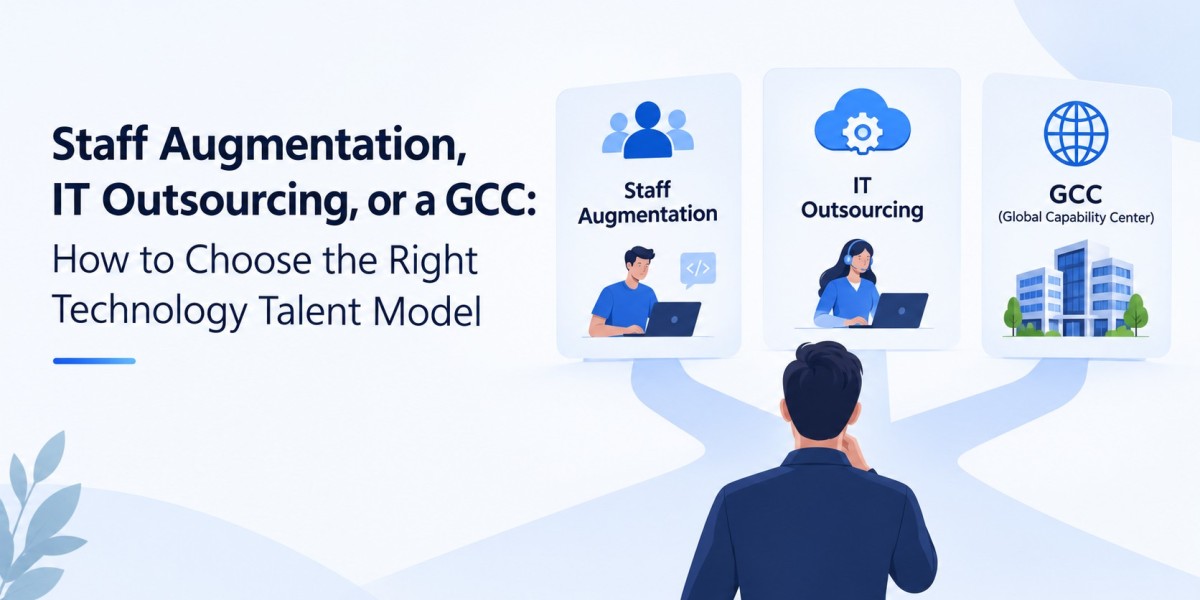

Most companies don't have a hiring problem. They have a "we hired for the wrong thing" problem.
You add five developers and releases still slip. You bring in a consultant and get a beautiful roadmap that nobody has the bandwidth to build. You open an office in Bengaluru, and six months later you're still working out who actually runs it.
None of this happens because the talent wasn't there. India has plenty of it. It happens because the business picked a team model before it was clear on the problem.
A startup racing to ship needs something very different from a SaaS company trying to grow engineering without breaking quality. And both need something different from a global enterprise planning a permanent Global Capability Center. Treat these as the same decision and you'll pay for it in cost, delays and blurred accountability.
This guide walks through how to work out what you really need, how the main workforce models compare, and how to pick a partner you won't regret six months in.
Start With the Problem, Not the Vendor List
Before you open a single "top 10" article, write down what's actually broken.
Here's a common one. A SaaS team is getting ready to launch an AI feature. They've got solid frontend and backend developers. What they don't have is anyone who has put a machine learning model into production. Hiring three more full-stack engineers won't fix that. It'll just make the team bigger.
Or take a team whose releases keep slipping. The instinct is to add people. But the real issue is often weak test coverage, fuzzy ownership, or nobody senior enough to make architecture calls. More headcount just adds more coordination.
Most gaps fall into one of five buckets:
Skills: you don't have in-house, like cloud, data engineering, security, AI or architecture.
Capacity: the right skills, just not enough people to hit the roadmap.
Leadership: no engineering manager, architect or tech lead to steer the ship. (If this is you, our guide on how to hire a CTO or VP Engineering in India is a good place to start.)
Process: thin documentation, patchy QA and unclear ownership.
Planning: no real view of how many people you'll need, when, or where to find them.
Be honest about which one hurts most. It shapes almost every decision that follows.
Short-term capacity or long-term capability?
This is the question most teams skip. Capacity means having enough hands to finish a known piece of work. Capability means building the expertise, leadership and know-how your company will lean on for years.
If you need five extra developers to get a product out the door in six months, a flexible arrangement is probably fine. If you're building a proprietary AI platform you'll be investing in for the next five years, you want people who stay, own the knowledge and grow into leaders. The cheapest option today is often the most expensive one three years from now.
The Four Team Models, in Plain Terms
Consulting firms, staffing providers, outsourcing vendors and GCC partners get lumped together all the time. They do very different jobs.
1. Technology consulting
Consultants help you make decisions: which architecture, which cloud, how to approach AI, how to restructure engineering. Think platform audits, migration roadmaps and process overhauls.
It's the right call when you know where you want to go but not how to get there. The catch? A strategy deck doesn't write code. Ask upfront whether the firm will help implement, or whether you'll need to find engineers separately.
When you're comparing the Best IT Consulting Companies, look past the logo. Ask whether they've solved problems like yours, in a tech stack like yours, and whether your team will be smarter when they leave. A smaller firm that has done your exact kind of migration three times will usually beat a big name doing it for the first time.
2. Staff augmentation
Here you add external professionals straight into your existing team without growing permanent headcount. A senior backend engineer for a tricky integration. A cloud architect for a migration. A QA lead before a big release.
Your managers keep control of priorities and day-to-day direction. That's the appeal, and also the requirement. Augmentation works best when your engineering leadership and processes are already solid and you're simply short on hands or specific skills. We've broken down the scenarios where staff augmentation actually makes sense if you want to sanity-check your situation.
Before you sign, get clear on what you're buying. Is it just the individual? Or does it include recruitment, replacements, onboarding and performance management?
3. Dedicated engineering teams
A dedicated team is a ready-made unit built around your product: developers, QA, DevOps, and often a tech lead or project manager, all working towards your goals.
It's a smart middle ground for companies that need to move faster than one-by-one hiring allows but aren't ready to set up their own entity in India. Curious how quickly that can happen? Here's a realistic look at how fast you can ramp a 15-person engineering pod in India.
It still needs clear ownership, measurable goals, shared documentation and a steady rhythm of communication. A dedicated team without direction is just an expensive group chat.
4. Global Capability Centers (GCCs)
A GCC is your own organisation in another country, set up to serve the wider business. Indian GCCs used to be mostly back-office. Today, many run core engineering, R&D, product, data, AI and cybersecurity.
The big difference from outsourcing is simple: it's yours. Your people, your IP, your culture.
That's also why GCC Setup in India is about far more than hiring. You need a leader, a location, a workforce plan, governance, local operations and a real plan to keep good people. If India is going to be a strategic base rather than a pool of project resources, this is the model to look at seriously.
How to Evaluate Staff Augmentation and Outsourcing Providers
Once you know the model, you can judge the providers. The question isn't "who's best?" It's "who's best for this?"
Look hard at how they find and vet people
A staffing partner is only as good as its ability to find people who fit your stack, your seniority bar and your way of working.
Ask how they source, how they screen, who runs the technical evaluation, and whether they have real networks or start from scratch every time. For specialist roles, ask how they test actual experience instead of just reading job titles and certifications. Someone who keeps an existing cloud setup running and someone who designs a new one from the ground up are very different hires.
When you're shortlisting Staff Augmentation Companies, check for:
Real depth in the technologies you use
The ability to find people at your required seniority
A proper technical screening process
Strong communication and experience with distributed, cross-time-zone teams
Replacement support if a hire doesn't work out
Clear fees, terms and notice periods
Room to scale up or down as plans change
If a pitch is all about how many candidates they have and says nothing about how they judge fit, push back. Our list of 12 red flags to avoid when choosing a staff augmentation company makes a useful gut check.
Know who's accountable for what
An IT Outsourcing Company usually takes on a defined service, function or project. That's handy when you'd rather hand off the work than manage every individual. Plenty of businesses outsource testing, maintenance or a contained build while keeping product decisions in-house.
The thing to nail down is responsibility. Are they supplying people, running delivery, or committing to service levels and outcomes? Each answer changes the pricing, the risk and how much you'll need to manage.
Get it in writing: deliverables, acceptance criteria, reporting, security, IP ownership, escalation and exit terms. And don't assume outsourcing hands over all the risk. Product calls, compliance and customer outcomes usually stay with you.
Compare total cost, not the rate card
Two quotes that look alike can hide very different things: seniority, management time, recruitment costs and replacement terms.
Add up the full picture:
Fees or salaries
Recruitment and onboarding
Equipment, licences and infrastructure
Your own management and coordination time
Training and knowledge transfer
Admin and compliance
The cost of turnover or missed deadlines
A cheaper engineer who needs constant supervision can end up costing more than a senior one who just gets on with it. The same logic applies to outsourcing versus a GCC. A GCC costs more upfront, but you get ownership and integration you simply can't rent. For real numbers, see our breakdowns of what it really costs to hire developers in India in 2026 and the fully loaded cost per engineer in the US vs India.
Hiring AI and Machine Learning Talent That Actually Ships
Everyone wants AI talent right now. Far fewer companies know exactly what they want it to do.
Start with the use case, not the job title. A customer-support assistant needs ML engineering, retrieval systems, application development, security and integration with your existing tools. A demand forecasting model needs data engineering, statistics, domain knowledge and ongoing monitoring. An internal workflow that uses AI may just need strong software engineers who know how to plug in existing models.
When you're hiring AI ML Specialists, test them against the real job:
Python and solid engineering habits
ML fundamentals and model evaluation
Data preparation, quality and pipelines
Deployment, monitoring and version management
Cloud platforms that suit your setup
Privacy, security and responsible AI
Turning business needs into measurable results
You probably don't need a research scientist. Most production AI work gets done by software, data and ML engineers who work well together.
Build for production, not the demo
A prototype proves something can work. Production proves it keeps working.
Picture a retailer whose forecasting prototype nails the historical data. Going live still needs reliable pipelines, monitoring, retraining, integration with planning tools and a plan for when the model gets it wrong. Hire for that part too, not just the exciting bit.
Test like the real job
CVs don't tell you much here. Ask an ML engineer to review a modelling approach or spot data leakage. Give a data engineer a pipeline problem involving schema changes. With senior people, talk through real trade-offs and incidents they've handled.
Keep it proportionate. Long unpaid take-home projects drive away good candidates and tell you less than a focused conversation. If you're scoping a search, our guide to hiring AI/ML engineers in India in 2026 covers salaries, availability and where the talent sits.
How to Compare Providers That All Claim to Be "The Best"
Every "top 10" list is a starting point, not a verdict.
Shortlist by model
Adding engineers to an existing team? Start with augmentation specialists.
Need a cross-functional unit? Look at dedicated team providers.
Need architecture or transformation guidance? Look at consulting firms that also implement.
Building a company-owned operation in India? Prioritise partners with GCC planning, leadership hiring and capability-building experience.
That way, you're comparing like with like.
Use one scorecard for everyone
Score every shortlisted provider on the same seven areas:
Technical capability: relevant skills, role-specific screening and real technical depth.
Business alignment: do they understand your product goals, industry and priorities?
Talent availability: realistic sourcing timelines and access to the profiles you need.
Delivery governance: clear ownership, reporting, escalation and performance tracking.
Commercial transparency: defined fees, replacement terms, scope and exit conditions.
Security and compliance: proper controls, confidentiality and contractual safeguards.
Scalability: can they grow or shrink with you as needs change?
Weight it to your priorities. Hiring a cybersecurity architect? Security practices and specialist depth matter most. Launching a GCC? Leadership and workforce planning move to the top.
Then ask for proof: case studies, references, sample profiles and a walkthrough of their process. A claim without evidence is still just a claim.
What good staff augmentation looks like after you sign
The Top IT Staff Augmentation Services prove themselves after the first CV lands, not before. Ask how your requirements turn into candidate profiles, how interviews are coordinated, how onboarding works and what happens if someone isn't working out. Who handles timesheets, leave, feedback and replacements?
These details feel small until they aren't. A responsive partner with a smaller bench often beats one with a huge database and nobody picking up the phone.
And be wary of universal rankings of the Best Staff Augmentation Companies. A firm that's brilliant at frontend hiring may be the wrong pick for a senior AI team or a brand-new engineering center.
GCC Setup in India: Building Something That Lasts
A GCC can make India a genuine part of how your company builds products. It's also a serious commitment, so go in with your eyes open.
Is a GCC right for you?
It tends to make sense when you expect a large, lasting tech capability and want to own the people, IP and priorities. It's harder to justify for a small, short-term team or a project with a fixed end date.
Ask yourself:
What should the India team own?
Will we keep hiring here for years?
Who leads locally, and how will they work with HQ?
Can we fund both setup and ongoing running costs?
Which work sits in India, and which stays at headquarters?
How will we give people careers worth staying for?
Starting small is perfectly fine if the business case holds up.
Look beyond recruitment
When you evaluate the Top GCC Setup Companies, check whether they understand the full journey from plan to working organisation: talent mapping, location choice, leadership hiring, workforce planning, org design and launch support. Some handle all of it directly, some coordinate through partners and some only recruit. Ask exactly which is which.
One pattern we see again and again: companies want to start with ten engineers. Usually, it's smarter to hire a site leader first, someone who shapes the hiring plan, the culture and the relationship with HQ. We explain why in your first India hire should be a site leader, not 10 engineers.
Choose the city for the talent you need
Bengaluru, Hyderabad, Pune, Chennai and Delhi NCR all have strong tech ecosystems. Don't choose on reputation alone. Check the availability of your exact profiles, competition for them, salary levels and access to senior leaders. A high-volume software hiring plan and a specialist AI lab might point you to different cities.
Then plan in phases: first hires, next waves, expected attrition, how many managers you'll need and which skills you'll need later. Retention deserves real attention from day one, and what the attrition data says actually works is worth a read before you build your people plan.
What a Good Talent Partner Brings to the Table
A Tech Talent Company worth working with connects hiring to your engineering strategy. It understands the roles, the market and the way your team actually operates.
Think about a startup that first needs an engineering leader and a handful of developers, then cloud specialists, data engineers, security expertise and more managers as it grows. A partner who sees that whole arc helps you hire deliberately instead of reactively.
Hire for how your team really works
Skill is only part of the story. People need to fit your process, explain their decisions and collaborate across functions and time zones. For leaders, look at judgement, mentoring and how they handle trade-offs. For individual contributors, look at problem-solving, code quality and testing habits. For teams, check that the combined skills cover the whole delivery, not just each person on paper.
Agree on what success looks like
Set your metrics before you start: time to fill, time to productivity, retention, delivery predictability, quality and stakeholder satisfaction.
Don't judge a recruiter by the number of CVs they send, or an engineering team by lines of code. Activity isn't value. Pick a balanced set of measures and review them regularly with your partner.
An 8-Step Framework for Choosing Your Technology Partner
Define the outcome. What problem are you solving, what results do you expect, and by when?
Pick the model. Consulting, individual specialists, a dedicated team, outsourcing or a GCC?
Write down the requirements. Skills, seniority, leadership, security needs and working arrangements.
Build a relevant shortlist. Compare specialists in your chosen model, not broad industry rankings.
Check the evidence. Candidate profiles, references, case studies, processes and contract terms.
Compare total cost. Recruitment, onboarding, management, infrastructure and long-term running costs.
Agree on governance. Responsibilities, metrics, communication rhythm, escalation and exit terms.
Review and adjust. Check results regularly and change course as your needs evolve.
Use this to separate the Top IT Staff Augmentation Companies that can prove what they do from those selling generic promises. As a bonus, it makes your final decision far easier to defend to procurement, finance and your leadership team.
Where SquadXP Fits In
SquadXP is a talent and team-building partner focused on India. We help companies grow through three routes:
GCC ramp-up for businesses building a long-term capability center in India.
Dedicated teams for companies that need a coordinated engineering unit built around their product.
Specialist hiring for leadership and business-critical roles you can't afford to get wrong.
Just need a couple of senior engineers? Specialist hiring is the place to start. Need a team that ships together? Look at dedicated teams. Planning a permanent base in India? GCC ramp-up is built for that.
Whichever route you're considering, hold us to the same scorecard you'd use for anyone else: technical fit, hiring process, leadership capability, commercial terms and the level of support you need. The right partner is the one that fits your engagement, not the one with the loudest claim.
The quickest way to start is to share your hiring priorities, expected team size, critical roles and preferred model. Talk to our team, or ask us to send you five relevant profiles, free.
Conclusion
Choosing a technology partner is really a decision about how your company will build, access and keep the capabilities it needs to grow.
Consulting sharpens your decisions. Staff augmentation fills specific gaps. Dedicated teams add coordinated capacity. Outsourcing hands off defined work. And a GCC builds something you own for the long run.
The right choice depends on your goal, the skills you need, how much control you want and how far ahead you're planning. Don't pick a partner on rankings, price or bench size alone. Look at expertise, hiring quality, accountability, transparency and whether they can grow with you.
In the end, the goal was never just to hire more people. It's to build a team that solves real problems, holds on to what it learns, delivers consistently and grows alongside your business.