
Middle East Sewage & Wastewater Pump Market Overview
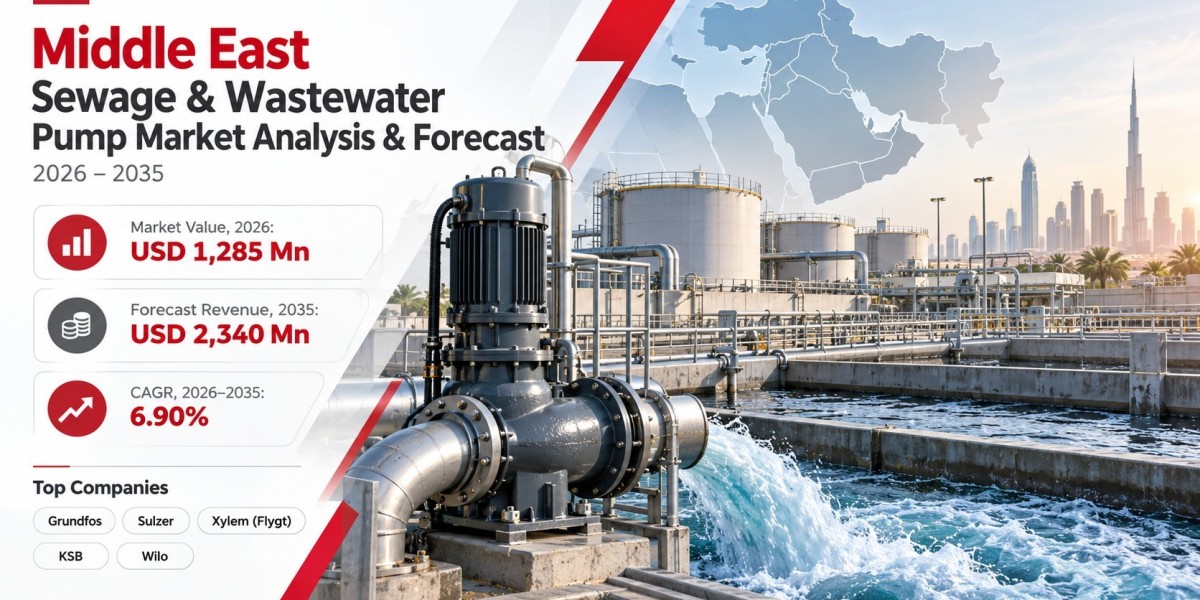
The Middle East Sewage & Wastewater Pump Market is valued at USD 1,285 million in 2026 and is projected to reach USD 2,340 million by 2035, expanding at a compound annual growth rate (CAGR) of 6.9% from 2026 to 2035, according to Dimension Market Research. The market includes pumps used in municipal sewage collection, wastewater treatment, sludge handling, drainage systems, industrial effluent management, and treated wastewater transfer. Increasing investments in water infrastructure, urban development, wastewater reuse, and sewer network modernization are supporting demand across the region.
As governments and utilities prioritize reliable wastewater services, pump buyers are increasingly evaluating energy efficiency, solids-handling performance, corrosion resistance, maintenance requirements, and lifecycle costs. Saudi Arabia, the United Arab Emirates, and Kuwait represent important national markets, supported by municipal infrastructure upgrades and treatment capacity expansion. At the same time, digital monitoring, variable frequency drives, and non-clog hydraulic designs are creating opportunities for manufacturers to improve operating efficiency and equipment reliability.
Get insight you need (request free sample)
Middle East Sewage & Wastewater Pump Market Snapshot
● The market is valued at USD 1,285 million in 2026.
● Market revenue is projected to reach USD 2,340 million by 2035.
● The market is forecast to expand at a 6.9% CAGR from 2026 to 2035.
● Centrifugal sewage pumps account for a 42.5% share in 2026.
● Wastewater treatment leads applications with a 34.0% share in 2026.
● Municipal water utilities hold a 48.0% share in 2026.
● Saudi Arabia is projected to reach USD 655 million by 2035.
● The UAE market is expected to reach USD 527 million by 2035.
● Kuwait is forecast to reach USD 198 million by 2035.
Market Research Findings
The market assessment identifies municipal water utilities as the largest end-user segment, holding 48.0% of the market in 2026. Centrifugal sewage pumps lead by pump type with a 42.5% share, while wastewater treatment represents the largest application at 34.0%. These positions reflect the importance of reliable pumping equipment throughout sewage collection networks, treatment facilities, sludge circulation, and effluent transfer operations. The report examines demand across pump types, configurations, impeller designs, drive technologies, materials, applications, and end-user industries. It also evaluates country-level opportunities, competitive positioning, technology developments, infrastructure investments, and purchasing considerations affecting manufacturers and buyers.
Why Is the Middle East Sewage & Wastewater Pump Market Growing?
Water scarcity, population growth, expanding cities, and rising wastewater treatment requirements are increasing the need for dependable pumping infrastructure. Municipal utilities require pumps to transport sewage, maintain treatment operations, and distribute treated water for appropriate reuse applications. Industrial facilities also need specialized pumping equipment to handle wastewater containing suspended solids, chemicals, oils, and abrasive materials. Meanwhile, infrastructure modernization is creating demand for replacement equipment and upgrades that reduce energy consumption and unplanned maintenance. These requirements are strengthening opportunities for suppliers offering efficient pumps, digital controls, installation support, and aftermarket services.
Key Growth Drivers in the Middle East Sewage & Wastewater Pump Market
● Expansion of municipal sewer networks and wastewater treatment plants.
● Increasing investment in treated wastewater reuse and water conservation.
● Urban development requiring additional sewage collection capacity.
● Modernization of aging pumping stations and drainage infrastructure.
● Industrial demand for dependable wastewater and sludge handling.
● Growing interest in energy-efficient motors and variable-speed operation.
● Digital monitoring supporting preventive maintenance and reliability.
Market Research Scope and Leading Segments
The report evaluates the Middle East sewage and wastewater pump industry across equipment categories, operating applications, customer groups, and national markets. Three leading segments provide a useful starting point for understanding current demand and investment priorities.
1. Pump Type: Centrifugal Sewage Pumps
Centrifugal sewage pumps lead the pump type segment with a 42.5% share in 2026. Their widespread use across municipal collection networks, wastewater treatment plants, drainage installations, and pumping stations supports their market position. Different configurations allow operators to address varying flow rates, installation requirements, and wastewater characteristics. Non-clog impellers, efficient motors, and improved solids passage are important design considerations, particularly in facilities handling fibrous waste and suspended solids.
● Relevant categories include submersible, dry-well, and self-priming pumps.
● Purchasing priorities include hydraulic performance, reliability, and maintenance costs.
2. Application: Wastewater Treatment
Wastewater treatment accounts for 34.0% of the market in 2026. Treatment facilities require pumps for raw sewage intake, sludge transfer, process circulation, treated effluent movement, and final discharge. New plant construction and capacity expansion create demand for multiple pump configurations within individual projects. Wastewater reuse initiatives can further increase requirements for treated-water transfer and distribution. Suppliers that provide reliable equipment, controls, commissioning, and maintenance services can address both new installations and modernization projects.
● Key applications include sewage intake, sludge handling, and treated effluent transfer.
● Performance requirements include solids handling, corrosion resistance, and energy efficiency.
3. End User: Municipal Water Utilities
Municipal water utilities represent 48.0% of the market in 2026. These organizations manage sewage collection systems, lift stations, treatment plants, and drainage assets requiring continuous and dependable operation. Their installed equipment base also generates recurring demand for replacement pumps, motors, impellers, seals, spare parts, and maintenance services. Infrastructure projects and long-term wastewater service arrangements create opportunities for manufacturers that can demonstrate operating reliability, technical compliance, and local service availability.
● Demand spans municipal networks, pumping stations, and treatment facilities.
● Aftermarket support can strengthen long-term supplier relationships.
Market Dynamics: Trends, Opportunities, and Challenges
Market Trends: Energy Efficiency and Smart Pumping
Energy-efficient pumps, variable frequency drives, and digital monitoring are influencing equipment selection. Sensors can monitor vibration, temperature, power consumption, and operating conditions, helping maintenance teams identify potential failures earlier. Variable-speed operation can also match pumping output to changing inflows. These technologies may reduce unnecessary electricity use and maintenance interruptions when properly designed and implemented. Suppliers combining efficient hydraulics with controls and service support are positioned to address utilities seeking better lifecycle performance.
Market Opportunities: Infrastructure Expansion and Modernization
Large sewerage programs, wastewater treatment investments, and pumping station upgrades create opportunities across new equipment installations and retrofits. Saudi Arabia's expanding sewage treatment infrastructure and the UAE's sewerage modernization initiatives support demand for high-capacity pumps, transfer systems, automation, and monitoring solutions. Existing facilities also offer opportunities for replacing inefficient equipment without rebuilding entire systems. Manufacturers can strengthen their position through engineering partnerships, regional service networks, spare-parts availability, and integrated project support.
Read more about this market: https://dimensionmarketresearch.com/report/middle-east-sewage-wastewater-pump-market/
Market Challenges: Maintenance Costs and Procurement Complexity
Wastewater pumps frequently handle abrasive particles, fibrous materials, sludge, and chemically aggressive fluids, increasing the risk of blockage, corrosion, and component wear. Maintaining reliable operations requires trained personnel, replacement parts, backup equipment, and regular servicing. Large municipal projects also involve lengthy technical reviews, vendor approvals, and procurement procedures. These factors can delay purchasing decisions and increase competition. Manufacturers must demonstrate performance, lifecycle value, compliance, and dependable support to meet customer requirements.
Regional and Country Outlook
Country-level forecasts indicate continued growth across the three markets with supplied financial estimates. Saudi Arabia benefits from municipal wastewater infrastructure investment, treatment capacity additions, and water reuse priorities. The UAE market is supported by urban development, sewerage modernization, and drainage requirements. Kuwait presents opportunities associated with municipal sewage collection, treatment infrastructure, pumping station upgrades, and equipment replacement.
● Saudi Arabia: USD 360 million in 2026, projected to reach USD 655 million by 2035, at a 6.9% CAGR.
● United Arab Emirates: USD 289 million in 2026, projected to reach USD 527 million by 2035, at a 6.9% CAGR.
● Kuwait: USD 109 million in 2026, projected to reach USD 198 million by 2035, at a 6.9% CAGR.
Middle East Sewage & Wastewater Pump Market: Key Competitor Companies
The competitive landscape includes established international pump manufacturers and specialist wastewater equipment suppliers competing on efficiency, reliability, hydraulic design, digital capabilities, and aftermarket support.
● Grundfos
● Sulzer
● Xylem (Flygt)
● KSB
● Wilo
● Ebara
● Tsurumi
● Gorman-Rupp
● Flowserve
● ITT Inc. (Goulds)
● Torishima
● HOMA Pumpen
● Zenit
● Caprari
● Faggiolati Pumps
● Hidrostal
● Jung Pumpen
● Vogelsang Wastewater Technology
Get 10% instant discount on report purchase
Report Also Covers: Frequently Asked Questions
1. What is the Middle East Sewage & Wastewater Pump Market size in 2026?
The market is valued at USD 1,285 million in 2026, according to Dimension Market Research.
2. What is the forecast market value by 2035?
The market is projected to reach USD 2,340 million by 2035.
3. What is the expected market CAGR from 2026 to 2035?
The market is expected to grow at a CAGR of 6.9% during the forecast period.
4. Which pump type leads the Middle East market?
Centrifugal sewage pumps lead the pump type segment with a 42.5% share in 2026.
5. Which application holds the largest market share?
Wastewater treatment leads the application segment with a 34.0% share in 2026.
6. Which end-user segment dominates the market?
Municipal water utilities hold the largest end-user share at 48.0% in 2026.
7. What is the Saudi Arabia wastewater pump market forecast?
Saudi Arabia is projected to grow from USD 360 million in 2026 to USD 655 million by 2035.
8. What is the UAE sewage and wastewater pump market forecast?
The UAE market is projected to increase from USD 289 million in 2026 to USD 527 million by 2035.
9. Which companies compete in the Middle East wastewater pump market?
Leading companies include Grundfos, Sulzer, Xylem (Flygt), KSB, Wilo, Ebara, and Tsurumi.
10. What factors are creating new market opportunities?
Wastewater treatment investments, infrastructure modernization, water reuse, energy efficiency, and smart pumping technologies support opportunities.