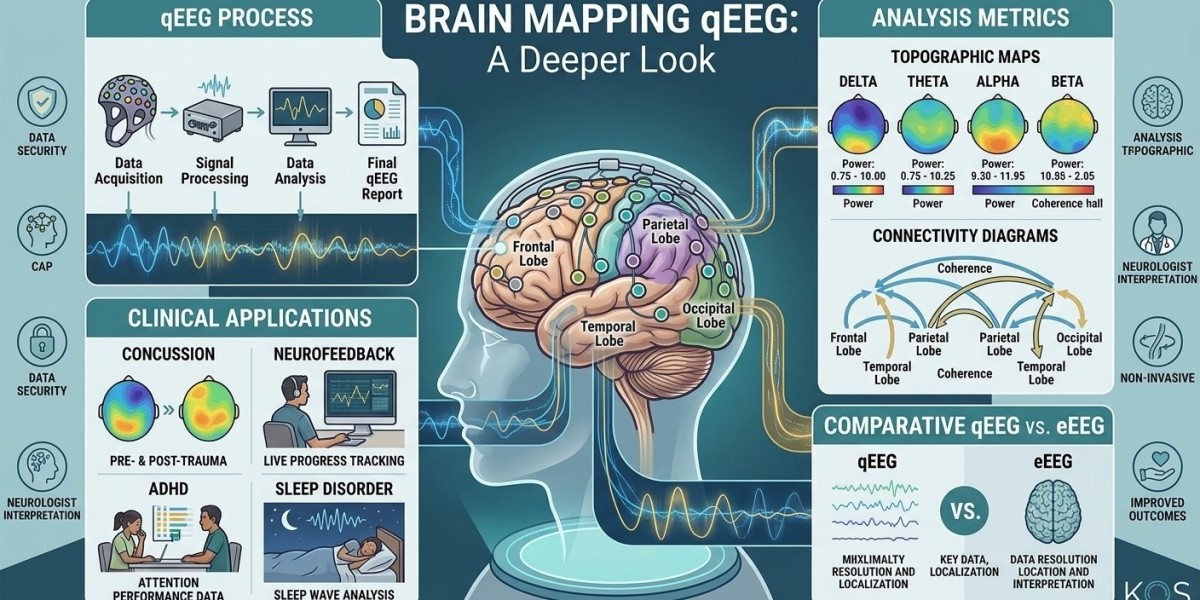

Understanding brain function can provide useful information when exploring concerns related to attention, coordination, and neurological health. Brain mapping and quantitative electroencephalography (qEEG) are terms often used when discussing ways to record and analyze electrical activity in the brain.
For individuals interested in learning more about their brain activity, understanding how brain mapping qEEG works can help them ask informed questions and explore suitable assessment options. These techniques have specific purposes and limitations, so professional interpretation is important.
What Is Brain Mapping qEEG?
Quantitative electroencephalography, commonly known as qEEG, is a method of analyzing electrical activity recorded through an electroencephalogram (EEG). During an EEG recording, sensors placed on the scalp detect electrical signals produced by brain activity.
The recorded information can be processed using specialized software to identify and display patterns in the data. This analysis is often referred to as brain mapping.
Brain mapping qEEG does not directly show the brain's structure like an MRI scan. Instead, it analyzes electrical activity recorded from the scalp. The findings need to be interpreted alongside relevant symptoms, medical history, and other clinical information.
How Does a qEEG Brain Mapping Assessment Work?
A qEEG assessment generally begins with an EEG recording. Sensors are positioned on the scalp to measure electrical signals without surgery or implanted devices.
The process may include the following steps:
Initial consultation: The provider discusses the person's concerns, background, and reason for considering an assessment.
EEG recording: Sensors record electrical activity from the scalp.
Data processing: Specialized software organizes and analyzes the recorded signals.
Professional interpretation: A qualified professional reviews the results in the context of the assessment's purpose.
Discussion of findings: The provider explains what the results may indicate and whether further evaluation is appropriate.
The exact process varies depending on the provider and the purpose of the assessment.
Why Do People Explore Brain Mapping qEEG?
People may explore qEEG when they want additional information about brain activity or are considering certain brain health services.
Reasons for seeking an assessment may include questions about attention, brain function, or the potential role of neurofeedback in a broader care plan.
However, the usefulness of qEEG depends on the clinical question being asked. It is not suitable for every concern, and it cannot independently diagnose all neurological or mental health conditions.
Before scheduling an assessment, individuals should ask the provider what the test is intended to evaluate and how the results will be used.
Brain Mapping qEEG and Neurofeedback
Brain mapping qEEG and neurofeedback are related in some settings, but they are different processes.
Brain mapping qEEG analyzes recorded electrical brain activity. Neurofeedback, by comparison, is a training approach that provides feedback about brain activity in real time, often through visual or audio signals.
Some providers may use assessment findings when planning a neurofeedback program. However, qEEG results do not automatically mean that neurofeedback is necessary or that it will produce a particular outcome.
Individuals should ask about the rationale for any recommended program, the available evidence, and how progress will be evaluated.
What Information Can Brain Mapping Provide?
A qEEG report can describe patterns in recorded electrical brain activity. Depending on the recording and analysis method, the results may include information about different frequency ranges and the distribution of activity across recording locations.
These patterns require careful interpretation. Factors such as movement, drowsiness, recording quality, medications, and the methods used for analysis can affect the results.
Brain mapping should therefore be treated as one potential source of information rather than a complete picture of a person's brain health. A qualified professional can explain the significance and limitations of the findings.
Who May Consider a Brain Mapping Assessment?
A person may consider discussing brain mapping with a healthcare professional when they have questions about brain activity or are exploring a specific assessment option.
Whether qEEG is appropriate depends on the individual's concerns, medical history, and the reason for testing.
Before proceeding, consider discussing:
Current symptoms or concerns
Previous injuries and relevant medical history
Existing diagnoses and treatments
The specific purpose of the assessment
Other tests or evaluations that may be more suitable
How the results could affect next steps
A professional assessment can help determine whether qEEG is relevant to the person's needs.
What to Expect During a Brain Mapping Appointment
An appointment typically involves placing sensors on the scalp and recording electrical brain activity. The procedure is non-invasive, although preparing for the recording may take some time.
The provider should explain the process and any preparation instructions before the session. Depending on the assessment, questions about sleep, medications, or other factors may be relevant.
After the recording, the data may be processed and interpreted. Individuals should ask when the results will be available, who will review them, and whether a follow-up discussion is included.
Understanding the report is important because the results may need to be considered alongside other clinical information.
Choosing a Brain Mapping qEEG Provider
When comparing providers, look beyond convenience and consider the quality of the assessment process.
Professional qualifications: Ask about the provider's experience with EEG recording, qEEG analysis, and interpretation.
Clear explanations: The provider should explain what the assessment measures and what it cannot establish.
Individualized recommendations: Services should be selected based on the person's needs and assessment goals.
Transparent costs: Confirm what the fee includes and whether interpretation or follow-up appointments cost extra.
Responsible care: Ask whether additional medical evaluation may be necessary and how the findings will be incorporated into a broader care plan.
These considerations can help individuals make more informed choices.
Brain Mapping qEEG Services at KOS Integrative Health
KOS Integrative Health in Honolulu offers brain health services that include brain mapping and qEEG-related services, neurofeedback, and neuro-motor rehabilitation.
These services have different purposes. Brain mapping involves analyzing recorded brain activity, neurofeedback uses feedback-based training, and neuro-motor rehabilitation focuses on movement and coordination.
Individuals interested in these options can discuss their goals with the clinic and ask which services may be appropriate for their circumstances.
Questions to Ask Before Scheduling qEEG
Before booking a brain mapping assessment, it can be useful to prepare a few questions:
What is the purpose of the assessment in my situation?
Who will interpret the results?
What are the limitations of qEEG?
Will I need other medical evaluations?
How will the findings influence my next steps?
What is included in the total cost?
A provider who answers these questions clearly can help set realistic expectations and support informed decision-making.
Final Thoughts on Brain Mapping qEEG
Brain mapping qEEG provides a way to analyze electrical activity recorded from the scalp. It may offer useful information in certain assessment settings, but the findings need careful interpretation and should not be treated as a stand-alone diagnosis.
Learning about the process, choosing a qualified provider, and understanding the limitations of the assessment can help individuals decide whether qEEG is appropriate for their needs. For those exploring brain health services in Honolulu, KOS Integrative Health is one option to investigate when researching brain mapping and related services. Read more blogs