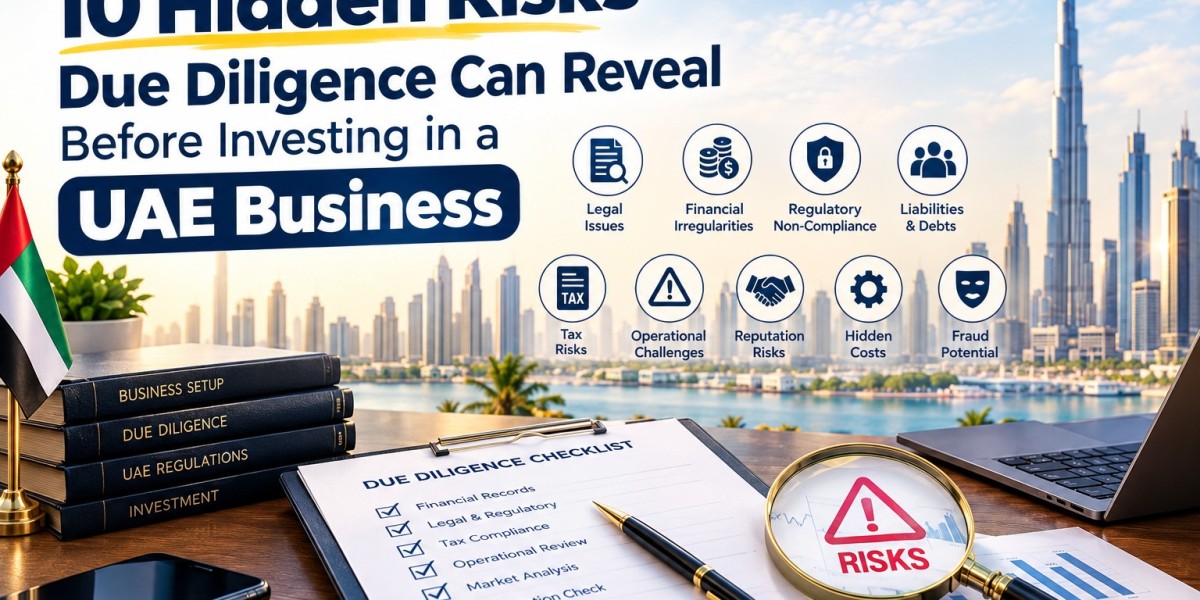

Introduction
Investing in an established UAE business can provide access to an existing customer base, operating infrastructure, employees, suppliers, and revenue streams. However, the information presented to an investor may not always reveal the full financial and operational picture.
A business can appear profitable while carrying undisclosed liabilities, contractual restrictions, compliance issues, customer concentration risks, or operational weaknesses. These issues may not become apparent until after the investment has been completed.
This is why business due diligence UAE investors conduct before committing capital is an important part of the investment process. A structured due diligence review examines the business from multiple perspectives and helps identify risks that may otherwise remain hidden.
Below are ten important risks that due diligence can help investors identify before investing in a UAE business.
What Is Business Due Diligence?
Business due diligence is the process of investigating and evaluating a company before an investment, acquisition, merger, partnership, or other significant transaction.
The scope can include:
- Financial performance
- Commercial position
- Legal structure
- Tax matters
- Regulatory compliance
- Operations
- Customers
- Suppliers
- Employees
- Contracts
- Assets and liabilities
The purpose is to provide investors with reliable information about the company and highlight areas that require further investigation.
1. Hidden Financial Liabilities
One of the most important risks due diligence can reveal is undisclosed or poorly understood financial obligations.
A company may have:
- Outstanding loans
- Supplier debts
- Unpaid expenses
- Lease obligations
- Employee-related liabilities
- Tax exposures
- Contingent liabilities
A review of financial statements, bank records, contracts, and supporting documentation can help investors understand the company's actual obligations.
This information can be particularly important when assessing the company's financial health and determining the potential economic value of an investment.
2. Overstated or Unsustainable Revenue
Reported revenue does not necessarily indicate sustainable business performance.
Due diligence can examine the source and quality of revenue by reviewing:
- Customer contracts
- Sales records
- Recurring revenue
- Customer concentration
- Revenue trends
- Payment history
- One-time transactions
An investor may discover that a significant portion of reported revenue comes from temporary contracts, unusual transactions, or a small number of customers.
Understanding the underlying quality of revenue helps investors assess the sustainability of the business model.
3. Poor Cash Flow Management
A company can report profits while still experiencing cash flow difficulties.
Cash flow problems may result from:
- Slow customer payments
- High operating expenses
- Excessive inventory
- Large working capital requirements
- Significant debt obligations
Financial due diligence can examine historical cash flows, receivables, payables, and working capital requirements.
This helps investors understand whether the business is generating sufficient cash to support its ongoing operations.
4. Customer Concentration Risk
A business that relies heavily on a small number of customers may face significant commercial risk.
For example, losing one major customer could have a substantial impact on revenue.
Due diligence can examine:
- Top customers
- Percentage of revenue by customer
- Contract duration
- Renewal rates
- Customer retention
- Payment history
Understanding customer concentration provides investors with a clearer view of the stability of the company's revenue base.
5. Unfavorable Contracts and Commercial Commitments
Contracts can create obligations that are not immediately visible from financial statements.
Due diligence may identify:
- Long-term supplier commitments
- Difficult termination clauses
- Automatic renewal provisions
- Change-of-control restrictions
- Minimum purchase obligations
- Pricing commitments
- Exclusivity arrangements
Some contracts may require approval or consent if ownership changes.
Reviewing important commercial agreements before investing helps investors understand the commitments associated with the business.
6. Legal and Regulatory Issues
Legal and regulatory problems can create significant uncertainty for an investor.
Due diligence can involve reviewing:
- Corporate documentation
- Trade licences
- Ownership records
- Material contracts
- Litigation
- Regulatory approvals
- Compliance records
A business may have unresolved disputes or regulatory matters that could affect its operations or financial position.
Identifying these issues before an investment gives investors an opportunity to investigate them further.
7. Tax and Compliance Risks
Tax-related issues can also become an important part of business due diligence.
Depending on the company's activities and circumstances, investors may need to examine relevant:
- VAT records
- Corporate tax matters
- Tax filings
- Tax payments
- Supporting documentation
- Compliance correspondence
Unresolved tax matters may create financial exposure or additional compliance obligations.
A detailed review can help investors understand the company's current tax position before completing a transaction.
8. Weak Internal Controls
Internal controls help businesses prevent errors, protect assets, maintain accurate records, and reduce the risk of unauthorized activity.
Weak controls may include:
- Poor approval procedures
- Inadequate segregation of duties
- Limited financial oversight
- Weak access controls
- Poor documentation
- Inconsistent reconciliation procedures
Due diligence can identify weaknesses in financial and operational processes that may require attention after the investment.
9. Operational Dependency on Key Individuals
Some businesses depend heavily on one founder, manager, employee, or specialist.
If a key individual leaves after the investment, the company could experience disruption.
Due diligence can examine:
- Management structure
- Employee responsibilities
- Key-person dependency
- Employment contracts
- Succession planning
- Critical operational knowledge
This can help investors understand whether important business functions are dependent on individuals rather than established systems and processes.
10. Unrealistic Growth Projections
Business plans and financial forecasts often play an important role in investment decisions.
However, projected growth should be supported by reasonable assumptions.
Due diligence can examine whether forecasts are consistent with:
- Historical performance
- Market conditions
- Customer demand
- Pricing
- Sales capacity
- Competition
- Operating resources
If projected growth depends on assumptions that are difficult to support, investors may need to investigate the underlying business plan more carefully.
Why Hidden Risks Matter to Investors
The purpose of due diligence is not simply to identify negative information.
Instead, it provides investors with a clearer understanding of the company before they commit capital.
A comprehensive review can help investors:
- Verify important information
- Identify potential liabilities
- Understand commercial risks
- Evaluate financial performance
- Examine operational weaknesses
- Assess compliance matters
- Understand customer and supplier relationships
- Review business projections
This information can then be considered alongside the investment's potential opportunities.
Financial Due Diligence vs Commercial Due Diligence
Different types of due diligence focus on different risk areas.
| Type of Due Diligence | Key Areas Reviewed |
|---|---|
| Financial Due Diligence | Revenue, expenses, cash flow, assets, liabilities, working capital |
| Commercial Due Diligence | Customers, competitors, market conditions, pricing, products, growth |
| Legal Due Diligence | Contracts, ownership, disputes, legal obligations |
| Tax Due Diligence | Tax registrations, filings, payments, potential exposures |
| Operational Due Diligence | Processes, employees, systems, suppliers |
| Regulatory Due Diligence | Licences, approvals, regulatory requirements, compliance |
For significant investments, several areas may need to be reviewed together.
Common Red Flags Investors Should Investigate
Certain findings should prompt additional questions.
Unexplained Financial Changes
Large changes in revenue, expenses, or profitability without a clear explanation may require further analysis.
Large Amounts of Overdue Receivables
Significant overdue customer balances can affect cash flow and the quality of reported revenue.
High Customer Concentration
Heavy reliance on a few customers may increase commercial risk.
Incomplete Documentation
Missing financial, legal, or commercial records can make it difficult to verify important information.
Related-Party Transactions
Transactions involving shareholders, directors, or related businesses may require additional review to understand their commercial terms and financial impact.
Regulatory or Legal Disputes
Unresolved disputes can create potential costs and operational uncertainty.
How Due Diligence Supports Investment Decisions
Due diligence does not eliminate investment risk. Instead, it helps investors understand and evaluate the risks associated with a particular business.
The findings may influence areas such as:
- Investment structure
- Transaction terms
- Purchase price negotiations
- Contractual protections
- Post-investment planning
- Integration requirements
Investors can use the findings to ask more informed questions and determine which issues require additional professional advice.
When Should Investors Conduct Due Diligence?
Due diligence is particularly relevant before:
- Acquiring a company
- Purchasing shares
- Making a significant business investment
- Entering a joint venture
- Merging businesses
- Entering a strategic partnership
- Expanding into a new market
The scope should reflect the size, complexity, industry, and structure of the proposed transaction.
How Professional Due Diligence Services Can Help
Business due diligence can involve reviewing large volumes of financial, legal, commercial, and operational information.
Professional advisers can provide a structured approach to this process.
Depending on the engagement, they may assist with:
- Financial analysis
- Commercial assessment
- Risk identification
- Document review
- Compliance assessment
- Liability analysis
- Customer and supplier review
- Business model assessment
- Management discussions
- Due diligence reporting
Professional support can help investors organize findings and identify areas requiring additional investigation.
Frequently Asked Questions
What is business due diligence in the UAE?
Business due diligence is a structured review of a company's financial, commercial, legal, operational, tax, and regulatory position before an investment or acquisition.
What risks can due diligence uncover?
Due diligence can help identify financial liabilities, revenue quality issues, customer concentration, legal disputes, tax exposures, contractual obligations, operational weaknesses, and unrealistic business projections.
Is due diligence necessary before investing in a UAE business?
The appropriate level of due diligence depends on the transaction, but reviewing material financial, commercial, legal, and operational risks can provide valuable information before committing capital.
What is the difference between financial and commercial due diligence?
Financial due diligence focuses on financial records and performance, while commercial due diligence examines the market, customers, competitors, products, pricing, and growth potential of the business.
Can due diligence uncover hidden liabilities?
A structured review can help identify liabilities and obligations that may not be obvious from headline financial information. The extent of the findings depends on the scope of the review and the information available.
How long does business due diligence take?
The timeframe varies depending on the size and complexity of the company, the number of documents involved, the transaction structure, and the availability of reliable information.
Conclusion
Investing in a UAE business requires careful evaluation of more than its headline revenue or projected growth. Financial obligations, customer concentration, legal matters, tax exposures, contractual commitments, operational weaknesses, and other risks can significantly influence the underlying investment.
Conducting business due diligence UAE investors can use before committing capital provides a structured way to examine these factors and develop a clearer understanding of the business.
Due diligence should not be viewed solely as a process for finding problems. It can also help investors understand the company's strengths, opportunities, commercial position, and potential for future growth.
For investors evaluating businesses in the UAE, Dubai Business and Tax Advisors provides professional due diligence support covering relevant financial, commercial, and compliance considerations. A structured review can help investors identify important issues, organize critical information, and approach major business decisions with greater clarity.
Ultimately, thorough due diligence gives investors a stronger information base for evaluating an opportunity before making a significant financial commitment.