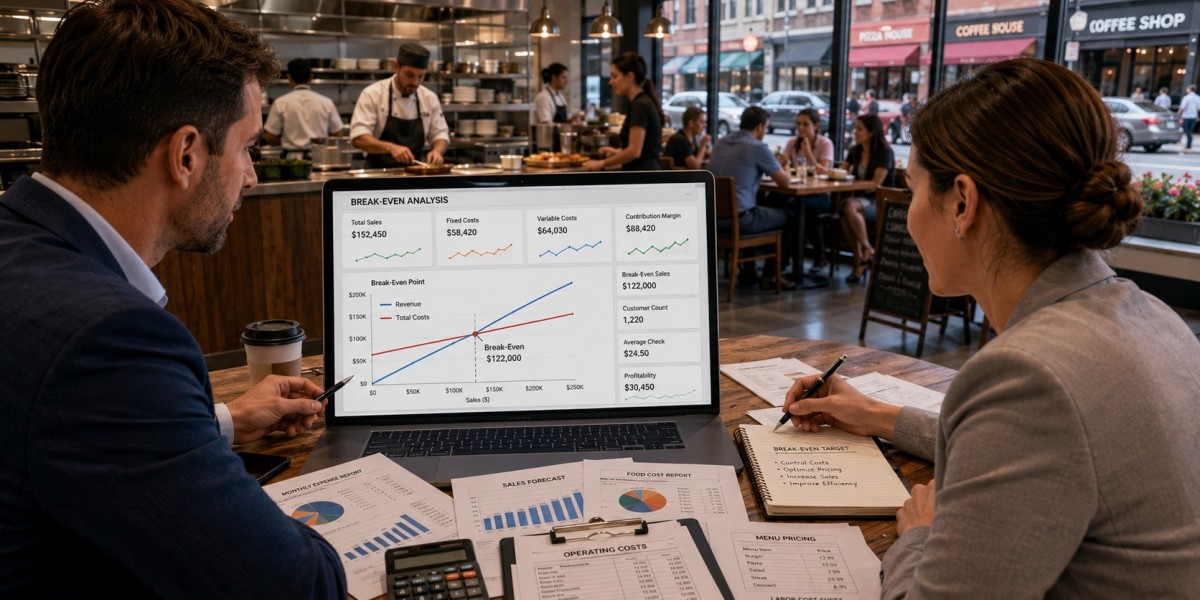

Understanding the break even point restaurant owners need to reach is one of the most important parts of financial planning. Before opening a restaurant, entrepreneurs need to know how much revenue the business must generate to cover its costs. Without this information, it can be difficult to determine whether pricing, sales targets, staffing levels, and operating expenses are sustainable.
The break-even point provides a clear financial benchmark. It tells restaurant owners when total revenue equals total costs, meaning the business has covered its expenses but has not yet generated a profit.
For a detailed explanation of the concept, the Restaurant Site Finder Break-Even Point Glossary provides additional information about break-even analysis and its importance for restaurant businesses.
What Is the Break Even Point in a Restaurant?
The break even point restaurant calculation identifies the level of sales required for total revenue to equal total expenses.
At the break-even point:
Total Revenue = Total Costs
The restaurant is neither making a profit nor experiencing a loss.
Once sales move above the break-even point, the restaurant can begin generating an operating profit, assuming the underlying cost assumptions remain accurate.
For restaurant owners, knowing this number can help answer important questions:
How much must the restaurant sell each month?
How many customers are needed each day?
What average check is required?
Are current menu prices sustainable?
Can the restaurant afford its rent and staffing?
How much revenue is needed before expansion?
Why Is Break-Even Analysis Important for Restaurants?
Restaurants operate with a combination of fixed and variable costs.
Some expenses remain relatively stable even when sales change, while others increase as sales increase.
Break-even analysis helps owners understand the relationship between these expenses and revenue.
It can be used when:
Creating a restaurant business plan
Evaluating a new concept
Selecting a location
Setting menu prices
Forecasting sales
Planning staffing
Evaluating expansion
Managing operating costs
Without a break-even target, restaurant owners may know their sales numbers but not understand whether those sales are sufficient to support the business.
Fixed Costs in a Restaurant
Fixed costs generally remain relatively stable over a specific period regardless of sales volume.
Common restaurant fixed costs may include:
Rent
Property-related expenses
Insurance
Certain software subscriptions
Equipment leases
Some administrative salaries
Loan payments
For example, if a restaurant pays $8,000 per month in rent, that expense generally remains $8,000 whether the restaurant generates $50,000 or $100,000 in sales.
However, not every expense is perfectly fixed. Some costs can change over time, so restaurant owners should use realistic assumptions when building their financial models.
Variable Costs in a Restaurant
Variable costs change as sales or production levels change.
Examples can include:
Food ingredients
Beverage ingredients
Packaging
Credit card processing fees
Certain hourly labor costs
Delivery-related costs
For example, a restaurant that sells more meals generally needs more ingredients.
This means food costs usually increase as sales increase.
The Restaurant Break-Even Formula
One common break-even formula is:
Break-Even Sales = Fixed Costs ÷ Contribution Margin Ratio
The contribution margin ratio is:
Contribution Margin Ratio = (Sales − Variable Costs) ÷ Sales
For example, suppose a restaurant has:
Monthly fixed costs: $30,000
Monthly sales: $100,000
Variable costs: $40,000
The contribution margin is:
$100,000 − $40,000 = $60,000
The contribution margin ratio is:
$60,000 ÷ $100,000 = 60%
The break-even sales level is:
$30,000 ÷ 60% = $50,000
The restaurant would therefore need approximately $50,000 in monthly sales to cover its estimated fixed and variable costs under these assumptions.
Break-Even Point in Units
Restaurant owners can also calculate break-even in terms of units sold.
The formula is:
Break-Even Units = Fixed Costs ÷ Contribution Margin per Unit
Suppose a restaurant sells an average meal for $25 and has an average variable cost of $10.
Contribution margin per meal:
$25 − $10 = $15
If fixed costs are $30,000:
$30,000 ÷ $15 = 2,000 meals
The restaurant would need to sell approximately 2,000 meals to reach break-even under these assumptions.
This calculation becomes more complicated for restaurants with large menus because different menu items have different prices and variable costs.
Calculating the Daily Break-Even Target
Monthly break-even sales can be converted into a daily sales target.
Suppose monthly break-even sales are $60,000 and the restaurant operates 30 days per month.
$60,000 ÷ 30 = $2,000
The restaurant would need approximately $2,000 in sales per day to reach monthly break-even, assuming sales and operating conditions are relatively consistent.
This daily target can help managers evaluate actual performance.
Break-Even Point and Average Check
Another useful calculation is estimating how many customers are required to reach break-even.
Suppose:
Monthly break-even sales = $60,000
Average customer check = $30
Operating days = 30
Monthly customers needed:
$60,000 ÷ $30 = 2,000 customers
Daily customers needed:
2,000 ÷ 30 = approximately 67 customers per day
This helps restaurant owners translate an abstract financial number into an operational target.
Break-Even Point and Menu Pricing
Menu pricing has a direct relationship with break-even performance.
If menu prices are too low, the restaurant may need extremely high sales volume to cover fixed costs.
If prices are too high, customer demand may decline.
Restaurant owners should therefore consider:
Ingredient costs
Labor requirements
Portion sizes
Customer expectations
Competitor pricing
Restaurant positioning
Operating expenses
Pricing should support both customer value and business sustainability.
How Food Costs Affect Break-Even
Food costs can significantly influence the contribution margin.
For example, imagine a menu item sells for $20.
If the ingredients cost $8:
Contribution before other variable costs = $12
If ingredient costs increase to $10:
Contribution = $10
The restaurant now earns less contribution from every sale.
This means the restaurant may need more sales to reach the same break-even point.
Inventory management, portion control, waste reduction, and supplier negotiations can therefore improve break-even performance.
How Labor Costs Affect Break-Even
Labor can also influence restaurant profitability.
Restaurants need enough employees to provide good service and maintain efficient operations.
However, excessive labor costs can increase the amount of revenue needed to break even.
Managers can improve labor efficiency by:
Forecasting demand
Creating appropriate schedules
Monitoring overtime
Training employees
Cross-training staff
Matching staffing to busy periods
The goal should not simply be to minimize labor costs. Understaffing can damage service quality and reduce customer satisfaction.
Break-Even Point and Restaurant Location
Location can have a major indirect effect on a restaurant's break-even point.
Different locations can have significantly different:
Rent
Labor costs
Customer traffic
Demographics
Competition
Parking availability
Visibility
Sales potential
A restaurant with high rent may need substantially more sales to break even than a similar concept operating in a lower-cost location.
This is why location research should happen before signing a lease.
Using Restaurant Site Finder for Location Planning
Restaurant Site Finder helps restaurant entrepreneurs discover and evaluate potential restaurant locations using insights related to demographics, competition, market opportunities, and other site-selection factors.
Location research can complement break-even analysis.
For example, an entrepreneur might compare two potential properties:
| Factor | Location A | Location B |
|---|---|---|
| Monthly Rent | $10,000 | $7,000 |
| Expected Customer Demand | High | Moderate |
| Competition | High | Moderate |
| Target Demographics | Strong | Strong |
| Estimated Sales Potential | High | Moderate |
| Break-Even Pressure | Higher | Lower |
The cheaper location is not automatically better. If Location A can generate significantly more sales, its higher rent may still be justified.
The goal is to evaluate the relationship between costs and revenue potential.
How to Lower a Restaurant's Break-Even Point
Restaurant owners can reduce their break-even sales requirement by managing costs and improving contribution margins.
Reduce Unnecessary Fixed Costs
Review expenses such as:
Rent
Equipment leases
Software
Administrative costs
Service contracts
Improve Food Cost Management
Reduce waste and improve purchasing.
Optimize Labor
Schedule employees based on demand.
Improve Menu Mix
Promote items with stronger contribution margins.
Increase Average Check
Restaurants can increase average check through:
Add-ons
Appetizers
Desserts
Beverages
Premium upgrades
Even a modest increase in average customer spending can improve revenue without requiring the same increase in customer volume.
Break-Even Analysis for New Restaurants
Break-even analysis is particularly important before opening.
Startup costs may include:
Lease deposits
Construction
Equipment
Furniture
Technology
Initial inventory
Permits
Marketing
Professional services
Working capital
Once monthly operating expenses are estimated, entrepreneurs can create a projected break-even target.
For example:
| Expense | Monthly Amount |
|---|---|
| Rent | $8,000 |
| Labor | $25,000 |
| Utilities | $4,000 |
| Insurance | $2,000 |
| Marketing | $3,000 |
| Other Fixed Costs | $8,000 |
| Total Fixed Costs | $50,000 |
If the restaurant has a 60% contribution margin ratio:
$50,000 ÷ 60% = $83,333
The restaurant would need approximately $83,333 in monthly sales to reach break-even based on these assumptions.
Common Break-Even Mistakes
Underestimating Fixed Costs
Owners may forget expenses such as insurance, maintenance, software, or administrative costs.
Using Unrealistic Sales Forecasts
Projected sales should be based on market research rather than optimism.
Ignoring Seasonality
Restaurants can experience significant seasonal changes.
Forgetting Variable Expenses
Some costs increase as sales increase and must be included in the calculation.
Treating Break-Even as a Profit Target
Break-even means the restaurant is covering costs, not generating meaningful profit.
Not Updating the Calculation
Rent, wages, food prices, and other costs can change. Break-even analysis should therefore be reviewed periodically.
Break-Even Point vs. Profitability
Reaching break-even is an important milestone, but it is not the final goal.
A restaurant that generates exactly enough revenue to cover expenses has no operating profit.
Owners should establish sales targets above break-even to create a financial cushion and generate sustainable returns.
For example:
Break-even sales: $70,000
Target sales: $85,000
Growth target: $100,000
This provides a clearer framework for financial planning.
Frequently Asked Questions
What is the break-even point for a restaurant?
The break-even point is the amount of sales a restaurant needs to generate to cover its total fixed and variable costs. At this point, revenue equals expenses and the business has neither a profit nor a loss.
How do you calculate the break-even point for a restaurant?
A common formula is Break-Even Sales = Fixed Costs ÷ Contribution Margin Ratio. The contribution margin ratio is calculated by subtracting variable costs from sales and dividing the result by sales.
Why is break-even analysis important for restaurants?
Break-even analysis helps restaurant owners establish sales targets, evaluate pricing, control costs, plan staffing, assess locations, and determine whether the business model can potentially support its expenses.
Can location affect a restaurant's break-even point?
Yes. Rent, labor costs, customer demand, competition, accessibility, and sales potential vary by location. A higher-cost property may require substantially higher sales to reach break-even.
Conclusion
Understanding the break even point restaurant owners need to reach is an essential part of building a financially sustainable business. Break-even analysis shows how much revenue is required to cover operating expenses and provides a practical benchmark for sales planning.
The calculation begins with identifying fixed and variable costs. Restaurant owners can then calculate their contribution margin and determine the sales level required to reach break-even.
However, break-even analysis should not be viewed as a one-time calculation. Food prices, labor costs, rent, customer demand, and other expenses can change over time. Regularly updating the analysis allows owners to maintain realistic financial targets.
Location should also be considered carefully because it can influence both costs and revenue potential. A property with high rent may require significantly greater sales, while a lower-cost location may have less customer demand.
For additional information about break-even analysis, the Restaurant Site Finder Break-Even Point Glossary provides a useful overview of the concept.
Restaurant Site Finder can also help entrepreneurs research and evaluate potential restaurant locations using data-driven insights related to demographics, competition, and market opportunities.
Ultimately, knowing your break-even point allows you to move from simply asking “How much can my restaurant sell?” to a much more important question: “How much does my restaurant need to sell to operate sustainably and generate a profit?”