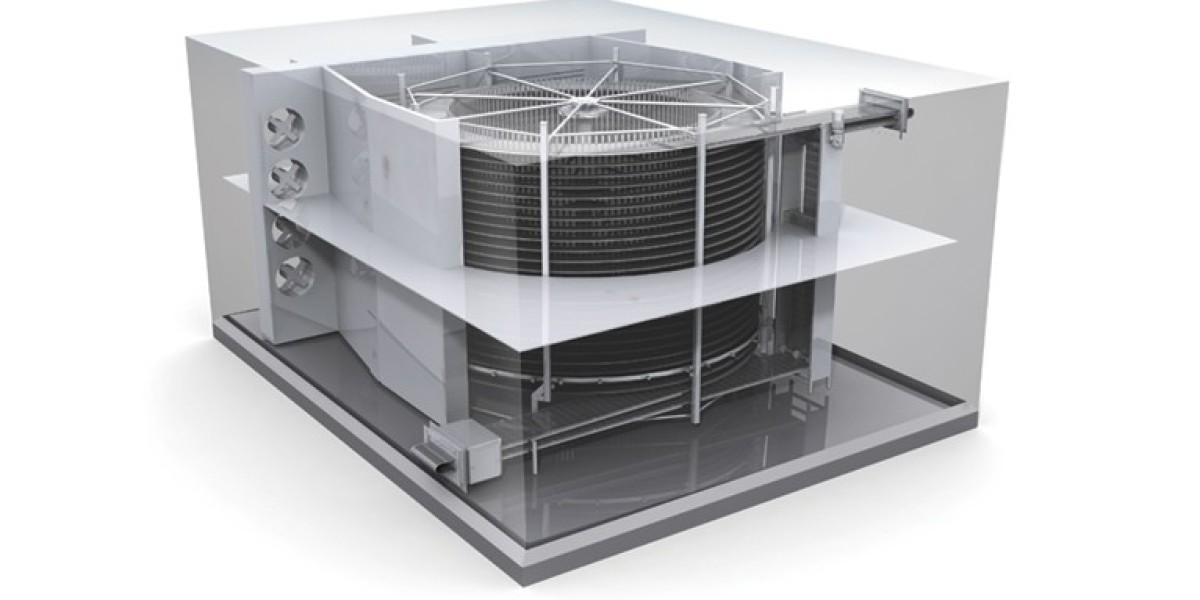

Despite these advantages, manufacturers and users face several challenges that can influence investment decisions, operating costs, equipment utilization, and long-term profitability. Understanding the major Spiral Freezer Threats is important for food processors, equipment manufacturers, technology providers, and plant operators seeking to build resilient production systems.
High Initial Investment and Installation Costs
One of the most significant threats is the substantial capital investment required to install a spiral freezing system. Compared with conventional freezing equipment, spiral freezers can involve complex mechanical structures, refrigeration systems, conveyor assemblies, insulation, controls, and specialized installation requirements.
The total investment can increase further when facilities need modifications to accommodate equipment dimensions, utilities, ventilation, drainage, and refrigeration infrastructure. Smaller and medium-sized food processors may find these costs difficult to justify, particularly when production volumes fluctuate.
Financing challenges can therefore slow the adoption of advanced spiral freezing solutions, especially in price-sensitive markets.
Rising Energy Consumption
Industrial freezing is an energy-intensive process. Spiral freezers require continuous refrigeration to maintain low operating temperatures, while conveyor systems, fans, motors, defrosting mechanisms, and automated controls also consume electricity.
Increasing energy prices can significantly affect operating margins. Food manufacturers operating on tight cost structures may hesitate to expand freezing capacity if energy consumption threatens profitability.
Energy efficiency has consequently become a major competitive factor. Equipment that does not incorporate efficient refrigeration components, optimized airflow, heat recovery, variable-speed systems, or advanced controls may face greater pressure as manufacturers seek to reduce utility expenses.
Refrigeration System Complexity
The refrigeration infrastructure supporting a spiral freezer can be technically demanding. Depending on the application, systems may use different refrigerant technologies and require carefully engineered compressors, evaporators, condensers, valves, piping, and control systems.
A malfunction in any major component can interrupt production. Refrigeration failures can also expose large quantities of food products to temperature fluctuations, potentially creating quality and safety concerns.
As refrigeration regulations and environmental expectations evolve, manufacturers may also need to redesign systems around lower-impact refrigerants and more efficient technologies. These transitions can increase equipment development costs and require additional technical expertise.
Maintenance and Downtime Risks
Spiral freezers contain numerous moving and mechanical components, including conveyor chains, sprockets, bearings, motors, fans, sensors, and drive mechanisms. Continuous operation places considerable stress on these components.
Unexpected equipment failures can result in production downtime, delayed orders, labor inefficiencies, and product losses. Because many food processing plants operate continuously or on extended schedules, even a relatively short interruption can have significant financial consequences.
Preventive maintenance is therefore essential, but it adds labor and service costs. Plants without trained technicians may also experience longer repair periods when specialized components fail.
Food Safety and Hygiene Challenges
Hygiene represents another important threat to the Spiral Freezer Market. Food processing equipment must be designed and operated to minimize contamination risks. The complex structure of a spiral freezer can create difficult-to-access areas where food particles, moisture, or residues may accumulate.
Cleaning and sanitation can become particularly challenging when equipment contains numerous conveyor levels and enclosed sections. Poor cleaning practices may increase microbial risks and create regulatory concerns.
Manufacturers are increasingly expected to develop hygienic designs that simplify cleaning, inspection, drainage, and sanitation. However, implementing these features can increase equipment complexity and manufacturing costs.
Space and Facility Constraints
Spiral freezers are designed to maximize vertical space, but they still require considerable floor area for loading, unloading, refrigeration equipment, access points, maintenance zones, and safety clearances.
Existing food processing facilities may not have sufficient space to install a high-capacity system without restructuring production layouts. Renovation can be expensive and may temporarily disrupt manufacturing activities.
This challenge can be especially significant for older plants where infrastructure was not designed for automated continuous freezing. In such cases, companies may choose smaller or alternative freezing technologies instead of investing in a large spiral system.
Supply Chain Disruptions
Spiral freezer manufacturers depend on a broad network of suppliers for motors, compressors, control systems, sensors, stainless-steel components, conveyor parts, refrigeration equipment, and specialized electronic systems.
Disruptions in the availability of these components can extend manufacturing lead times and increase equipment prices. Global logistics challenges, raw material price fluctuations, transportation constraints, and shortages of specialized components can create additional uncertainty.
Food processors planning capacity expansions may consequently delay projects when equipment delivery schedules become unpredictable.
Shortage of Skilled Technical Personnel
Advanced spiral freezer systems increasingly incorporate automation, digital monitoring, sensors, programmable controls, and sophisticated refrigeration technologies. Operating and maintaining these systems requires technicians with specialized knowledge.
A shortage of skilled personnel can make installation, troubleshooting, preventive maintenance, and system optimization more difficult. Companies may need to invest in employee training or rely heavily on external service providers.
The challenge becomes more pronounced in developing food-processing regions where access to specialized industrial refrigeration and automation expertise may be limited.
Competition from Alternative Freezing Technologies
The Spiral Freezer Market also faces competitive pressure from alternative freezing systems. Impingement freezers, tunnel freezers, blast freezers, plate freezers, fluidized-bed systems, and cryogenic technologies can serve different product categories and production requirements.
For some applications, an alternative system may provide lower investment costs, simpler maintenance, faster freezing, or greater flexibility. Manufacturers of spiral freezers must therefore demonstrate clear advantages in throughput, footprint, product quality, energy efficiency, automation, and operating economics.
Changing production requirements can also cause processors to reconsider whether a fixed high-capacity spiral system remains the most appropriate solution.
Regulatory and Environmental Pressure
Environmental regulations are becoming increasingly important for industrial refrigeration and food-processing operations. Companies may face stricter requirements concerning refrigerants, energy efficiency, emissions, wastewater, equipment safety, and workplace conditions.
Compliance can require equipment upgrades, monitoring systems, improved refrigeration technologies, or changes in operating procedures. These measures can increase the overall cost of ownership.
At the same time, food manufacturers are under pressure to reduce their environmental footprint. Equipment suppliers that cannot demonstrate meaningful improvements in energy efficiency and resource utilization may find it more difficult to compete for sustainability-focused customers.
Product Quality and Freezing Performance Risks
Different food products have different freezing requirements. Variations in product size, moisture content, packaging, shape, density, and production speed can affect freezing performance.
If airflow, temperature, conveyor speed, or refrigeration capacity is not properly configured, products may freeze unevenly. This can lead to texture changes, excessive dehydration, freezer burn, damaged packaging, or inconsistent quality.
Such issues can result in product rejection and higher waste. Manufacturers must therefore provide flexible systems capable of handling changing product specifications without compromising freezing consistency.
Conclusion
The Spiral Freezer Threats facing the industry extend beyond equipment prices. High energy requirements, complex refrigeration systems, maintenance demands, hygiene concerns, skilled-labor shortages, supply chain disruptions, regulatory changes, and competition from alternative freezing technologies can all influence market development.
Nevertheless, these challenges also create opportunities for innovation. Energy-efficient refrigeration, hygienic equipment designs, predictive maintenance, advanced automation, remote monitoring, improved insulation, intelligent airflow management, and environmentally responsible refrigerant solutions can strengthen the value proposition of spiral freezing systems.
Companies that address these threats through technological innovation, efficient service networks, flexible equipment design, and strong lifecycle support will be better positioned to respond to the changing requirements of modern food-processing operations. As demand for efficient and automated food production continues to evolve, the ability to manage these risks will remain a decisive factor in the long-term development of the Spiral Freezer Market.