
Market Overview
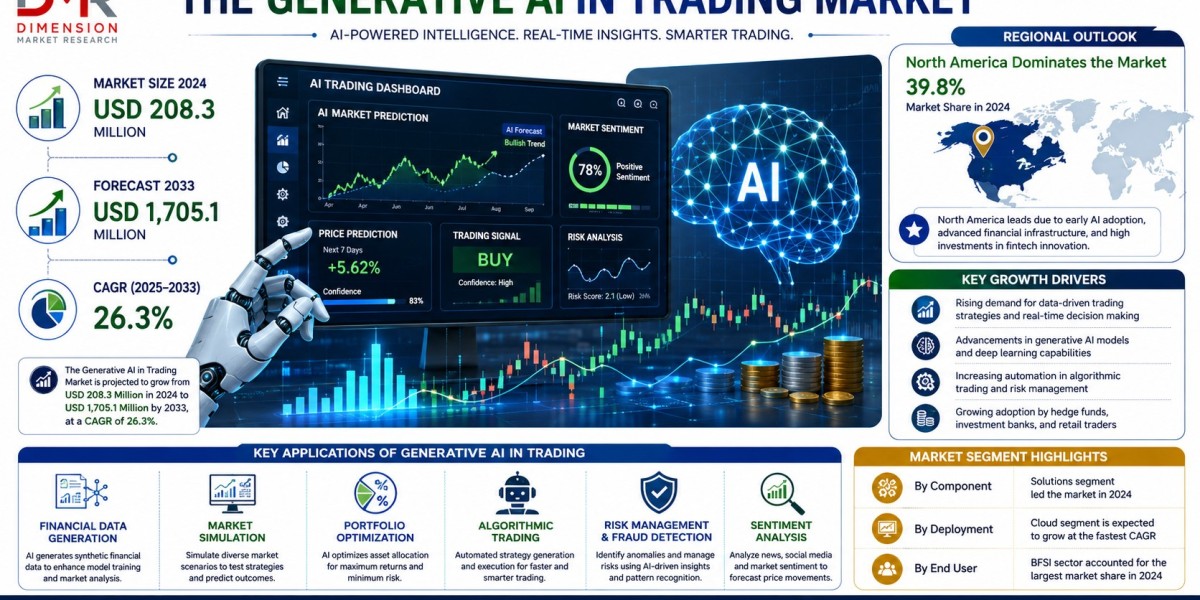
According to Dimension Market Research, the Global Generative AI in Trading Market is expected to reach a value of USD 208.3 million by the end of 2024, and it is further anticipated to reach a market value of USD 1,705.1 million by 2033 growing at a CAGR of 26.3%. The market is witnessing rapid growth due to the increasing demand for advanced analytical capabilities in financial markets, the need for real-time data processing and decision-making, and the growing adoption of AI-driven solutions for portfolio optimization, risk management, and trading strategy development.
Generative AI, uses neural networks, creates realistic content and proves highly valuable in trading due to its adaptability to market changes. By analyzing a volume of historical data, it identifies complex patterns, providing actionable insights for decision-making. However, it's important to see that while Generative AI improves analytical capabilities, it acts as a complement to human judgment rather than a replacement, which integrates AI-generated insights with the better decision-making of experienced traders.
As per the AIPRM, the global generative AI market, valued at nearly $45 billion in 2023, is projected to surpass $200 billion by 2030, marking a 361% increase. The market generated $68 billion in revenue in 2023, a 68% rise from 2022, with North America dominating 41% of the global share. More than two-thirds (68%) of users engaged with generative AI to answer queries, reflecting its broad utility. Among businesses, 64% of leaders feel an urgent need to integrate generative AI, while 44% expect workforce reductions within three years.
Generative AI is rapidly transforming the trading sector, offering innovative opportunities and prompting significant developments. Amazon's AWS re:Invent conference highlighted advancements in generative AI, including cost reductions through proprietary chips and the Bedrock platform. Robinhood plans to introduce AI-powered financial advice, aiming to provide cost-effective, accessible financial management services. A survey by KPMG revealed that 65% of U.S. executives anticipate a high impact from generative AI within the next 3-5 years, though 60% feel unprepared for immediate adoption.
Definition and Market Significance
Generative AI in trading refers to the application of artificial intelligence models—including generative adversarial networks (GANs), variational autoencoders (VAEs), and transformer-based architectures—to create synthetic financial data, simulate market conditions, generate trading strategies, and optimize investment portfolios. These systems analyze vast historical datasets to identify complex patterns and generate realistic market scenarios.
The importance of generative AI in trading lies in its ability to enhance decision-making by providing traders with actionable insights, predictive analytics, and risk assessment capabilities. By generating synthetic data that mirrors real-market conditions, it enables traders to test strategies, refine models, and adapt to changing market dynamics without risking real capital.
Generative AI also supports broader financial innovation by enabling more objective, data-driven trading strategies, reducing human biases and emotions, and improving the efficiency of portfolio management, risk assessment, and market analysis.
Request a Complimentary PDF Sample
https://dimensionmarketresearch.com/request-sample/generative-ai-in-trading-market/
Market Drivers
A major factor driving the Generative AI in Trading Market is the increasing demand for advanced data generation and market simulation capabilities. Generative AI models develop artificial financial data that mirrors real-time market conditions, filling gaps in historical datasets and helping traders refine their models through data augmentation or synthetic data generation. By replicating market scenarios, traders can analyze the impact of various events on portfolio strategies and performance.
The growing need for real-time decision-making and competitive advantage in financial markets is another key driver supporting market expansion. Generative AI's high-speed data processing capabilities enable traders to make informed decisions in real-time, seizing market opportunities swiftly. Its accuracy is enhanced by removing human biases and emotions, leading to more objective trading strategies based on data-driven insights.
The increasing adoption of AI-powered solutions for risk management and portfolio optimization is also contributing to market growth. Generative AI helps in identifying and reducing portfolio risks through simulating scenarios and datasets, enabling traders to make informed decisions on asset allocation and optimize portfolio performance.
Market Trends
The integration of deep learning and reinforcement learning techniques is emerging as an important trend in the trading sector. Traders are integrating generative AI and reinforcement learning to build intelligent trading agents that learn to adapt to market dynamics via interactions and feedback loops, improving decision-making processes and trading strategies.
Another significant trend is the increasing use of hybrid models that combine generative AI with traditional quantitative and econometric models. This provides a more complete understanding of the market, improves the accuracy of trading strategies and predictions, and boosts returns.
The focus on explainable AI (XAI) is also transforming the market. Researchers are creating models that are both generative and explainable, making the decision-making process of generative models more transparent and understandable for regulators and traders, addressing interpretability challenges and building trust.
Market Restraints
Despite its strong growth potential, the generative AI in trading market faces certain limitations. The effectiveness of generative AI depends on the accuracy of its training data, and flawed or biased inputs can yield unreliable synthetic models or erroneous data, undermining its utility in financial markets. Maintaining diverse and high-quality datasets is challenging due to market biases and data limitations.
The complexity and opacity of generative AI models creates perception challenges for humans, potentially impacting trust and acceptance, mainly in regulatory contexts where transparency is important. The regulatory landscape creates further hurdles, as opaque AI models may raise concerns regarding compliance with privacy, fairness, and risk management regulations.
In addition, the risk of overfitting highlights the need for AI models to adapt quickly to transforming market conditions. Failure to do so may produce inaccurate outputs and ineffective trading strategies, emphasizing the importance of agile and adaptable generative AI solutions.
Market Opportunities
Generative AI empowers traders by helping them develop more effective trading strategies through mock data generation and market scenario modeling. By analyzing hidden patterns and detecting emerging trading signals, these models improve predictive accuracy, potentially leading to better trading performance and profits. In addition, generative AI helps in risk management by replicating extreme market conditions, enabling traders to identify vulnerabilities in their portfolios and proactively implement risk reduction strategies.
The ability to customize investment strategies is another promising opportunity. Generative AI enables customized investment strategies by analyzing individual risk profiles, goals, and preferences, improving the dependency of portfolios and optimizing investment outcomes.
Furthermore, the growth of generative AI applications in emerging markets, particularly in Asia Pacific, is expected to open new opportunities for the generative AI in trading industry, as financial institutions in these regions increasingly adopt AI-driven solutions for trading automation, risk management, and market analysis.
Segmentation
The Generative AI in Trading Market is categorized based on type, deployment, and application.
By type, the financial data generation segment is expected to claim the majority share of revenue in 2024, as it holds significant promise by revolutionizing data generation processes in trading. By using specialized algorithms and neural networks, generative AI systems are capable of producing highly accurate financial data that closely replicates real-world market conditions.
By deployment, the on-premises segment is expected to be the most lucrative in 2024, giving traders complete control and ownership over their AI solutions while meeting regulatory needs, with speedier processing enabling immediate analysis and decision-making. The cloud-based segment is expected to be the fastest-growing, providing adaptability and cost savings by removing infrastructure maintenance requirements.
By application, portfolio optimization is set to be the dominant segment, commanding a major market share in 2024. Through generative AI models, investors and traders can build and evaluate multiple portfolios across different market conditions, refining portfolio allocation strategies aligned with risk-return objectives.
Regional Analysis
North America is anticipated to lead the global Generative AI in trading market with about 48.0% market share in 2024, making it the most profitable region. The United States, in particular, stands out as a major player in applying generative AI within trading markets. Known for its advanced financial services industry and strong tech ecosystem, which includes leading tech firms and research institutions, North America, mainly cities like New York and Chicago, acts as a hub for innovation in generative AI tools for trading. The region's longstanding commitment to adopting advanced technologies has driven it to the forefront of developing and integrating generative AI solutions for trading purposes.
Europe holds a substantial share of the generative AI in trading market due to its strong financial services sector, growing AI adoption, and supportive regulatory environment. The United Kingdom, Germany, and France are key national markets, with increasing investments in AI-driven trading solutions.
Asia Pacific emerges as the fastest-growing market in the forecast period for generative AI in trading, as countries like Japan, China, and Singapore have quickly embraced generative AI within their trading markets. Growth in investment in technological development and increasing adoption by financial institutions highlights the region's commitment to using generative AI for trading automation, risk management, and market analysis.
Latin America and the Middle East & Africa are gradually adopting generative AI in trading as financial markets modernize and awareness of AI-driven solutions increases, with Brazil, Mexico, the UAE, and Saudi Arabia emerging as key markets.
Competitive Landscape
In the generative AI in trading market, players compete for market share, using advanced technologies and innovative solutions to gain a competitive edge. Key factors influencing competition include technological developments, research and development initiatives, and strategic partnerships within the financial services and technology sectors.
Companies look to differentiate themselves by providing specialized generative AI tools customized to meet the changing needs of traders, focusing on areas like portfolio optimization, trading strategy development, and risk assessment. With an aim on improving data accuracy, processing speed, and model interpretability, competitors focus on attracting and retaining clients by delivering comprehensive, reliable, and efficient generative AI solutions for trading applications.
Prominent players include Kavout Inc, Numerai LLC, OpenAI AP, Aidyia Holding Ltd, Pecan AI Ltd, and Sentient Technologies Holdings Ltd. Recent developments include Birlasoft Ltd's launch of the Cogito Generative AI platform (February 2024), TradeAlgo's announcement of TradeGPT for retail traders (February 2024), and SEBI's announcement of utilizing a generative AI tool to clear IPO applications (January 2024).
Technological Advancements
Rapid advancements in neural network architectures, including transformers and generative adversarial networks, are transforming generative AI capabilities in trading. These technologies enable more accurate financial data generation, sophisticated market simulations, and adaptive trading strategies.
The development of explainable AI (XAI) and transfer learning techniques is also playing a significant role, making AI models more transparent and adaptable to new trading scenarios, addressing interpretability challenges and overcoming data limitations.
Consumer Adoption Patterns
Financial institutions, hedge funds, proprietary trading firms, and retail traders are increasingly adopting generative AI solutions for portfolio optimization, strategy development, and risk management. The growing availability of cloud-based platforms and specialized AI tools is making these technologies more accessible to traders of all sizes.
Regulatory Environment
Financial regulators across different regions, including the SEC in the United States, SEBI in India, and ESMA in Europe, are developing frameworks for AI use in financial markets. Compliance with regulations concerning algorithmic trading, data privacy, and model transparency is essential for market participants. The Federal Trade Commission's scrutiny of investments and partnerships involving generative AI companies highlights the evolving regulatory landscape.
Market Challenges
The generative AI in trading market faces challenges related to data quality and bias, model opacity and interpretability, regulatory compliance, and the risk of overfitting. Additionally, the need for significant computational resources and specialized talent to develop and deploy generative AI solutions creates barriers for some organizations.
Future Outlook
The future of the Generative AI in Trading Market remains highly promising as financial institutions increasingly adopt AI-driven solutions to gain competitive advantages. Advancements in deep learning, explainable AI, and transfer learning, along with growing investment in AI technologies and expanding applications in emerging markets, are expected to drive strong market growth during the forecast period.
FAQs
What is the expected size of the Generative AI in Trading Market in 2024?
The market is expected to reach USD 208.3 million by the end of 2024.
What is the projected market value by 2033?
The market is forecast to reach USD 1,705.1 million by 2033.
What is the CAGR of the Generative AI in Trading Market?
The market is expected to grow at a CAGR of 26.3% during 2024–2033.
Which type segment dominates the market?
Financial data generation is expected to get the largest revenue share in 2024.
Which region leads the global generative AI in trading market?
North America is anticipated to lead with about 48.0% market share in 2024.
Summary of Key Insights
The global Generative AI in Trading Market is expected to grow from USD 208.3 million in 2024 to USD 1,705.1 million by 2033, recording a CAGR of 26.3% during the forecast period. Financial data generation leads the type segment, while on-premises deployment dominates. Portfolio optimization leads applications. North America holds the largest regional share with 48.0% of global revenue in 2024, while Asia Pacific is projected as the fastest-growing region.
Purchase the Full Report
https://dimensionmarketresearch.com/checkout/generative-ai-in-trading-market/