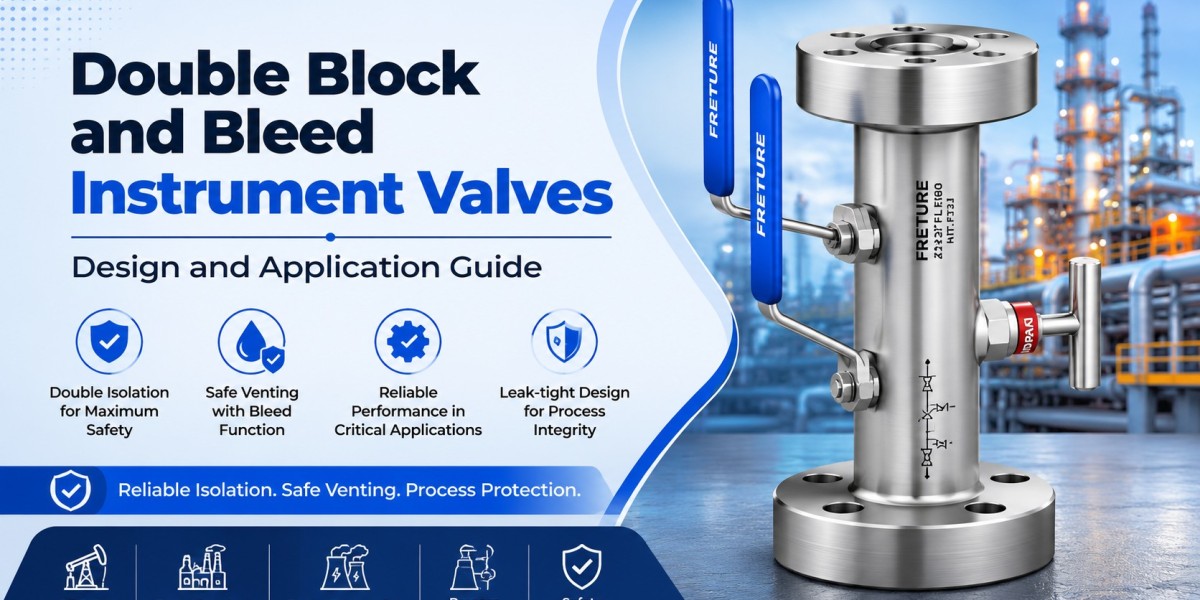

Instrumentation connected to live pipelines and process vessels — pressure transmitters, gauges, and sampling points — requires reliable isolation for calibration, maintenance, and replacement without shutting down the entire process line. A double block and bleed instrument valve provides this isolation in a compact, single-body design, combining two independent seals with a bleed port to verify isolation before instrument work begins. This guide covers the design, standards, and applications of DBB instrument valves for engineers specifying instrumentation isolation systems.
What a DBB Instrument Valve Does
Unlike full-bore pipeline DBB valves used for line isolation, DBB instrument valves are compact, typically needle or ball-type valves mounted directly at instrument takeoff points. They provide two independent block valves plus a bleed/vent valve in one integrated body, allowing technicians to isolate an instrument from process pressure, vent the trapped cavity to confirm zero pressure, and safely remove or service the instrument — all without a separate manifold assembly.
Needle-Type vs. Ball-Type DBB Instrument Valves
Needle-type DBB instrument valves offer fine throttling control during bleed-down, useful where controlled depressurization is important for sensitive instruments. Ball-type DBB instrument valves offer faster, quarter-turn operation and lower operating torque, often preferred where quick isolation and reduced maintenance are priorities.
Standards Governing DBB Instrument Valves
Design and Pressure Ratings
DBB instrument valves should conform to ASME B16.34 for pressure-temperature ratings, with connection types typically per instrumentation standards (NPT, tube fitting, or flanged per ASME B16.5 for larger sizes).
Fire-Safe and Fugitive Emissions
For hydrocarbon service instrumentation, API 607 fire-safe certification is relevant, and where fugitive emissions control is mandated at instrument connection points, stem sealing should be validated to ISO 15848-1.
Testing
Seat leakage and shell testing should follow API 598 principles adapted to instrument valve scale, with manufacturers providing test certification confirming independent seat integrity at both block positions.
Applications
DBB instrument valves are specified at pressure transmitter and gauge takeoff points on pipelines, process vessels, and skid-mounted systems across oil & gas, petrochemical, and power plant instrumentation loops where safe isolation without full system shutdown is required.
Evaluating DBB Instrument Valve Manufacturers
Confirm documented independent seat testing data, appropriate connection type for your instrumentation standard, fire-safe certification where hydrocarbon service demands it, and in-house machining precision given the compact tolerances involved in instrument-scale valves.
Conclusion
Freture Techno Pvt. Ltd. manufactures double block and bleed instrument valves engineered to ASME B16.34 and API 607 standards, purpose-built for safe instrumentation isolation in oil & gas and process plant applications.
Sourcing DBB instrument valves for your instrumentation loops? Contact Freture Techno's engineering team to discuss connection type, pressure class, and certification for your application.