
One Dry Bearing Can Stop the Line
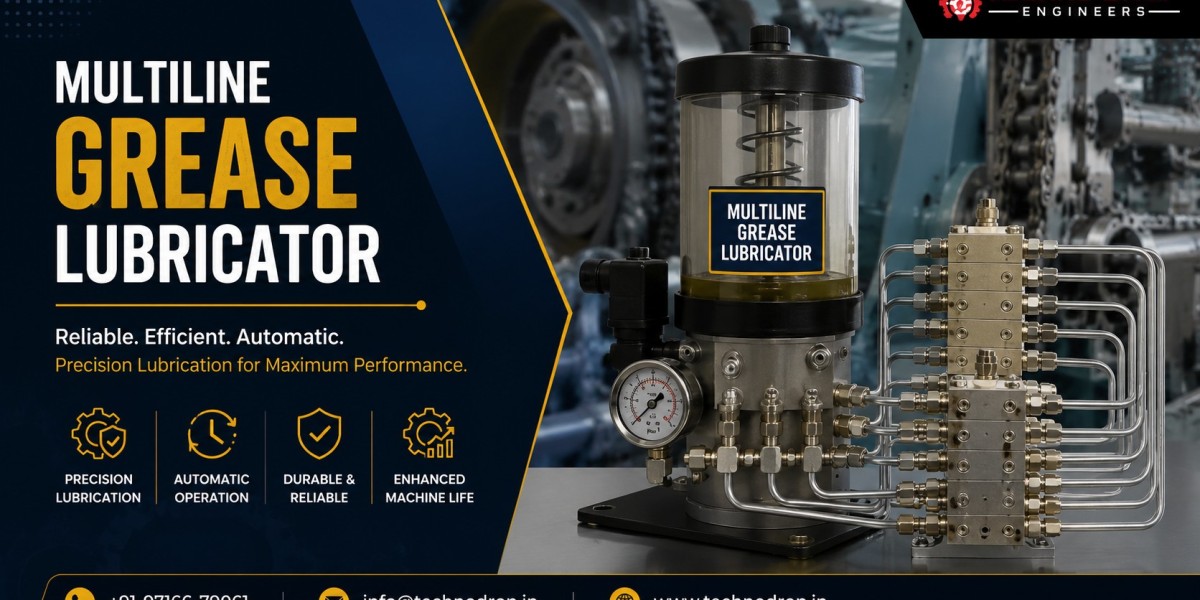
And yet, a lubrication sheet may say “done” while the farthest bearing is nearly dry. Manual greasing records activity; it rarely proves how much grease reached each point. A Multiline Grease Lubricator closes that gap through several pump elements in one central unit, each feeding its own line. Technodrop’s listed automatic model has a 25 kg reservoir and a 350 bar maximum pressure rating. Grease placed somewhere near the machine is not controlled lubrication.
How a Multiline Grease Lubricator Controls Delivery
One Element Feeds One Line
A common drive operates several pumping elements from one reservoir. Each element meters grease and sends it directly to an assigned bearing, slideway, gear, or pin. Because the routes are independent, resistance in one line does not govern every outlet. Technodrop lists 415 VAC, 0.37 kW power, automatic operation, and 1/4-inch BSP ports.
Pressure Must Match Resistance
Grease moves reluctantly through long pipes, narrow fittings, cold sections, and tight bends. Higher NLGI grades add resistance. Pressure must reach the hardest point without overloading the pipework; Technodrop publishes a 350 bar maximum for its unit. SKF also documents multiline pumps rated at 350 bar for direct lubrication-point supply.
The Detail Buyers Skip: Priming
Trapped air compresses before grease reaches the bearing, creating apparently successful cycles with little useful delivery. Nobody tells you that priming the longest line can be harder than mounting the pump.
Five Supplier Answers Worth Testing
1. Output Per Stroke
A capable supplier calculates demand from bearing size, speed, load, and lubrication frequency. “The output is adjustable” is a bad answer. One documented SKF design delivers 0.16 cm³ per stroke through its K6 pump element, showing why actual delivery figures matter.
2. Grease Compatibility
Reliable Multiline Grease Lubricator Manufacturers ask for the grease brand, NLGI grade, temperature range, and back pressure. “Any grease will work” is careless. SKF notes that NLGI grade, temperature, back pressure, and the number of pump elements can alter actual delivery.
3. Line-by-Line Layout
The proposal should map lubrication points, pipe lengths, fittings, and outlet assignments. Quoting only by point count is poor practice—12 nearby bearings and 12 points spread across a rolling mill are different hydraulic problems.
4. Monitoring Method
Ask how low reservoir level, motor overload, pressure loss, and blocked routes are identified. “The operator will notice” is not a monitoring plan. Technodrop states that multiline systems can be integrated with timers, limit switches, or PLC controls.
5. Commissioning Responsibility
Require written scope for line priming, pressure setting, cycle testing, and operator training. “Installation is simple” is the answer that usually disappears when a remote bearing stays dry.
Benefits: Accuracy That Protects Production Margin
Less Grease Waste
Metered cycles reduce routine overgreasing, protecting lubricant cost and lowering the risk of grease collecting around seals and housings.
Lower Starvation Risk
Independent lines allow a controlled quantity to be assigned to each point instead of relying entirely on an operator’s judgement.
Lubrication During Operation
Automatic cycles can feed moving equipment during normal operation rather than waiting for a shutdown or maintenance round.
Faster Fault Finding
Separate outlets let technicians inspect one pump element, fitting, or line instead of opening the entire distribution network.
Better Labour and Spare Planning
Technodrop identifies cement plants, rolling mills, crushers, conveyors, cranes, industrial pumps, mining equipment, and forging machinery as suitable applications. Fewer manual rounds release technicians for planned work, while defined pump elements and fittings make spare stocking more predictable.
Multiline Grease Lubricator Manufacturers in India
Technodrop operates from Plot No. 103, Unit 1, HUDA Industrial Area, Faridabad 121004, Haryana. This places Multiline Grease Lubricator Manufacturers in India near Delhi NCR’s established OEM, industrial automation, fabrication, and heavy-engineering base.
For plants outside North India, Multiline Grease Lubricator suppliers in India should confirm drawing approval, dispatch testing, replacement pump elements, fittings, and remote commissioning support. Buyers who compare delivery days but ignore spare lead time are doing incomplete procurement.
About Us: What We Build in Faridabad
We have manufactured centralized and automatic lubrication equipment since 1999. Our range includes grease systems, oil systems, lubrication pumps, fittings, distribution components, and multiline units for industrial machinery. We know the awkward fault is often not inside the pump; it is a line that was never fully primed after maintenance.
We review point count, grease grade, longest pipe distance, operating cycle, and control method before recommending an arrangement. Our listed multiline configuration carries a 25 kg reservoir, a 0.37 kW motor, and a maximum pressure rating of 350 bar.
Send Us the Machine Data First
We aim to respond within one working day after receiving a usable application brief. Our MOQ is application-dependent and confirmed in the written quotation after we review the machine layout.
Send us the machine drawing, point count, component details, longest line distance, grease brand and NLGI grade, available voltage, operating cycle, and preferred timer or PLC control. We will recommend the outlet arrangement, reservoir capacity, pressure range, accessories, and commissioning scope. Our published contact number is +91-97166-79061.
Conclusion: Accuracy Starts Before Ordering
Even a 350 bar-rated Multiline Grease Lubricator cannot compensate for incorrect outlet delivery, unsuitable grease, excessive line resistance, or poor priming. Buying by reservoir size alone is careless. Future maintenance teams will depend less on manual rounds and more on measurable, point-specific lubrication.
FAQs
1. How is the grease metered by the Multiline Grease Lubricator?
Every pumping device distributes a predetermined amount of grease to the particular line either during each stroke or revolution. Accuracy relies on proper adjustment, priming, good quality of the lubricant used, temperature and design of the pipeline.
2. How many lubrication points could one system serve?
It depends on its design. Known SKF designs contain pumps from 1–12 and 1–15 direct outlets, so all points have to be known before the choice.
3. What questions should be put to the supplier of Multiline Grease Lubricator?
Outlet delivery, maximum pressure, type of grease used, reservoir capacity, supervision, responsibility for the commissioning and spare availability have to be known.
4. How does sizing of a Multiline Grease Lubricator system in India occur?
This requires calculations of the demand at various points, and also consideration of the pipe length, temperatures, losses of pressure, cycles, voltage supply, and controls.
5. Is there any problem with using NLGI 2 Grease for a Multiline System?
A multiline system can use NLGI 2 grease in most industrial applications. However, cold weather, long hoses, high back pressures, and small pipe diameters will affect the flow rate.