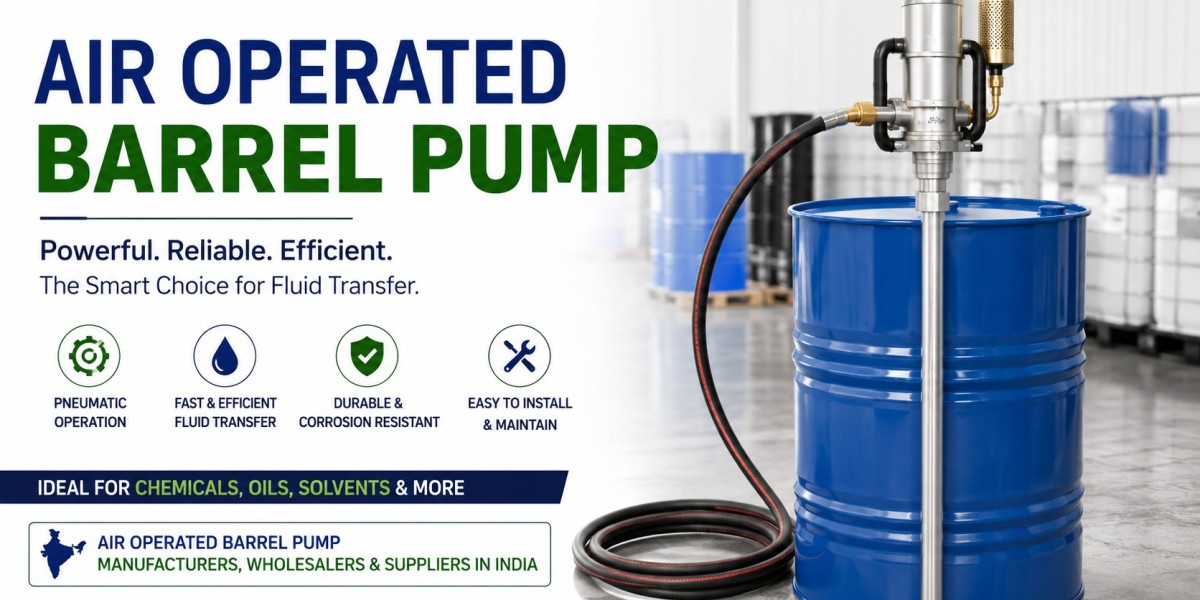

A solvent drum reaches production, the shift is already behind schedule, and the pump cannot handle the liquid safely. That is when purchasing teams learn that an Air Operated Barrel Pump is not merely a price comparison. It is a compatibility, safety, flow and service decision. Giza lists four construction choices—SS 316, PP, PVDF and aluminium—for chemical plants, refineries, paint units and solvent-handling facilities.
Bad suppliers sell the pump first and ask about the liquid later.
The Specification Details That Decide Pump Life
Match Every Wetted Part
Selection starts with the liquid name, concentration, temperature and viscosity. SS 316, PP, PVDF and aluminium do not offer identical compatibility, while seals, hoses and nozzles matter as much as the main tube. Giza identifies all four material routes for its pneumatic models.
A supplier who says “suitable for chemicals” without requesting the SDS is guessing with your money.
Treat Catalogue Flow as a Test Condition
Flow must be checked against head, hose length, nozzle restriction and viscosity. Compressed-air drum-pump ranges can span roughly 20 to 216 litres per minute; one stainless-steel configuration is rated at 50 litres per minute, 1,000 mm immersion and viscosity up to 800 mPa·s. Those figures are model-specific.
Here’s the overlooked detail: maximum flow may be measured with water at 20°C and no accessories, so actual output can be lower.
Five Supplier Checks That Expose Weak Quotations
Compatibility: A good answer names tube, seal, hose and nozzle materials. A bad answer is “SS works for everything.”
Operating data: Ask for air pressure, expected flow, head and viscosity limit. A bad answer gives only a maximum-flow headline.
Safety: For flammable service, ask about hazardous-area suitability, bonding and grounding. A bad answer claims air operation removes every ignition risk; OSHA still identifies bonding and grounding as controls during relevant flammable-liquid transfer.
Testing: Ask which checks occur before dispatch. “Quality checked” without test names is not an answer.
Support: Ask who handles seals, spares and incorrect selection. “We will manage later” usually means nobody owns the problem.
Six Ways a Capable Supplier Protects Buyer Margin
Lower spill exposure: Correct matching reduces discharge and product loss.
Less corrosion: Compatible wetted parts protect replacement budgets.
Predictable filling: Verified output gives planners a usable cycle estimate.
Reduced handling: Top-entry pumping avoids repeated drum tipping.
Better consistency: Controlled transfer reduces dispensing variation.
Fewer failed arrivals: Giza states that 100% of its pumps are tested before dispatch for pressure integrity, flow performance and leakage.
Nobody tells you the hard part is often collecting accurate data from production, EHS and maintenance before the purchase order is released.
Why Indian Availability Is a Supply-Chain Decision
Air Operated Barrel Pump Suppliers in India support chemical, oil, paint, pharmaceutical, adhesive and manufacturing operations. Giza operates from Shapar, Rajkot, Gujarat, states that it has a pan-India supply network, and lists 1999 as its establishment year.
Which means location is not just an address. Buyers still need written stock and transit commitments before placing urgent orders.
Established Air Operated Barrel Pump Wholesalers can also reduce stock gaps by grouping material variants and spares into planned lots instead of buying one emergency unit at a time.
What We Check Before a Giza Pump Leaves
We have worked in industrial pumping since 1999. We manufacture air-operated models in four material options. We test 100% of pumps before dispatch for pressure integrity, flow performance and leakage. We ask for application data before recommending a model.
We know a pump that runs cleanly on test liquid can behave differently after adding a long hose, nozzle and higher-viscosity product.
Send us the liquid name, SDS, concentration, temperature, viscosity, drum or IBC size, required flow and discharge height. We acknowledge a complete enquiry within one working day; MOQ is model-dependent and confirmed in our quotation for single-unit and wholesale requirements.
Conclusion
An Air Operated Barrel Pump should be selected against four realities: fluid compatibility, air supply, required output and site safety. The cheapest quotation becomes expensive when seals swell, flow collapses or spares disappear. Documented applications lead to faster, safer repeat orders.
Frequently Asked Questions
1. What Information Is Needed to Select an Air Operated Barrel Pump?
Share the SDS, viscosity, temperature, drum depth, desired flow and discharge height. Without those six inputs, any recommendation is provisional.
2. Are Air-Operated Pumps Automatically Safe for Flammable Liquids?
No. Removing an electric motor may reduce one ignition source, but bonding, grounding, ventilation and approved equipment can still be required. Site rules and the SDS take priority.
3. Can These Pumps Handle Viscous Liquids?
Some can, but not every model is built for thick media. One industrial configuration is rated up to 800 mPa·s, so obtain the actual limit in writing.
4. How Do Air Operated Barrel Pump Suppliers in India Support Urgent Orders?
They guide selection, dispatch and spare planning. Delivery still depends on material, stock and destination, so confirm “ready stock” on the quotation. Giza states that it supports pan-India supply.
5. What Should Buyers Expect From Air Operated Barrel Pump Wholesalers?
Expect consistent model coding, batch pricing, packing details and spare availability. A low rate without material consistency across the lot creates a future warranty dispute.
6. How Often Should the Pump Be Inspected?
Check hoses, seals, couplings, the air line and leakage condition before use, then follow the model’s service schedule. The interval varies with chemical aggressiveness and operating hours, so one universal monthly figure would be misleading.