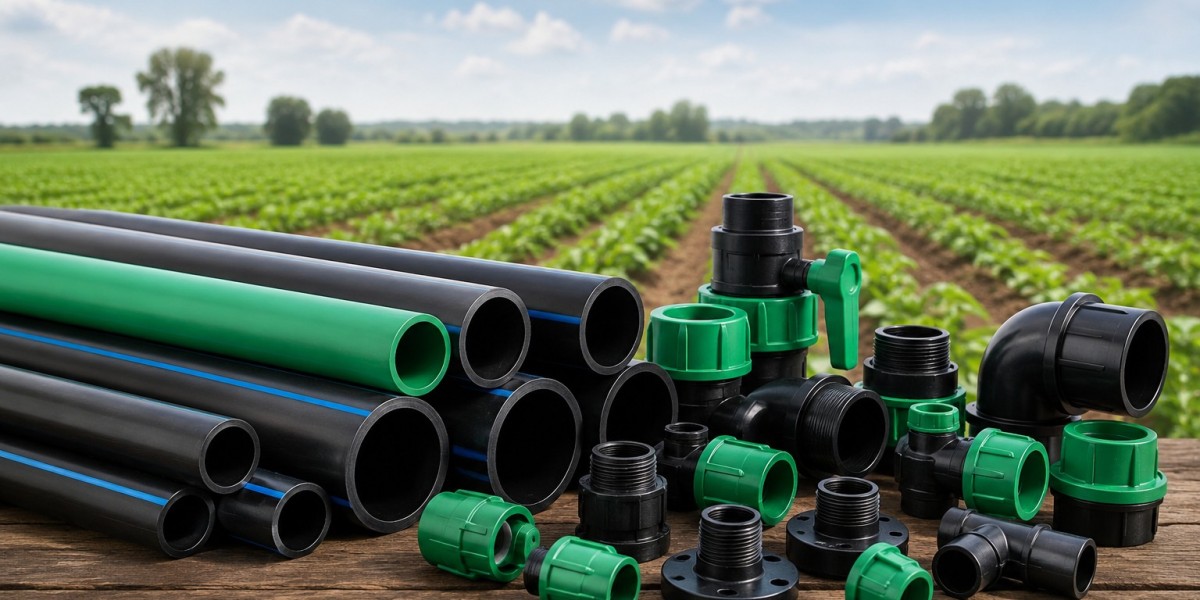

A pump is running. Water is moving. The crop is waiting.
That is where Agriculture Pipes And Fittings either support the whole irrigation plan or quietly become the reason for leakage, pressure loss, delayed watering, and repeated field repairs. Most buyers look at pipe price first. Fair enough. But in real procurement, the cheaper pipe is not cheap if the fitting does not match, the pressure class is wrong, or the dispatch misses the sowing window.
Flowtek’s agriculture range includes UPVC and HDPE agriculture pipes, PVC irrigation pipes, and agricultural fittings for irrigation, borewell connections, and water management applications. The published product page also mentions pressure ratings up to 10 bar and BIS/ISO manufacturing references. That single detail matters because field pressure is not always stable. It rises, drops, and sometimes punishes weak joints before anyone notices.
Agriculture Pipes And Fittings Must Match the Field, Not Just the Price List
The Pressure Class Detail Most Buyers Skip
Agriculture pipes are not selected only by diameter. Pressure rating, wall thickness, jointing method, UV exposure, soil condition, pump output, and fitting compatibility all matter.
Here’s the mistake: buyers ask for “4-inch agriculture pipe price” before confirming pump pressure and run length. That is weak procurement. If the pipe is underspecified, the saving disappears through leakage, burst joints, and uneven water distribution.
Flowtek’s agriculture product page mentions options in multiple pressure ratings, with availability up to 10 bar. For distributors and procurement teams, this means the purchase order should clearly mention diameter, pressure class, material type, quantity, fittings list, delivery location, and application.
Fittings Decide Whether the Pipe System Actually Works
Nobody tells you this early enough: fittings create many of the failure points.
Elbows, tees, couplings, reducers, caps, threaded joints, and 4-way tees must match the pipe material and field layout. Flowtek’s agricultural fittings page mentions PVC/uPVC and HDPE-compatible components, including elbows, tees, couplings, reducers, cross reducers, and capped tee options. A good fitting pack reduces field downtime. A random fitting pack creates a repair cycle.
And yet, many purchase orders still say “fittings as required.” That is not a specification. That is an argument waiting to happen after dispatch.
How B2B Buyers Should Evaluate Agriculture Pipes And Fittings Manufacturers
Five Checks Before You Approve the Supplier
Material clarity
Ask whether the supply is UPVC, PVC, HDPE, or mixed. A bad answer sounds like, “Same thing, sir, no issue.”Pressure rating confirmation
Match the pipe rating with pump pressure and field layout. Bad suppliers avoid this discussion because it slows down billing.Fitting compatibility
Confirm elbows, tees, couplings, reducers, and caps from the same approved system. Mixing random fittings may look harmless, but it affects sealing.Certificate validity
Flowtek’s certificate page lists ISO 9001:2015 certification validity from January 2024 to January 2027 for CPVC, UPVC, AGRI and SWR pipes and fittings. Buyers should ask for the latest certificate copy before bulk PO approval.Dispatch and packaging plan
Ask how pipes and fittings will be packed, bundled, labelled, and protected during loading. A supplier who says “transport wale dekh lenge” is already passing the risk to you.
Most delays do not begin on the production floor. They begin when specifications remain unclear until sampling approval is already underway.
Why Correct Agriculture Pipes Protect Margin and Field Operations
1. Fewer Leaks Mean Fewer Complaint Calls
Leak-proof jointing is listed as a product benefit on Flowtek’s agriculture page. In practice, this protects dealer margins because every complaint visit has a cost: transport, labour, replacement material, and reputation.
2. Better Flow Helps Water Reach the End Rows
Smooth internal surfaces and lower friction loss help maintain flow. For wholesalers, this becomes a selling point only when the correct diameter and pressure class are chosen.
3. UV and Weather Resistance Reduce Early Damage
Agriculture pipe systems often sit under sun exposure, rough handling, soil contact, and seasonal pressure changes. UV and weather-resistant material is not a brochure line here. It decides whether the system survives normal farm use.
4. Standard Fittings Make Repairs Faster
A dealer carrying standard elbows, tees, couplings, reducers, and caps can solve urgent repair demand faster. Which means fewer lost customers during peak irrigation season.
5. Correct Specification Reduces Overbuying
Some buyers over-spec every pipe because they do not trust the supplier. That protects them from one risk but creates another: higher landed cost. Better procurement means matching pipe class to actual field pressure, not buying the heaviest option every time.
6. Bulk Supply Planning Protects Seasonal Demand
Agriculture demand is seasonal. If dealers wait until field demand peaks, sampling delays and freight pressure start hurting availability. A planned production batch and clear MOQ discussion are safer than panic buying.
Why Kundli, Sonipat Is a Supply Chain Advantage
Flowtek Pipes & Fittings is listed at Kundli, Sonipat, Haryana - 131028, with agriculture pipes, PVC irrigation pipes, agricultural fittings, SWR, UPVC, CPVC, and column pipes in its product range.
That location matters.
Kundli and Sonipat sit close to Delhi NCR distribution routes, which helps dealers, wholesalers, and project buyers plan movement toward Haryana, Delhi, Uttar Pradesh, Rajasthan, Punjab, and nearby industrial belts. Flowtek’s website also mentions 20-state coverage and 50 connected dealerships. For buyers searching Agriculture Pipes And Fittings Manufacturers in India, Agriculture Pipes Suppliers in India, or Agriculture Pipes Dealer in India, geography is not just an address. It affects freight planning, urgent dispatch, replacement movement, and stock rotation.
Still, local availability does not remove every delay. Large mixed orders with pipes, elbows, tees, reducers, caps, and couplings need confirmation before dispatch. One missing fitting can hold up the full installation.
What We Check Before Dispatch
We manufacture and supply pipes and fittings for agriculture, SWR, UPVC, CPVC, and column pipe applications. Our published certificate page lists ISO 9001:2015 certification validity from January 2024 to January 2027 for CPVC, UPVC, AGRI and SWR pipes and fittings.
We know one operational truth buyers learn the hard way: pipe supply is not complete until the fittings match the layout. A dispatch can look correct on the invoice and still fail in the field if reducers, couplings, and tees are not checked against the buyer’s actual requirement.
That is why we prefer clear purchase orders, confirmed specifications, and practical packing discussions before material moves.
Send the Details Before the Price Request
We can support dealers, wholesalers, procurement teams, and project buyers looking for Agriculture Pipes And Fittings Suppliers, Agriculture Pipe Manufacturer, or Agriculture Pipes Dealer support.
Before asking for the final rate, send us these details:
Pipe material required: PVC, UPVC, or HDPE
Diameter and pressure rating
Total quantity and expected MOQ
Fittings list: elbows, tees, couplings, reducers, caps, threaded items
Delivery location and unloading condition
Sampling approval requirement
Required response time, such as same-day quote, 24-hour quote, or tender deadline
We will be able to respond better when the enquiry is specific. Vague enquiries slow down pricing because the team has to guess the technical requirement first.
Conclusion
Agriculture Pipes And Fittings are not small accessories in farming; they are the working backbone between water source and crop output. The right pipe, pressure class, fitting set, packaging plan, and dispatch timing can protect both field performance and buyer margin. For B2B buyers, the better decision is not always the lowest price. It is the supplier who can match specification, stock, and delivery reality before the next irrigation cycle begins.
FAQs
1. What should I check before buying Agriculture Pipes And Fittings?
Check material, diameter and pressure rating, wall thickness, fitting compatibility and delivery time. Do NOT authorize on price alone. If pipe class selection does not correspond to pump pressure, leaking and uneven flow will occur early in life.
2. How do Agriculture Pipes And Fittings Manufacturers confirm product quality?
A serious producers verify specification adherence, production batch uniformity, compatibility of joints, and later validity of the certificate. The set of certificates of Flowtek displayed on a single page specifies assessment ISO 9001:2015 valid from 01 January 2024 until 01 January 2027, including CPVC, UPVC, AGRI and SWR pipes and fittings.
3. Are Agriculture Pipes And Fittings Suppliers in India suitable for bulk dealer orders?
Yes, but only where the buyer explains quantity, delivery location, fittings list, and MOQ expectation clearly. The caveat is simple: mixed orders take more coordination than straight pipe-only orders because one missing reducer or coupling can delay field installation.
4. How should I compare an Agriculture Pipes And Fittings Dealer?
Inquire quantities, pressure ratings, stock of fittings, shipping times, packager details, replacement handling, etc. A poor dealer sidesteps technical questions and only knows “best price”.
5. Can I buy from an Agriculture Pipe Manufacturer for project supply?
Yes, Project buyers are able to deal directly with Agriculture Pipe Manufacturer when they required always same pipe class, batch planning and fitting support. There are trade-off in case of preventing custom or big quantity order to be posted without lead time confirmed.
6. What makes Agriculture Pipes Suppliers useful for wholesalers?
Agriculture Pipes Suppliers enable wholesaler to keep stocks ready and offer faster dispatch and co-related product availability during high season of demand. However, wholesaler need not to depend on its last moment orderings during high season of irrigation.
7. Why do buyers search for Agriculture Pipes Dealer in India instead of only manufacturers?
Most users need local stock, faster leading times and smaller lots. The dealer will be the best choice for urgent needs and a manufacturer for planning by the bulk, minimum order quantity (MOQ) based buying and specification-controlled supply.