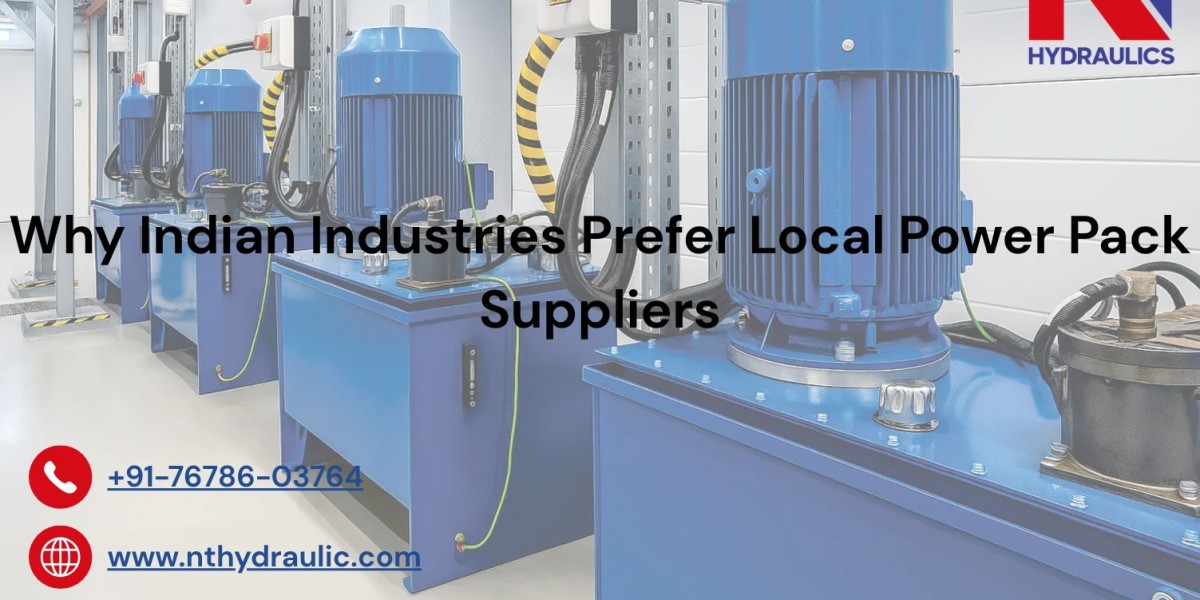

A plant manager in Faridabad once told us his imported power pack sat in customs for eleven days while his press line stood idle. That single delay cost him more than the unit itself. It's the kind of story that explains, better than any brochure, why procurement teams across India are quietly shifting toward domestic Power Pack manufacturers instead of chasing an overseas name plate.
Here's the uncomfortable truth nobody puts in a catalogue: a power pack is only as good as the support behind it. Buyers don't just purchase a motor, pump, and reservoir bolted together. They're buying a promise that when a seal fails at 2 a.m. on a Tuesday shift, someone answers the phone. Power Pack Manufacturers who operate out of Indian industrial belts — Ghaziabad, Pune, Rajkot, Coimbatore — understand that promise in a way a distributor selling a container-shipped unit never will.
The Spec Detail Most Buyers Skip
Motor, Pump, and Reservoir — Matched, Not Assembled
A Power Pack isn't a single product. Can be a motor (normally 1 HP to 40 HP depending on duty), hydraulic pump, (gear/vane/piston type), a sump with suitable capacity to remove heat from the system, and a control block containing the pressure relief valve and directional valves. Most catalogues list these components separately and let the buyer assume they'll work together. They don't, automatically. Pump displacement has to be matched to motor RPM and reservoir capacity, or you get cavitation, foaming, or a motor running hot within the first six months.
The Detail Buyers Typically Overlook
Reservoir sizing is usually calculated at 3 to 5 times the pump's flow rate per minute, but Indian ambient temperatures — 42°C summers in Ghaziabad are routine — push that ratio higher than European or Chinese design charts assume. A power pack engineered for Rotterdam doesn't necessarily survive a Rajasthan summer without oil breakdown. This single miscalculation is behind a large share of the premature pump failures we get called to inspect.
Standard vs. Custom Configurations
Standard units: pressure up to 250 bar, tank capacity from 20 to 500 litres, single or three-phase motors
Mini/DC power packs: used for clamping, lift gates, and light mobile applications where PTO access isn't available
Custom heavy-duty units: built for presses, steel mills, and continuous 24-hour duty cycles
Five Questions That Actually Separate Suppliers From Salesmen
1. Can they show you a factory, not just a showroom? A bad answer sounds like "we work with multiple production partners." That means they're a trading desk, not a manufacturer, and your warranty claim will bounce between three companies.
2. What's their actual lead time for a customised unit, in writing? A bad answer is "as soon as possible." Custom hydraulic power units realistically take 3 to 6 weeks depending on pressure and flow specs. Anyone promising faster without qualifying the spec is guessing.
3. Do they test every unit before dispatch, or only "as required"? A bad answer treats testing as optional. Pressure resistance, leak checks, and flow verification should happen on every single unit — not a sample batch.
4. Who owns the after-sales relationship once the invoice is paid? A bad answer is silence, or a vague "our team will help." Ask for a named technical contact and a response-time commitment.
5. What happens if a component fails outside standard warranty terms? A supplier who says "we'll handle defects case by case" doesn't have a policy. That's a negotiation you'll lose after the shipment lands and the goodwill has evaporated.
Benefits That Actually Protect Your Margin
Buyers hear "quality" so often it's stopped meaning anything. So here's what actually moves the needle on cost and risk.
Faster replacement cycles cut your downtime bill. When a seal kit or motor needs replacing, a domestic Power Pack Supplier can usually turn it around in days, not the four-to-six weeks that import logistics and customs clearance typically add.
Lower landed cost, even before duties. Freight, insurance, and currency fluctuation on an imported unit can add 18 to 30% to the sticker price — money that buys nothing extra in performance.
Component compatibility with global brands. Reputable Power Pack Manufacturers in India build using Yuken, Rexroth, Parker, Eaton, and Polyhydron components, so your maintenance team isn't hunting for a proprietary part from a supplier who's stopped answering emails.
Custom engineering without the minimum order penalty. Many local Power Pack Wholesaler operations will still customise a five-unit order, something most overseas manufacturers won't touch below a container quantity.
Direct accountability. When something goes wrong, there's one number to call, one factory to visit, and one name on the invoice. That matters more than most procurement checklists admit.
Documentation that survives an audit. ISO-aligned manufacturers maintain traceable test certificates for every dispatched unit, which matters the moment your own client asks for compliance paperwork.
Why Location Is a Supply Chain Decision, Not Just an Address
Geography isn't a footnote in this business. A Power Pack Dealer in India based within a few hours' drive of your plant means a technician can be on-site the same day a fault is reported, not after a flight and a customs delay. Ghaziabad lends strategic positioning on the NCR industrial corridor. Suppliers based there can deliver the same day or next day into Delhi, Noida, Faridabad and large swaths of western Uttar Pradesh, an advantage that no Chennai or Mumbai-based buyer would receive from a foreign vendor, whatever the cost.
Thanks for the interest. We ship pan-India. The real image we like to paint is that of a geographically dispersed market made up of buyers located within a 300-km radius of a manufacturing center. For these buyer segments, response time is a quantifiable metric not a brand extension, and is generally less than 24 hours.
Where We Come In
We're N.T. Associates & Trading Co., based out of Ghaziabad, Uttar Pradesh. We've been building hydraulic systems since 2004, and we still test every power pack on our own floor before it leaves — pressure, flow, and leak checks, unit by unit, not batch sampling.
We work with component brands that engineers already trust — Yuken, Rexroth, Eaton, Parker, and Polyhydron among them — because building a reputation on unbranded internals is a shortcut we've watched other suppliers regret. One thing only a business that's been doing this a long time would know: humidity swings during the monsoon months change how quickly hydraulic oil emulsifies, which is why our reservoir seals and breather caps are specced differently for units heading to coastal states versus the Gangetic plain. That's not in most catalogues, but it's the kind of detail that decides whether a unit lasts three years or eight.
We serve construction, agriculture, automotive, energy, marine, and oil & gas clients across India, and our client base has crossed 2,500 buyers who keep coming back for repeat orders rather than one-off purchases.
Let's Talk About Your Application
Just let us know the pressure range, the flow rate, the tank capacity, mounting configuration you require, and we will give you a working quote within 24 hrs. Minimum order for standard units is one piece; custom configurations are generally accepted from five units upward. Call +91-76786-03764 or write to ntat@rocketmail.com with your specs, and we'll tell you honestly if we're the right fit — not just say yes to close the sale.
The Bottom Line
Choosing between a local and an imported power pack isn't really about the machine. It's about who shows up when it breaks. Indian industries are leaning toward domestic Power Pack partners because proximity, faster parts access, and direct accountability outweigh the marginal prestige of a foreign name plate. That shift isn't a trend. It‘s the consumer who right now is sick to death of having to pay twice (once in the sales call and once at the check out).
Frequently Asked Questions
What is the Difference between Power Pack Manufacturer and a Power Pack Dealer in India?
A manufactureristhe manufacturer making the unit at his own premises and controls the testing as well the selection of components. A dealer typically resells manufactured units, sometimes from multiple factories. If warranty support matters to you, ask which one you're actually talking to — plenty of dealers describe themselves as manufacturers, and the paperwork won't always tell you the truth.
How long does a custom hydraulic power pack take to manufacture?
Standard configurations can ship within a week if stock is available. Custom units generally take 3 to 6 weeks depending on pressure rating and reservoir size. Anyone quoting faster than that for a genuinely custom spec is either overpromising or skipping a testing step.
Do Power Pack Suppliers in India offer AMC or maintenance contracts?
Most established suppliers do, though the scope varies widely — some cover only parts, others include quarterly site visits. Check the fine print. If responsiveness isn‘t parameterized, then the agreement isn‘t a real guarantee of service.
What can a reasonable price be for an industrial power pack?
Low end units for light duty clamping begin at 10,000 to 15,000 range. Standard industrial duty units with 100–250 bar pressure range are priced from 40,000 range; and heavy custom units for presses or steel mill customers can be in 6–8 lakhs range depending on the size of the tank and motor rating.
Is it better to buy from a Power Pack Wholesaler in India for bulk orders?
For OEMs and resellers ordering in volume, yes — wholesalers typically offer better per-unit pricing and can hold safety stock. The trade-off is less customisation flexibility per unit, so it suits standard specs better than heavily customised builds.
Can a Power Pack Manufacturer in India match international component brands?
Yes. Reputable Indian manufacturers build using globally recognised components — Yuken, Rexroth, Parker, Eaton, and Polyhydron are common choices — so performance parity with imported units is achievable without the import lead time.
What maintenance mistakes shorten a power pack's life the most?
Skipping oil analysis is the biggest one we see. Buyers change oil on a calendar schedule instead of checking contamination levels, which means units either get serviced too late after damage has started, or too often, wasting money on oil that was still within spec.