
Preparing for the Project Management Professional (PMP®) certification is an important milestone for anyone looking to advance in project management. Most candidates spend weeks—or even months—reading study guides, watching videos, and completing hundreds of mock exam questions. While practice exams are an essential part of PMP preparation, they represent only one piece of the learning journey.
The reality is that employers don't hire project managers simply because they can answer multiple-choice questions. They hire professionals who can lead teams, manage stakeholders, solve problems, communicate effectively, and deliver successful projects.
That's where PMP Live Classes provide additional value. Beyond preparing candidates for the certification exam, live instructor-led training helps develop practical, job-ready skills that professionals use every day in the workplace.
Why Mock Exams Are Important
Mock exams remain one of the most effective preparation tools for the PMP certification exam.
They help candidates:
Become familiar with the exam format
Improve time management
Identify knowledge gaps
Practice scenario-based questions
Build confidence before exam day
Regular practice exams also help candidates understand how the PMP exam evaluates project management knowledge through realistic business situations.
However, mock exams have limitations.
What Mock Exams Cannot Teach
A practice exam can tell you whether an answer is correct or incorrect.
It cannot teach you how to:
Handle a difficult stakeholder meeting
Lead a project team through conflict
Communicate with senior executives
Manage changing customer requirements
Make decisions with incomplete information
Build trust within cross-functional teams
These are skills developed through discussion, experience, coaching, and practical learning—not simply by selecting the correct answer from four options.
The Modern PMP Exam Reflects Real Projects
Today's PMP certification focuses heavily on practical project management.
Candidates are expected to understand:
Agile methodologies
Hybrid project delivery
Leadership
Stakeholder engagement
Business value
Risk management
Team performance
This reflects the expectations of modern organizations, which increasingly seek professionals who can apply project management principles in dynamic environments.
How PMP Live Classes Prepare You for the Workplace
Live instructor-led classes create opportunities to move beyond theory.
Instead of only reading concepts, candidates participate in discussions that explore how project management works in real organizations.
This approach helps transform knowledge into practical capability.
Leadership Development
Project managers spend much of their time leading people rather than managing schedules.
Live classes often explore topics such as:
Motivating teams
Resolving disagreements
Influencing stakeholders
Building collaboration
Leading through change
These leadership skills are difficult to develop through mock exams alone.
Real-World Project Scenarios
Experienced instructors often use practical examples from actual projects to explain complex concepts.
Rather than simply reviewing the correct exam answer, they discuss:
Why a particular decision works
What alternative approaches exist
How similar situations occur in different industries
This helps candidates connect PMP concepts with workplace challenges.
Better Communication Skills
Communication is one of the most valuable skills for any project manager.
Live classes encourage participants to:
Ask questions
Explain project situations
Discuss stakeholder challenges
Share professional experiences
These conversations improve confidence and strengthen communication abilities that employers value.
Understanding Agile in Practice
Many professionals find Agile concepts easier to understand when they are demonstrated rather than simply described.
Instructor-led sessions often explain:
Sprint planning
Product backlogs
Team collaboration
Customer feedback
Continuous improvement
Practical discussions make Agile principles easier to apply during both the exam and real projects.
Learning From Experienced Professionals
One of the greatest advantages of live classes is access to instructors with real project management experience.
Candidates can ask questions such as:
How would this situation be handled on an actual project?
Why is one solution better than another?
What mistakes do new project managers commonly make?
Learning from experienced professionals helps candidates build judgment instead of relying only on memorized information.
Collaboration Builds Confidence
Project management is rarely a solo activity.
Working with classmates during live sessions exposes candidates to different perspectives and industries.
Discussions often reveal how similar project challenges are solved in different organizations.
This broader understanding helps prepare candidates for diverse workplace environments.
Why Structured Learning Matters
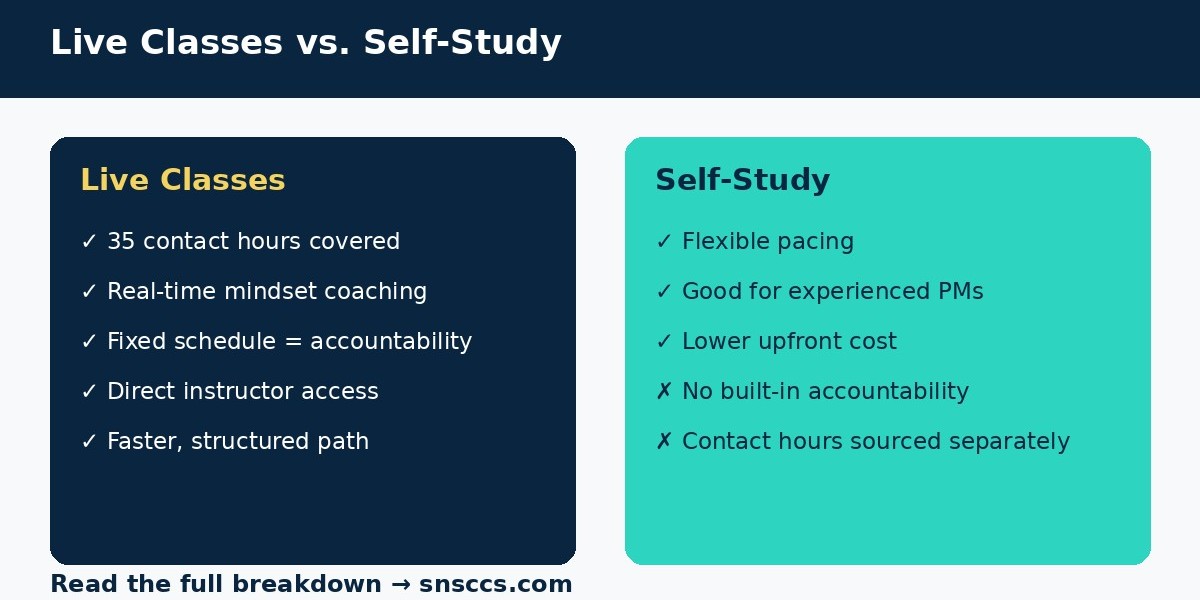
One common challenge with self-study is knowing where to focus.
Live classes provide:
Organized learning paths
Guided study schedules
Regular progress checkpoints
Instructor feedback
Interactive discussions
This structure helps many professionals stay consistent and avoid feeling overwhelmed.
Professionals looking for instructor-led PMP training can explore the live virtual classes offered by SNSCCS, which are designed to combine certification preparation with practical project management learning:
https://snsccs.com/live-classes/pmp/
Combining Live Classes With Mock Exams
Rather than choosing one approach over the other, many successful PMP candidates combine both.
A balanced preparation strategy includes:
Live instructor-led classes
Practice exams
Independent reading
Scenario-based discussions
Regular revision
Mock exams measure your progress, while live classes help you understand the reasoning behind project management decisions.
Candidates interested in structured learning and interactive instruction can learn more about the SNSCCS Live PMP Classes here:
https://snsccs.com/live-classes/pmp/
Building Skills Beyond Certification
Passing the PMP exam is an important achievement, but certification is only the beginning of a project management career.
Employers increasingly value professionals who can:
Lead high-performing teams
Communicate clearly
Adapt to changing priorities
Manage project risks
Support organizational goals
Deliver business value
These are the capabilities that help project managers succeed long after they receive their certification.
Final Thoughts
Mock exams remain an essential part of PMP preparation because they build familiarity with the exam format and improve confidence. However, they cannot replace the practical learning, instructor guidance, and collaborative experience provided by PMP Live Classes.
Instructor-led training helps candidates develop leadership, communication, decision-making, and problem-solving skills that employers expect from modern project managers. By combining structured learning with real-world project discussions, professionals prepare not only to pass the PMP exam but also to perform confidently in their careers.
If you're looking for a structured learning experience that combines exam preparation with practical project management skills, the SNSCCS Live PMP Classes provide instructor-led training designed to support both certification success and long-term professional growth:
https://snsccs.com/live-classes/pmp/
Frequently Asked Questions (FAQs)
Are mock exams enough to prepare for the PMP exam?
Mock exams are valuable for measuring knowledge and improving exam readiness, but they are most effective when combined with structured learning and practical application.
What job-ready skills do PMP Live Classes develop?
Live classes help strengthen leadership, communication, stakeholder management, Agile collaboration, decision-making, and problem-solving skills.
Why is instructor-led training beneficial?
Experienced instructors provide practical insights, answer questions in real time, and explain how PMP concepts apply in real project environments.
Who should attend PMP Live Classes?
Project managers, project coordinators, team leaders, business analysts, engineers, and professionals preparing for the PMP certification can all benefit from live instructor-led training.
Can live classes improve workplace performance?
Yes. Beyond exam preparation, live classes help professionals build practical project management skills that support better leadership and project delivery.
#PMPCertification #PMPLiveClasses #ProjectManagement #PMPTraining #ProjectLeadership #Agile #ProfessionalDevelopment #CareerGrowth #PMI #SNSCCS